Lingzhi Mushroom: Other Identified Special Species — (28) Ganoderma submubraculum
✵This article documents another identified special species of Lingzhi mushroom, (28) Ganoderma submubraculum, including its English name, Latin name, pinyin name, properties and flavor, and provides a detailed botanical description of its morphological features, growth characteristics, ecological environment, pharmacological actions, medicinal efficacy, and administration guidelines.
Other Identified Special Species of Lingzhi Mushroom: (28) Ganoderma submubraculum
Botanical Description:Ganoderma submubraculum Imazeki is a fungus in the family Ganodermataceae (or Polyporaceae) and genus Ganoderma. It is commonly known as Umbrella-shaped Ganoderma or Sanzhuang Lingzhi (“umbrella-like Lingzhi”). The basidiocarp (fruiting body) is annual, petiolate, and suberiform to ligniform. The pileus (cap) is circular (rounded), measuring 14 cm in diameter; the upper surface is convex, the lower surface is concave, with an umbilicate protuberance at the center. The surface is black, exhibiting a lacquer-like luster, with sparse rugae, shallow wheel-shaped grooves, and radial wrinkles; the margin is thin, sharp, and slightly involute (rolled inward). The context is tripartite: the upper layer is cinnamomeous, 1–1.2 cm thick; the middle layer is dirty white, 1–2 mm thick, harder, and continuous with the stipe; the lower layer is brownish-cinnamomeous, 2–5 mm thick. The hymenophoral tubes are ~1 cm long and brownish-cinnamomeous; the pore surface is the same color as the tubes, with pores that are nearly circular, 4–5 per mm. The stipe (prostheca) is mesic, erect, cylindrical, measuring 6 × 1.8 cm, black, glossy, hard, and the same color as the tubes; the pileipellis (hymeniderm) is 2–3 mm thick.
The pileipellis (hymeniderm) is a sporiferous-layer type, hazel (pale brown) in color; the composite hyphae are clavate, with the enlarged apical portion 4.5–7.5 μm wide and 25–30 μm long.
The mycelial system is trimitic: generative hyphae are hyaline, leptodermous (thin-walled), 3–4.5 μm in diameter; skeletal hyphae are hazel (pale brown), pachydermous (thick-walled) to farctate, with arborizations (dendritic branching); the skeletal portion measures 3–6 μm in dry diameter; flagelliform, colorless binding hyphae arise at the apices of branches; binding hyphae are colorless, pachydermous (thick-walled), and 1–2 μm in diameter.
The basidiospores are ovoid or nearly elliptic, with a predominantly obtuse (blunt) apex, double-walled: the outer wall is colorless and transparent and smooth; the inner wall is hazel (pale brown), lacking spinules or bearing only indistinct spinules, measuring 6–9 × 4.5–5.3 μm. (Original records report basidiospore dimensions as 11–12 × 7–7.5 μm, without spinules.)
Ecological Environment:Ganoderma submubraculum Imazeki grows in mountainous forests and is primarily distributed in China.
References:
1. Introduction of Ling Zhi: Ganoderma lucidum, Fairy Grass
2. Lingzhi Mushroom: Other Identified Special Species — Ganoderma submubraculum

 ✵This article documents another identified special species of Lingzhi mushroom, (28) Ganoderma submubraculum, including its English name, Latin name, pinyin name, properties and flavor, and provides a detailed botanical description of its morphological features, growth characteristics, ecological environment, pharmacological actions, medicinal efficacy, and administration guidelines.
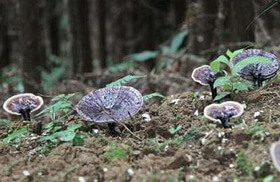 Botanical Description: Ganoderma submubraculum Imazeki is a fungus in the family Ganodermataceae (or Polyporaceae) and genus Ganoderma. It is commonly known as Umbrella-shaped Ganoderma or Sanzhuang Lingzhi (“umbrella-like Lingzhi”). The basidiocarp (fruiting body) is annual, petiolate, and suberiform to ligniform. The pileus (cap) is circular (rounded), measuring 14 cm in diameter; the upper surface is convex, the lower surface is concave, with an umbilicate protuberance at the center. The surface is black, exhibiting a lacquer-like luster, with sparse rugae, shallow wheel-shaped grooves, and radial wrinkles; the margin is thin, sharp, and slightly involute (rolled inward). The context is tripartite: the upper layer is cinnamomeous, 1–1.2 cm thick; the middle layer is dirty white, 1–2 mm thick, harder, and continuous with the stipe; the lower layer is brownish-cinnamomeous, 2–5 mm thick. The hymenophoral tubes are ~1 cm long and brownish-cinnamomeous; the pore surface is the same color as the tubes, with pores that are nearly circular, 4–5 per mm. The stipe (prostheca) is mesic, erect, cylindrical, measuring 6 × 1.8 cm, black, glossy, hard, and the same color as the tubes; the pileipellis (hymeniderm) is 2–3 mm thick.
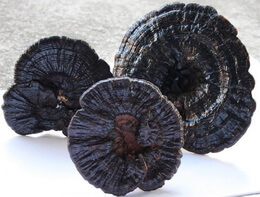 The pileipellis (hymeniderm) is a sporiferous-layer type, hazel (pale brown) in color; the composite hyphae are clavate, with the enlarged apical portion 4.5–7.5 μm wide and 25–30 μm long.
