Lingzhi Mushroom: Other Identified Special Species (43) Ganoderma ochrolaccatum.
✵The article records another identified special species of Lingzhi mushroom—(43) Ganoderma ochrolaccatum—including its English name, Latin name, Pinyin name, properties and flavor, and provides a detailed introduction to its botanical features, growth characteristics, and ecological environment; morphological features; pharmacological actions, medicinal efficacy, and administration guidelines.
Other Identified Special Species of Lingzhi Mushroom (43) Ganoderma ochrolaccatum.
Botanical Description:Ganoderma ochrolaccatum (Mont.) Pat. is a fungus in the family Ganodermataceae (or Polyporaceae) and genus Ganoderma. It is commonly known as Ganoderma ochrolaccatum, Ochre-Paint Ganoderma, or Zhe Qi Lingzhi. The basidiocarp (fruiting body) is perennial, sessile, and suberose to ligneous. The pileus (cap) is high horseshoe-shaped (U-shaped), sometimes hanging upside-down from the substrate, measuring 1.2–5.2 cm in width and 3–5 cm in height; the surface is sallow (grayish yellow) to fuscid or dark brown (nearly black), bearing concentric ring grooves and raised ring edges, smooth, without lacquer-like luster; the margin is truncate. The context is blackish brown to pale chestnut brown, hard, and 0.5–1.5 cm thick. The tubes are multilayered, though stratification is indistinct; the total tube length reaches up to 3 cm and is dark coffee-colored (dark brown). In later stages, the pore surface color closely resembles that of the context. The pores are slightly rounded, with approximately 5 per mm.
The husk is 1 mm thick; its structure consists of transparent, leptodermous (thin-walled) generative hyphae and pachydermous, brown skeletal hyphae. The hyphae are tightly adherent and difficult to separate. Generative hyphae measure 3–4 μm in diameter and often form a transparent layer over the skeletal hyphae; skeletal hyphae measure 4–6 μm in diameter, are mostly clavate and arranged in parallel, and range in color from hazel (pale brown) to dark brown.
The mycelial system is trimitic: generative hyphae are colorless and transparent or hazel (pale brown), septate, leptodermous (thin-walled), and 3–4.5 μm in diameter; skeletal hyphae are hazel (pale brown) to brown, pachydermous (thick-walled) to farctate, with a skeletal portion 4–5 μm in dry diameter; flagelliform, colorless binding hyphae may arise from the tips of branches; binding hyphae are colorless, pachydermous (thick-walled), curved and ramified, 1–2 μm in diameter.
The basidiospores are oval (egg-shaped), broadly ovate, or nearly broadly elliptical; they are double-walled—the outer wall is colorless, transparent, and smooth; the inner wall bearing spinules and ranging in color from hazel (pale brown) to brown—measuring 9–21 × 6–12 μm.
Ecological Environment:Ganoderma ochrolaccatum (Mont.) Pat. grows in mountainous forests. This species is endemic to China and also reported from island nations in Southeast Asia.
References:
1. Introduction of Ling Zhi: Ganoderma lucidum, Fairy Grass.
2. Lingzhi Mushroom: Other Identified Special Species—Ganoderma ochrolaccatum.

 ✵The article records another identified special species of Lingzhi mushroom—(43) Ganoderma ochrolaccatum—including its English name, Latin name, Pinyin name, properties and flavor, and provides a detailed introduction to its botanical features, growth characteristics, and ecological environment; morphological features; pharmacological actions, medicinal efficacy, and administration guidelines.
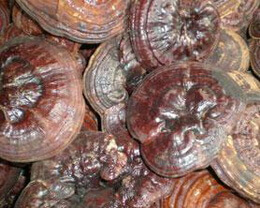 Botanical Description: Ganoderma ochrolaccatum (Mont.) Pat. is a fungus in the family Ganodermataceae (or Polyporaceae) and genus Ganoderma. It is commonly known as Ganoderma ochrolaccatum, Ochre-Paint Ganoderma, or Zhe Qi Lingzhi. The basidiocarp (fruiting body) is perennial, sessile, and suberose to ligneous. The pileus (cap) is high horseshoe-shaped (U-shaped), sometimes hanging upside-down from the substrate, measuring 1.2–5.2 cm in width and 3–5 cm in height; the surface is sallow (grayish yellow) to fuscid or dark brown (nearly black), bearing concentric ring grooves and raised ring edges, smooth, without lacquer-like luster; the margin is truncate. The context is blackish brown to pale chestnut brown, hard, and 0.5–1.5 cm thick. The tubes are multilayered, though stratification is indistinct; the total tube length reaches up to 3 cm and is dark coffee-colored (dark brown). In later stages, the pore surface color closely resembles that of the context. The pores are slightly rounded, with approximately 5 per mm.
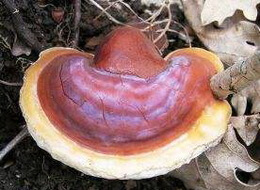 The husk is 1 mm thick; its structure consists of transparent, leptodermous (thin-walled) generative hyphae and pachydermous, brown skeletal hyphae. The hyphae are tightly adherent and difficult to separate. Generative hyphae measure 3–4 μm in diameter and often form a transparent layer over the skeletal hyphae; skeletal hyphae measure 4–6 μm in diameter, are mostly clavate and arranged in parallel, and range in color from hazel (pale brown) to dark brown.
