Lingzhi Mushroom: Other Identified Special Species (37) Ganoderma guinanense.
✵The article records another identified special species of Lingzhi mushroom—(37) Ganoderma guinanense—including its English name, Latin name, Pinyin name, properties and flavor, and provides a detailed introduction to its botanical features, growth characteristics, and ecological environment; morphological features; pharmacological actions, medicinal efficacy, and administration guidelines.
Other Identified Special Species of Lingzhi Mushroom (37) Ganoderma guinanense.
Botanical Description:Ganoderma guinanense J.D. Zhao et X.Q. Zhang is a fungus in the family Ganodermataceae (or Polyporaceae) and genus Ganoderma. It is commonly known as Ganoderma guinanense or Gui Nan Lingzhi. The basidiocarp (fruiting body) is annual, stipitate, and suberinite. The pileus (cap) is orbicular (nearly circular), with a centrally depressed region, approximately 7.5 cm in diameter and 3–8 mm thick. The surface is darkish brown to black, bearing faint concentric rings and vertical wrinkles; it is smooth and exhibits a lacquer-like luster. The margin is entire and sharp; the undersurface possesses a narrow infertile zone. The context is evenly brown, 3–5.5 mm thick, gradually thinning toward the margin. The hymenophore (tube layer) is 1–2 mm long; the pore surface is brown; the pores are orbicular (nearly circular), 4–5 per mm. The stipe is mesic, ~11 cm long and 1–1.2 cm in diameter, with a strong lacquer-like luster. The context near the outer layer of the stipe is slightly hard (2–3 mm thick), hazel (pale brown), whereas the inner layer is soft and brown.
The pileipellis (hymenial crust) is composed of transparent, leptodermous (thin-walled) generative hyphae and subdiaphanous (nearly colorless), farctate skeletal hyphae, which are tightly interwoven and not easily separable; the composite hyphae predominantly lean to one side, with tips enlarged or slightly pointed, typically 2–4 μm wide and 20–30 μm long.
The hyphal system is trimitic: generative hyphae are transparent and leptodermous (thin-walled), 3–6 μm in diameter, and possess septa; skeletal hyphae are pale brownish or hazel (pale brown), pachypleurous (thick-walled) to farctate, sometimes tortuous, bearing arborizations (dendritic branching) or acicular projections; the skeletal portion measures 3–4 μm in dry diameter; flagelliform, colorless binding hyphae arise from branch tips; binding hyphae are colorless, pachypleurous (thick-walled), and 1.5–2 μm in diameter.
The basidiospores are broadly ovoid or subglobose, bilayered (double-walled); the exospore is colorless and transparent and smooth; the endospore bears indistinct spinules and ranges from colorless to pale brownish; dimensions are (4.5–)6–11 × 5–8 μm.
Ecological Environment:Ganoderma guinanense J.D. Zhao et X.Q. Zhang grows in mountainous forests. This species is primarily distributed in China; globally, it is reported only from China.
References:
1. Introduction of Ling Zhi: Ganoderma lucidum, Fairy Grass.
2. Lingzhi Mushroom: Other Identified Special Species — Ganoderma guinanense.

 ✵The article records another identified special species of Lingzhi mushroom—(37) Ganoderma guinanense—including its English name, Latin name, Pinyin name, properties and flavor, and provides a detailed introduction to its botanical features, growth characteristics, and ecological environment; morphological features; pharmacological actions, medicinal efficacy, and administration guidelines.
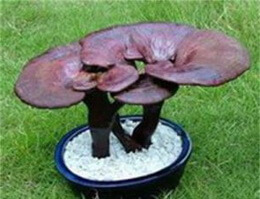 Botanical Description: Ganoderma guinanense J.D. Zhao et X.Q. Zhang is a fungus in the family Ganodermataceae (or Polyporaceae) and genus Ganoderma. It is commonly known as Ganoderma guinanense or Gui Nan Lingzhi. The basidiocarp (fruiting body) is annual, stipitate, and suberinite. The pileus (cap) is orbicular (nearly circular), with a centrally depressed region, approximately 7.5 cm in diameter and 3–8 mm thick. The surface is darkish brown to black, bearing faint concentric rings and vertical wrinkles; it is smooth and exhibits a lacquer-like luster. The margin is entire and sharp; the undersurface possesses a narrow infertile zone. The context is evenly brown, 3–5.5 mm thick, gradually thinning toward the margin. The hymenophore (tube layer) is 1–2 mm long; the pore surface is brown; the pores are orbicular (nearly circular), 4–5 per mm. The stipe is mesic, ~11 cm long and 1–1.2 cm in diameter, with a strong lacquer-like luster. The context near the outer layer of the stipe is slightly hard (2–3 mm thick), hazel (pale brown), whereas the inner layer is soft and brown.
