Lingzhi Mushroom: Other Identified Special Species: (52) Ganoderma sanmingense.
✵The article records another identified special species of Lingzhi mushroom—(52) Ganoderma sanmingense—including its English name, Latin name, Pinyin name, properties and flavor. It provides a detailed introduction to the botanical features, growth characteristics, and ecological environment of this species; the morphological features of the fungus; its pharmacological actions, medicinal efficacy, and administration guidelines.
Other Identified Special Species of Lingzhi Mushroom: (52) Ganoderma sanmingense.
Botanical Description:Ganoderma sanmingense J. D. Zhang et X. Q. Zhang is a fungus in the family Ganodermataceae (or Polyporaceae) and genus Ganoderma. It is commonly known as Sanming artist’s conk or Sanming Shushe. The basidiocarp (fruiting body) is annual to perennial, sessile, suberose to ligneous, and attaches to the substratum via a narrow or broad base. The pileus (cap) is semicircular or fan-shaped, measuring 4–5 × 6–7 cm; diameter ranges from 4–8 cm; thickness is 5–8 mm; color is tawny (yellowish brown), with a broader concentric zone hazel (pale brown) to brown; the margin is blunt, convex, or concave, and bears a deeper groove encircling the pileus; the context is flavotestaceous (fawn-colored), deep wood-colored, or yellowish brown—hard as wood, 2–5 mm thick, with a black chitinous layer (cuticle) near the base; the hymenophoral tubes are 2–3 mm long, with inconspicuous stratification; the pore surface is tawny (yellowish brown); the pores are slightly rounded, polygonal, or oblong, 6–7 per mm.
The pileipellis is thin and hard, with a flocculent-layered structure; the surface bears a layer of free, fine hyphae—sometimes tufted; the composite hyphae are mostly colorless and transparent, solitary or branched, leptodermous (thin-walled), typically 2–2.5 μm in diameter.
The mycelial system is trimitic: generative hyphae are transparent, leptodermous (thin-walled), septate, 4.5–5 μm in diameter; skeletal hyphae are colorless to slightly brown, pachypleurous (thick-walled) to farctate, 4.5–6 μm in diameter, predominant in the context; binding hyphae are colorless, pachypleurous (thick-walled), 1.5–2 μm in diameter, predominantly orthogonally branched, fragile and easily fragmented—resembling those of the Bovista type.
The basidiospores are elliptic (elliptical), broadly elliptic, or torulose (subglobose); they are double-walled—the outer wall is colorless and transparent, smooth; the inner wall is colorless or faintly brownish, bearing either no spinules or distinct spinules; size: 6.5–10.5 × 4–9 μm.
Ecological Environment:Ganoderma sanmingense J. D. Zhang et X. Q. Zhang grows in mountainous forests on decaying hardwood logs and deadwood in deciduous forests. This species is endemic to China. Globally, it is currently only documented in China.
(53) Other species of Ganoderma.
In addition to the species described above, several other Ganoderma species have been identified as Lingzhi mushrooms. These include: (53) Ganoderma annulatum, (54) Ganoderma bawanglingense (Bawangling Shushe), (55) Ganoderma brownii (He Shushe), (56) Ganoderma aensingiatum (Miwen Shushe), (57) Ganoderma diaoluoshanense (Diaoluoshan Shushe), (58) Ganoderma limushanense (Limushan Shushe), (59) Ganoderma mojiangense (Mojiang Shushe), (60) Ganoderma philippii (Xiangjiao Shushe), (61) Ganoderma shangsiense (Shangsi Shushe), (62) Ganoderma triangulatum (Sanjiaozhuang Shushe), (63) Ganoderma matizhuangense (Matizhuang Shushe), and (64) Ganoderma koningsbergii (Jiaowen Shushe).
References:
1. Introduction of Ling Zhi: Ganoderma lucidum, Fairy Grass.
2. Lingzhi Mushroom: Other Identified Special Species: Ganoderma sanmingense.

 ✵The article records another identified special species of Lingzhi mushroom—(52) Ganoderma sanmingense—including its English name, Latin name, Pinyin name, properties and flavor. It provides a detailed introduction to the botanical features, growth characteristics, and ecological environment of this species; the morphological features of the fungus; its pharmacological actions, medicinal efficacy, and administration guidelines.
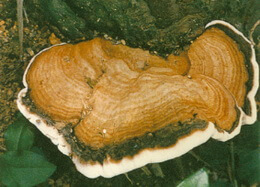 Botanical Description: Ganoderma sanmingense J. D. Zhang et X. Q. Zhang is a fungus in the family Ganodermataceae (or Polyporaceae) and genus Ganoderma. It is commonly known as Sanming artist’s conk or Sanming Shushe. The basidiocarp (fruiting body) is annual to perennial, sessile, suberose to ligneous, and attaches to the substratum via a narrow or broad base. The pileus (cap) is semicircular or fan-shaped, measuring 4–5 × 6–7 cm; diameter ranges from 4–8 cm; thickness is 5–8 mm; color is tawny (yellowish brown), with a broader concentric zone hazel (pale brown) to brown; the margin is blunt, convex, or concave, and bears a deeper groove encircling the pileus; the context is flavotestaceous (fawn-colored), deep wood-colored, or yellowish brown—hard as wood, 2–5 mm thick, with a black chitinous layer (cuticle) near the base; the hymenophoral tubes are 2–3 mm long, with inconspicuous stratification; the pore surface is tawny (yellowish brown); the pores are slightly rounded, polygonal, or oblong, 6–7 per mm.
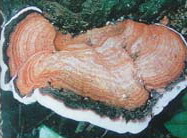 Ecological Environment: Ganoderma sanmingense J. D. Zhang et X. Q. Zhang grows in mountainous forests on decaying hardwood logs and deadwood in deciduous forests. This species is endemic to China. Globally, it is currently only documented in China.
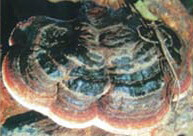 In addition to the species described above, several other Ganoderma species have been identified as Lingzhi mushrooms. These include: (53) Ganoderma annulatum, (54) Ganoderma bawanglingense (Bawangling Shushe), (55) Ganoderma brownii (He Shushe), (56) Ganoderma aensingiatum (Miwen Shushe), (57) Ganoderma diaoluoshanense (Diaoluoshan Shushe), (58) Ganoderma limushanense (Limushan Shushe), (59) Ganoderma mojiangense (Mojiang Shushe), (60) Ganoderma philippii (Xiangjiao Shushe), (61) Ganoderma shangsiense (Shangsi Shushe), (62) Ganoderma triangulatum (Sanjiaozhuang Shushe), (63) Ganoderma matizhuangense (Matizhuang Shushe), and (64) Ganoderma koningsbergii (Jiaowen Shushe).
