Lingzhi mushroom: Other Identified Special Species: (51) Ganoderma australe.
✵The article records other identified special species of Lingzhi mushroom—(51) Ganoderma australe—including its English name, Latin name, Pinyin name, properties and flavor. It provides a detailed introduction to the botanical features, growth characteristics, and ecological environment of this species; the morphological features of the fungus; its pharmacological actions, medicinal efficacy, and administration guidelines.
Other Identified Special Species of Lingzhi mushroom:(51).Ganoderma australe.
Botanical Description:Ganoderma australe (Fr.) Pat. is a fungus in the family Ganodermataceae (or Polyporaceae) and genus Ganoderma. It is commonly known as southern artist’s conk, Nanfang Shushe, Lao Mu Jun, etc. The basidiocarp (fruiting body) is annual to perennial, sessile, suberose to ligneous. The pileus (cap) is semicircular, 6.5–13 cm × 4.5–10 cm, about 4 cm thick; the surface is dark brown (blackish brown) or taupe (dusty gray), lacking a lacquer-like luster, with distinct concentric ridges and annuli—sometimes rimose; the margin is blunt, same color as the pileus or occasionally russet (reddish brown); the context is uniformly chocolate brown (tan) or tawny (cinnamon-colored), hard, 1.5–2 cm thick, and bears a black chitinous layer (cuticle); the hymenophoral tubes are brown to bistre (seal brown), with no interlayer spacing—each layer is 5–7 mm long; the pore surface is brown or tawny (yellowish brown), sometimes yellow; the pores are slightly circular, 4–5 per mm.
The pileipellis structure consists of tightly adherent, transparent, leptodermous generative hyphae and pachypleurous brown skeletal hyphae; the surface comprises a layer of transparent hyphae that are difficult to separate; generative hyphae are 2–3.5 μm in diameter, with some tips clavate; skeletal hyphae are 4–4.5 μm in diameter; the total thickness is 50–60 μm—firm and hard, resembling an interwoven crustaceous type.
The mycelial system is trimitic: generative hyphae are transparent, leptodermous (thin-walled), branched, septate, 3–6 μm in diameter; skeletal hyphae are hazel (pale brown) to brown, pachypleurous (thick-walled) to farctate, with arborizations (dendritic branching) or acicular morphology—the skeletal portion measures 3–5 μm in dry diameter; flagelliform, colorless binding hyphae arise at branch tips; binding hyphae are colorless to slightly tawny (pale yellowish brown), pachypleurous (thick-walled) to farctate, with nearly orthogonal branching, 1–2 μm in diameter—resembling the Bovista type.
The basidiospores are elliptic (elliptical), broadly elliptic, or slightly truncate at the apex; they are double-walled—the outer wall is colorless and transparent, smooth; spines (spinules) on the inner wall are distinct, hazel (pale brown) to brown, measuring 7.5–13 × 5.8–7.7 μm.
Ecological Environment:Ganoderma australe (Fr.) Pat. grows in mountainous forests, causing white rot of wood and root rot of trees, often leading to host tree mortality. This species is predominantly distributed in China. Globally, it occurs in China and is also widely distributed across central to southern Europe, tropical and subtropical Asia, and other regions.
References:
1. Introduction of Ling Zhi: Ganoderma lucidum, Fairy Grass.
2. Lingzhi Mushroom: Other Identified Special Species: Ganoderma australe.

 ✵The article records other identified special species of Lingzhi mushroom—(51) Ganoderma australe—including its English name, Latin name, Pinyin name, properties and flavor. It provides a detailed introduction to the botanical features, growth characteristics, and ecological environment of this species; the morphological features of the fungus; its pharmacological actions, medicinal efficacy, and administration guidelines.
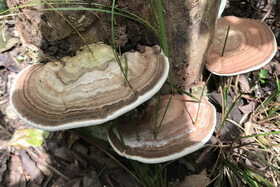 Botanical Description: Ganoderma australe (Fr.) Pat. is a fungus in the family Ganodermataceae (or Polyporaceae) and genus Ganoderma. It is commonly known as southern artist’s conk, Nanfang Shushe, Lao Mu Jun, etc. The basidiocarp (fruiting body) is annual to perennial, sessile, suberose to ligneous. The pileus (cap) is semicircular, 6.5–13 cm × 4.5–10 cm, about 4 cm thick; the surface is dark brown (blackish brown) or taupe (dusty gray), lacking a lacquer-like luster, with distinct concentric ridges and annuli—sometimes rimose; the margin is blunt, same color as the pileus or occasionally russet (reddish brown); the context is uniformly chocolate brown (tan) or tawny (cinnamon-colored), hard, 1.5–2 cm thick, and bears a black chitinous layer (cuticle); the hymenophoral tubes are brown to bistre (seal brown), with no interlayer spacing—each layer is 5–7 mm long; the pore surface is brown or tawny (yellowish brown), sometimes yellow; the pores are slightly circular, 4–5 per mm.
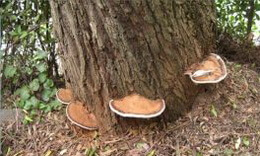 Ecological Environment: Ganoderma australe (Fr.) Pat. grows in mountainous forests, causing white rot of wood and root rot of trees, often leading to host tree mortality. This species is predominantly distributed in China. Globally, it occurs in China and is also widely distributed across central to southern Europe, tropical and subtropical Asia, and other regions.
