Lingzhi Mushroom: Other Identified Special Species — (30) Ganoderma amboinense.
✵The article records the herb’s other identified special species of Lingzhi mushroom — (30) Ganoderma amboinense — including its English name, Latin name, Pinyin name, properties and flavor, as well as a detailed introduction to the botanical features, growth characteristics, and ecological environment of these fungi; their morphological features; pharmacological actions; medicinal efficacy; and administration guidelines.
Other Identified Special Species of Lingzhi Mushroom — (30) Ganoderma amboinense
Botanical Description:Ganoderma amboinense (Lam.) Pat. is a fungus in the family Ganodermataceae (or Polyporaceae) and genus Ganoderma. It is commonly known as Ganoderma amboinense, Imitating-Deer Ganoderma, or NiLu Lingzhi. The basidiocarp (fruiting body) is annual, stipitate, and suberose. The pileus (cap) is semicircular or nearly spatulate (spoon-shaped), 1–2.5 × 1–3.5 cm, with a thickness of 0.7–1.7 cm; the surface is reddish-brown, sometimes purplish-brown (puce), and exhibits a lacquer-like luster; the margin is sometimes pale brown (hazel), blunt or truncate; the context is light brown or wood-colored, 0.2–0.8 cm thick; the tubes are light brown and 0.5–1 cm long. The tube pores are yellowish-brown to light brown, circular, and number 4–5 per mm. The stipe (back or lateral side) is elongated and variably thick, nearly rosy to dark reddish-brown, glossy, 3–4.2 cm long and 0.3–2 cm thick.
The husk structure is of irregular sporiferous layer type, light brown; compositive hyphae are clavate, with the enlarged part of the apex 4.5–7.5 μm wide and the length 15–30 μm.
The mycelial system is trimitic: generative hyphae are transparent, leptodermous (thin-walled), and sometimes ramified, 3–4 μm in diameter; skeletal hyphae are light brown, pachypleurous (thick-walled), with arboriform (dendritic) branching; the skeletal portion measures 3–6 μm in dry diameter; one end connects to generative hyphae, while the other branches also give rise to leptodermous generative hyphae; flagelliform, colorless binding hyphae arise at the tips of branches; binding hyphae are filamentous, colorless, opaque, pachypleurous (thick-walled), ramified, and 1–3 μm in diameter.
The basidiospores are oval (egg-shaped), bilayered; the outer wall is colorless and transparent; the inner wall is pale yellow to light brown and bears spinules; 8.3–9.8 (–10.6) × 5.8–6.8 μm.
Ecological Environment:Ganoderma amboinense (Lam.) Pat. grows on decaying wood in mountainous forests. It is distributed in China.
References:
1. Introduction of Ling Zhi: Ganoderma lucidum, Fairy Grass.
2. Lingzhi Mushroom: Other Identified Special Species — Ganoderma amboinense.

 ✵The article records the herb’s other identified special species of Lingzhi mushroom — (30) Ganoderma amboinense — including its English name, Latin name, Pinyin name, properties and flavor, as well as a detailed introduction to the botanical features, growth characteristics, and ecological environment of these fungi; their morphological features; pharmacological actions; medicinal efficacy; and administration guidelines.
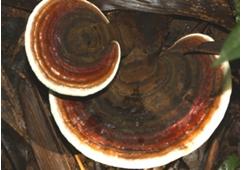 Botanical Description: Ganoderma amboinense (Lam.) Pat. is a fungus in the family Ganodermataceae (or Polyporaceae) and genus Ganoderma. It is commonly known as Ganoderma amboinense, Imitating-Deer Ganoderma, or NiLu Lingzhi. The basidiocarp (fruiting body) is annual, stipitate, and suberose. The pileus (cap) is semicircular or nearly spatulate (spoon-shaped), 1–2.5 × 1–3.5 cm, with a thickness of 0.7–1.7 cm; the surface is reddish-brown, sometimes purplish-brown (puce), and exhibits a lacquer-like luster; the margin is sometimes pale brown (hazel), blunt or truncate; the context is light brown or wood-colored, 0.2–0.8 cm thick; the tubes are light brown and 0.5–1 cm long. The tube pores are yellowish-brown to light brown, circular, and number 4–5 per mm. The stipe (back or lateral side) is elongated and variably thick, nearly rosy to dark reddish-brown, glossy, 3–4.2 cm long and 0.3–2 cm thick.
