Lingzhi Mushroom: Other Identified Special Species (45) Ganoderma simaoense.
✵The article records another identified special species of Lingzhi mushroom—(45) Ganoderma simaoense—including its English name, Latin name, Pinyin name, properties and flavor, and provides a detailed introduction to its botanical features, growth characteristics, and ecological environment; morphological features; pharmacological actions, medicinal efficacy, and administration guidelines.
Other Identified Special Species of Lingzhi Mushroom (45) Ganoderma simaoense.
Botanical Description:Ganoderma simaoense J. D. Zhao is a fungus in the family Ganodermataceae (or Polyporaceae) and genus Ganoderma. It is commonly known as Ganoderma simaoense or Simao Lingzhi. The basidiocarp (fruiting body) is annual, sessile, and suberose to ligneous. The pileus (cap) is pulvinate to colliculose, measuring 3–5 × 4–9 cm and 4–6 mm thick. Near the base, the surface is dark brown (nearly black), with a lacquer-like luster and no annulus; color gradually transitions from brown toward the margin to hazel (pale brown); the margin is blunt and entire; the lower surface is infertile. The context is uniformly brown, fibrous, lacking a chitinous (shell) layer, 4–6 mm thick, with inconspicuous concentric ring veins; it turns black upon contact with aqueous KOH (potassium hydroxide solution). The tubes are 2–4 mm long and hazel (pale brown); the pore surface is pale yellowish white and uneven; the pores are orbicular, with 3–5 per mm.
The hymenium (sporiferous layer) is thin; its cross-section is dark brown (nearly black); the apices of composite hyphae are enlarged, 3–7 μm wide, nearly irregularly womb-shaped (of uniform diameter), covered with a black glutinous substance; the apical region is uneven and sometimes contains a septum.
The mycelial system is trimitic: generative hyphae are colorless and transparent, leptodermous (thin-walled), and 2.0–4.5 μm in diameter; skeletal hyphae are bifurcated or acicular, hazel (pale brown) in the skeletal portion, 3–5 μm in diameter, pachydermous (thick-walled); flagelliform, colorless binding hyphae arise from the tips of branches; binding hyphae are colorless, pachydermous (thick-walled), and 1.5–2 μm in diameter.
The basidiospores are elliptical; they are double-walled—the outer wall is colorless, transparent, and smooth; the inner wall is hazel (pale brown) and lacking spinules—measuring 6–7.5 × 3.7–4.5 μm.
Ecological Environment:Ganoderma simaoense J. D. Zhao grows in mountainous forests. This species is endemic to China.
References:
1. Introduction of Ling Zhi: Ganoderma lucidum, Fairy Grass.
2. Lingzhi Mushroom: Other Identified Special Species—Ganoderma simaoense.

 ✵The article records another identified special species of Lingzhi mushroom—(45) Ganoderma simaoense—including its English name, Latin name, Pinyin name, properties and flavor, and provides a detailed introduction to its botanical features, growth characteristics, and ecological environment; morphological features; pharmacological actions, medicinal efficacy, and administration guidelines.
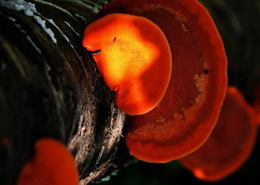 Botanical Description: Ganoderma simaoense J. D. Zhao is a fungus in the family Ganodermataceae (or Polyporaceae) and genus Ganoderma. It is commonly known as Ganoderma simaoense or Simao Lingzhi. The basidiocarp (fruiting body) is annual, sessile, and suberose to ligneous. The pileus (cap) is pulvinate to colliculose, measuring 3–5 × 4–9 cm and 4–6 mm thick. Near the base, the surface is dark brown (nearly black), with a lacquer-like luster and no annulus; color gradually transitions from brown toward the margin to hazel (pale brown); the margin is blunt and entire; the lower surface is infertile. The context is uniformly brown, fibrous, lacking a chitinous (shell) layer, 4–6 mm thick, with inconspicuous concentric ring veins; it turns black upon contact with aqueous KOH (potassium hydroxide solution). The tubes are 2–4 mm long and hazel (pale brown); the pore surface is pale yellowish white and uneven; the pores are orbicular, with 3–5 per mm.
