Lingzhi mushroom: Other Identified Special Species (36) Ganoderma fulvellum.
✵The article records other identified special species of Lingzhi mushroom—(36) Ganoderma fulvellum—including its English name, Latin name, Pinyin name, properties and flavor, and provides a detailed introduction to the botanical features, growth characteristics, and ecological environment of this species; the morphological features of the fungus; its pharmacological actions, medicinal efficacy, and administration guidelines.
Other Identified Special Species of Lingzhi Mushroom (36) Ganoderma fulvellum.
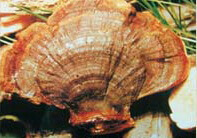
Botanical Description:Ganoderma fulvellum Bres. is a fungus in the family Ganodermataceae (or Polyporaceae) and genus Ganoderma. It is commonly known as Ganoderma fulvellum, Yellow-brown Ganoderma, or Huang He Lingzhi. The basidiocarp (fruiting body) is semicircular, fan-shaped, or conchoidal, measuring 7–9 × 5.5–8 cm; the smallest pileus (cap) is only 2 × 1.5 cm. New pilei may arise from old ones and are often imbricate or fused together. The surface is reddish-brown to dark brown, with a lacquer-like luster and inconspicuous concentric rings; the margin is thin or blunt, ranging from pale yellow to brown. The context is brown to dark brown, lacking a black cuticle (corneous layer), and 0.3–1.5 cm thick; the hymenophore (tube layer) is single-layered, occasionally multilayered, brown to dark brown, up to 1 cm long; the pores are orbicular (nearly circular), 4–5 per mm. The stipe is absent (aseptic), or sometimes basal.
The pileipellis (hymenial crust) consists of transparent, leptodermous (thin-walled) generative hyphae and brown, pachypleurous (thick-walled) skeletal hyphae, which are interwoven into a parallel arrangement; the uppermost layer comprises one or two rows of orbicular cells, 3–6.5 μm wide and 20–30 μm long.
The hyphal system is trimitic: generative hyphae are colorless and transparent, leptodermous (thin-walled), easily twisted, 3.8–6.3 μm in diameter; skeletal hyphae are hazel (pale brown) to light brown, pachypleurous (thick-walled) to farctate, with trifurcated apices; the skeletal portion measures 5–7.5 μm in dry diameter; binding hyphae are pale yellow, curved, sparsely branched, and 1.5–3.8 μm in diameter.
The basidiospores are ovoid (egg-shaped), hazel (pale brown), sometimes truncate at the apex; the exospore is colorless and transparent and smooth; the endospore bears sparse spinules; dimensions are 8.8–10.5 × 5–7.5 μm.
Ecological Environment:Ganoderma fulvellum Bres. grows in mountainous forests. This species is primarily distributed in China; globally, it is reported only from China, with major production areas located therein.
References:
1. Introduction of Ling Zhi: Ganoderma lucidum, Fairy Grass.
2. Lingzhi Mushroom: Other Identified Special Species — Ganoderma fulvellum.

 ✵The article records other identified special species of Lingzhi mushroom—(36) Ganoderma fulvellum—including its English name, Latin name, Pinyin name, properties and flavor, and provides a detailed introduction to the botanical features, growth characteristics, and ecological environment of this species; the morphological features of the fungus; its pharmacological actions, medicinal efficacy, and administration guidelines.
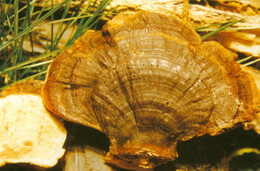 Botanical Description: Ganoderma fulvellum Bres. is a fungus in the family Ganodermataceae (or Polyporaceae) and genus Ganoderma. It is commonly known as Ganoderma fulvellum, Yellow-brown Ganoderma, or Huang He Lingzhi. The basidiocarp (fruiting body) is semicircular, fan-shaped, or conchoidal, measuring 7–9 × 5.5–8 cm; the smallest pileus (cap) is only 2 × 1.5 cm. New pilei may arise from old ones and are often imbricate or fused together. The surface is reddish-brown to dark brown, with a lacquer-like luster and inconspicuous concentric rings; the margin is thin or blunt, ranging from pale yellow to brown. The context is brown to dark brown, lacking a black cuticle (corneous layer), and 0.3–1.5 cm thick; the hymenophore (tube layer) is single-layered, occasionally multilayered, brown to dark brown, up to 1 cm long; the pores are orbicular (nearly circular), 4–5 per mm. The stipe is absent (aseptic), or sometimes basal.
 The basidiospores are ovoid (egg-shaped), hazel (pale brown), sometimes truncate at the apex; the exospore is colorless and transparent and smooth; the endospore bears sparse spinules; dimensions are 8.8–10.5 × 5–7.5 μm.
