Lingzhi Mushroom: Other Identified Special Species (50) Ganoderma multiplex.
✵The article records another identified special species of Lingzhi mushroom — (50) Ganoderma multiplex — including its English name, Latin name, Pinyin name, properties and flavor, and provides a detailed introduction to the botanical features, growth characteristics, ecological environment, morphological features, pharmacological actions, medicinal efficacy, and administration guidelines of this fungal species.
Other Identified Special Species of Lingzhi Mushroom: (50) Ganoderma multiplex.
Botanical Description:Ganoderma multiplex D. H. Hou is a fungus in the family Ganodermataceae (or Polyporaceae) and genus Ganoderma; it is commonly known as Ganoderma multiplex or Chonggai Lingzhi. The basidiocarp (fruiting body) is petiolate. The pileus (cap) is orbicular (nearly round) or fan-shaped, superposed (overlapping), measuring 5–10 × 3–4 cm, with a thickness of 5–9 mm. Some prosthecae and pilei are connate; the context is nemaline (fibrous), suberinite to ligneous. The upper surface of the pileus is convex and mirror-like, sometimes explanate; the underside is rarely concave. The margins are regular, entire or undulate (wave-like), and rarely reflexed. The surface sometimes bears annules, is uneven (not flat), exhibits an umbilicate protuberance, and may have concentric ring grooves; it displays a lacquer-like luster, is smooth, and ranges in color from chestnut brown to pale yellowish red — fading toward the margin to pale yellowish or pale whitish. The primary prosthecae are irregular, short, and thick, 3–5 cm long and 1–3.5 cm in diameter; they are pleurogenous, upright or sloping, and exhibit a lacquer-like luster and reddish chestnut brown color. The secondary pileus (secondary cap), emerging from the lower pileus, measures 1–2 × 1–2.5 cm, with a thickness of 5–8 mm; its prosthecae are short, cylindrical or flattened, lateral (pleurogenous), 1–1.5 cm long, and share the same color as the lower pileus. The tube wall is thin; the tubes are 1–2 mm long and unstratified (not layered); the pores are round and pale yellowish brown.
The hymenium structure is of the sporiferous layer type; the subhymenial layer is thin; the tips of the composite hyphae are abruptly enlarged, balloon-shaped, measuring 2.35–6.05 μm in width and approximately 16.5 μm in length; the surface bears a very thin layer of lacquer-like secretory substance.
The basidiospores are oval (egg-shaped), double-walled; the outer wall is colorless, transparent, and smooth; the apex is umbilicate-protruding or truncate; the inner wall is brown, thick, and densely covered with spinules; dimensions: 8.2–9.4 × 4.7 μm; the junction between the basidiospore and the sterigma (basidial stipe) is visible near the basal region.
Ecological Environment:Ganoderma multiplex D. H. Hou grows in mountainous forests. This species is mainly distributed in China.
References:
1. Introduction of Ling Zhi: Ganoderma lucidum, Fairy Grass.
2. Lingzhi Mushroom: Other Identified Special Species — Ganoderma multiplex.

 ✵The article records another identified special species of Lingzhi mushroom — (50) Ganoderma multiplex — including its English name, Latin name, Pinyin name, properties and flavor, and provides a detailed introduction to the botanical features, growth characteristics, ecological environment, morphological features, pharmacological actions, medicinal efficacy, and administration guidelines of this fungal species.
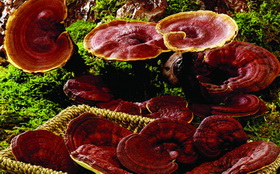 Botanical Description: Ganoderma multiplex D. H. Hou is a fungus in the family Ganodermataceae (or Polyporaceae) and genus Ganoderma; it is commonly known as Ganoderma multiplex or Chonggai Lingzhi. The basidiocarp (fruiting body) is petiolate. The pileus (cap) is orbicular (nearly round) or fan-shaped, superposed (overlapping), measuring 5–10 × 3–4 cm, with a thickness of 5–9 mm. Some prosthecae and pilei are connate; the context is nemaline (fibrous), suberinite to ligneous. The upper surface of the pileus is convex and mirror-like, sometimes explanate; the underside is rarely concave. The margins are regular, entire or undulate (wave-like), and rarely reflexed. The surface sometimes bears annules, is uneven (not flat), exhibits an umbilicate protuberance, and may have concentric ring grooves; it displays a lacquer-like luster, is smooth, and ranges in color from chestnut brown to pale yellowish red — fading toward the margin to pale yellowish or pale whitish. The primary prosthecae are irregular, short, and thick, 3–5 cm long and 1–3.5 cm in diameter; they are pleurogenous, upright or sloping, and exhibit a lacquer-like luster and reddish chestnut brown color. The secondary pileus (secondary cap), emerging from the lower pileus, measures 1–2 × 1–2.5 cm, with a thickness of 5–8 mm; its prosthecae are short, cylindrical or flattened, lateral (pleurogenous), 1–1.5 cm long, and share the same color as the lower pileus. The tube wall is thin; the tubes are 1–2 mm long and unstratified (not layered); the pores are round and pale yellowish brown.
