Lingzhi Mushroom: Other Identified Special Species (49) Ganoderma formosanum.
✵The article records another identified special species of Lingzhi mushroom — (49) Ganoderma formosanum — including its English name, Latin name, Pinyin name, properties and flavor, and provides a detailed introduction to the botanical features, growth characteristics, ecological environment, morphological features, pharmacological actions, medicinal efficacy, and administration guidelines of this fungal species.
Other Identified Special Species of Lingzhi Mushroom: (49) Ganoderma formosanum.
Botanical Description:Ganoderma formosanum Chang et Chen is a fungus in the family Ganodermataceae (or Polyporaceae) and genus Ganoderma; it is commonly known as Ganoderma formosanum or Black Reishi Lingzhi. The basidiocarp (fruiting body) has a mesic, lateral, or eccentric stalk; it is rarely sessile, with a texture ranging from suberinite to ligneous. The pileus (cap) is orbicular (subrotund), round, or reniform, up to 15 cm in diameter and 0.3–2 cm thick. The surface bears sparse concentric ring grooves, numerous annules, or slight vertical wrinkles, and is flat or concave at the center. Coloration ranges from claret red-brown to pale dark brown (nearly black-brown), dark grayish purple, or black, with a lacquer-like luster. The margins are sharp to blunt, sometimes recurved, and range from regular to undulate. The context is 1–3 cm thick: the upper portion is white and thin, while the lower portion near the tubes is pale black or black. The tubes are 0.3–1.7 cm long. Prosthecae reach up to 30 cm in length and 0.8–2.5 cm in diameter, and are verruculose.
The hymenium structure is of the sporiferous layer type, hazel (pale brown); the composite hyphae are cylindrical to clavate, 5.1–6.3 μm in diameter and 35.6–48 μm in length. The upper context consists of transparent binding hyphae oriented perpendicularly to the hymenium of the sporiferous layer, while the lower context consists of skeletal hyphae and binding hyphae. The pores are circular, 131–151 (–181) μm in diameter. The tube wall is 60–122 (–202) μm thick.
The basidiospores are oval (egg-shaped) to torulose (subsphaeroidal), with transparent papillae at the apex; they do not collapse or rarely collapse to a truncate apex at maturity; brown in color; dimensions: 11.5–12 (–12.5) × 7–7.6 (–8.5) μm.
Ecological Environment:Ganoderma formosanum Chang et Chen grows in mountainous forests. This species is mainly distributed in China.
References:
1. Introduction of Ling Zhi: Ganoderma lucidum, Fairy Grass.
2. Lingzhi Mushroom: Other Identified Special Species — Ganoderma formosanum.

 ✵The article records another identified special species of Lingzhi mushroom — (49) Ganoderma formosanum — including its English name, Latin name, Pinyin name, properties and flavor, and provides a detailed introduction to the botanical features, growth characteristics, ecological environment, morphological features, pharmacological actions, medicinal efficacy, and administration guidelines of this fungal species.
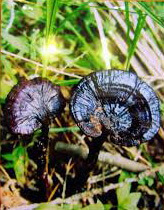 Botanical Description: Ganoderma formosanum Chang et Chen is a fungus in the family Ganodermataceae (or Polyporaceae) and genus Ganoderma; it is commonly known as Ganoderma formosanum or Black Reishi Lingzhi. The basidiocarp (fruiting body) has a mesic, lateral, or eccentric stalk; it is rarely sessile, with a texture ranging from suberinite to ligneous. The pileus (cap) is orbicular (subrotund), round, or reniform, up to 15 cm in diameter and 0.3–2 cm thick. The surface bears sparse concentric ring grooves, numerous annules, or slight vertical wrinkles, and is flat or concave at the center. Coloration ranges from claret red-brown to pale dark brown (nearly black-brown), dark grayish purple, or black, with a lacquer-like luster. The margins are sharp to blunt, sometimes recurved, and range from regular to undulate. The context is 1–3 cm thick: the upper portion is white and thin, while the lower portion near the tubes is pale black or black. The tubes are 0.3–1.7 cm long. Prosthecae reach up to 30 cm in length and 0.8–2.5 cm in diameter, and are verruculose.
