Lingzhi mushroom: Other Identified Special Species (42) Ganoderma mirivelutinum.
✵The article records other identified special species of Lingzhi mushroom—(42) Ganoderma mirivelutinum—including its English name, Latin name, Pinyin name, properties and flavor, and provides a detailed introduction to the botanical features, growth characteristics, and ecological environment of this species; the morphological features of the fungus; its pharmacological actions, medicinal efficacy, and administration guidelines.
Other Identified Special Species of Lingzhi Mushroom (42) Ganoderma mirivelutinum.
Botanical Description:Ganoderma mirivelutinum J. D. Zhao is a fungus in the family Ganodermataceae (or Polyporaceae) and genus Ganoderma. It is commonly known as Ganoderma mirivelutinum, Strange Fluff Ganoderma, Strange Hair Ganoderma, or Qi Rongmao Lingzhi. The basidiocarp (fruiting body) is annual, sessile, and suberose to ligneous. The pileus (cap) is semicircular, measuring 5 × 8 cm, with a thickness of 1.8 cm at the base; the surface is brunneous (reddish-brown), darkening to dark brown (nearly black) toward the base, bearing dense concentric ridges and annular ribs; sometimes covered with numerous thin-necked, doliform (bottle-shaped) hairs; the margin is hazel (pale brown), blunt, and undulate; the lower surface is infertile and 4–5 mm wide. The context is uniformly brown, 4–8 mm thick, and features a black chitinous (shell) layer. The tubes are brown and 1–1.2 cm long. The pore surface is pale white or hazel (pale brown); the pores are slightly rounded, with 4–5 per mm.
The hymenium (sporiferous layer) is hazel (pale brown); some generative hyphae are enlarged at the tips, while others are irregularly shaped; they typically measure 3.0–6.0 μm in width and 20–25 μm in length.
The mycelial system is trimitic: generative hyphae are colorless and transparent, leptodermous (thin-walled), 2.5–4.0 μm in diameter; skeletal hyphae are hazel (pale brown), pachydermous (thick-walled) to farctate, with dendritic branching or unbranched; the skeletal portion measures 3–4.5 μm in dry diameter; one end of a branch often connects to a generative hypha, and flagelliform, colorless binding hyphae may arise from the branch tips, forming a composite system of skeletal–generative–binding hyphae; binding hyphae are colorless, pachydermous (thick-walled), and 1–2 μm in diameter.
The basidiospores are oval (egg-shaped) or broadly ovate, sometimes with a slightly truncate apex; they are double-walled—the outer wall colorless, transparent, and smooth; the inner wall lacking spinules or bearing inconspicuous spinules, colorless or faintly pale brown—measuring 8.3–12 × 5.2–9 μm.
Ecological Environment:Ganoderma mirivelutinum J. D. Zhao grows in mountainous forests. This species is endemic to China.
References:
1. Introduction of Ling Zhi: Ganoderma lucidum, Fairy Grass.
2. Lingzhi Mushroom: Other Identified Special Species—Ganoderma mirivelutinum.

 ✵The article records other identified special species of Lingzhi mushroom—(42) Ganoderma mirivelutinum—including its English name, Latin name, Pinyin name, properties and flavor, and provides a detailed introduction to the botanical features, growth characteristics, and ecological environment of this species; the morphological features of the fungus; its pharmacological actions, medicinal efficacy, and administration guidelines.
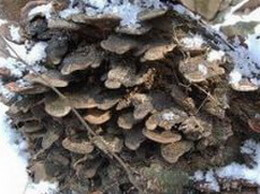 Botanical Description: Ganoderma mirivelutinum J. D. Zhao is a fungus in the family Ganodermataceae (or Polyporaceae) and genus Ganoderma. It is commonly known as Ganoderma mirivelutinum, Strange Fluff Ganoderma, Strange Hair Ganoderma, or Qi Rongmao Lingzhi. The basidiocarp (fruiting body) is annual, sessile, and suberose to ligneous. The pileus (cap) is semicircular, measuring 5 × 8 cm, with a thickness of 1.8 cm at the base; the surface is brunneous (reddish-brown), darkening to dark brown (nearly black) toward the base, bearing dense concentric ridges and annular ribs; sometimes covered with numerous thin-necked, doliform (bottle-shaped) hairs; the margin is hazel (pale brown), blunt, and undulate; the lower surface is infertile and 4–5 mm wide. The context is uniformly brown, 4–8 mm thick, and features a black chitinous (shell) layer. The tubes are brown and 1–1.2 cm long. The pore surface is pale white or hazel (pale brown); the pores are slightly rounded, with 4–5 per mm.
