Lingzhi Mushroom: Other Identified Special Species — (25) Ganoderma ramosissimum.
✵The article records other identified special species of the Lingzhi mushroom, namely (25) Ganoderma ramosissimum, including its English name, Latin name, Pinyin name, properties and flavor. It provides a detailed introduction to the botanical features, growth characteristics, and ecological environment of these fungal species; their morphological features; pharmacological actions; medicinal efficacy; and administration guidelines.
Other Identified Special Species of Lingzhi Mushroom: (25) Ganoderma ramosissimum
Botanical Description:Ganoderma ramosissimum J. D. Zhao is a fungus in the family Ganodermataceae (or Polyporaceae) and genus Ganoderma. It is commonly known as Multi-branched Ganoderma or Duo Fen Zhi Lingzhi. The basidiocarp (fruiting body) is annual or perennial, petiolate, and suberiform. The pileus (cap) is fan-shaped or irregularly shaped; sometimes several pilei are fused, measuring 3–3.5 × 1–3 cm, with a thickness of 0.5–1 cm. The surface is light brown, brown, or puce (purple-brown), smooth, and exhibits a lacquer-like luster; concentric annuli are inconspicuous. The margin is fawn-colored (flavotestaceous), blunt, and the lower margin is sterile. The context is whitish to wood-colored or slightly brownish and does not turn black upon contact with aqueous KOH solution. The hymenophoral tubes are 2–4 mm long. The pore surface is hazel (pale brown) or fuscid (dirty brown); the pores are nearly circular, 4–5 per mm. The stipe (prostheca) is pleurogenous (lateral in origin), highly glossy with a strong lacquer-like luster, up to 19 cm long, typically 0.5–1 cm thick, slightly flattened toward the apex, and dichotomously, trifurcately, or irregularly branched; branch width is uneven, occasionally reaching 2 cm in thickness; infertile branches are common, and branch tips may bear a pileus or lack one.
The pileipellis (hymeniderm) is a typical sporiferous-layer type, hazel (pale brown) in color; the composite hyphae are clavate, with tips either enlarged or nearly unenlarged, usually 5–7 μm wide and 20–25 μm long—sometimes shorter.
The hyphal system is trimitic: generative hyphae are hyaline, leptodermous (thin-walled), 2–3 μm in diameter; skeletal hyphae are colorless to slightly brownish, pachydermous (thick-walled) to farctate, with arborizations (dendritic branching); the skeletal portion measures 3–4.5 μm in dry diameter; flagelliform, colorless binding hyphae arise at the apices of branches; binding hyphae are colorless, pachydermous (thick-walled), ramified, and 1.5–2.0 μm in diameter.
The basidiospores are elliptic or broadly elliptic, double-walled: the outer wall is colorless and transparent and smooth; the inner wall bears spinules—sometimes indistinct—and is hazel (pale brown) in color, measuring 9–11 × 5.3–6.0 μm.
Ecological Environment:Ganoderma ramosissimum J. D. Zhao grows in mountainous forests and is primarily distributed in China.
References:
1. Introduction of Ling Zhi: Ganoderma lucidum, Fairy Grass
2. Lingzhi Mushroom: Other Identified Special Species — Ganoderma ramosissimum

 ✵The article records other identified special species of the Lingzhi mushroom, namely (25) Ganoderma ramosissimum, including its English name, Latin name, Pinyin name, properties and flavor. It provides a detailed introduction to the botanical features, growth characteristics, and ecological environment of these fungal species; their morphological features; pharmacological actions; medicinal efficacy; and administration guidelines.
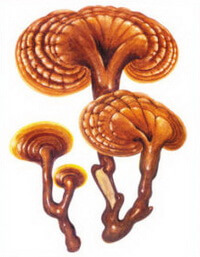 Botanical Description: Ganoderma ramosissimum J. D. Zhao is a fungus in the family Ganodermataceae (or Polyporaceae) and genus Ganoderma. It is commonly known as Multi-branched Ganoderma or Duo Fen Zhi Lingzhi. The basidiocarp (fruiting body) is annual or perennial, petiolate, and suberiform. The pileus (cap) is fan-shaped or irregularly shaped; sometimes several pilei are fused, measuring 3–3.5 × 1–3 cm, with a thickness of 0.5–1 cm. The surface is light brown, brown, or puce (purple-brown), smooth, and exhibits a lacquer-like luster; concentric annuli are inconspicuous. The margin is fawn-colored (flavotestaceous), blunt, and the lower margin is sterile. The context is whitish to wood-colored or slightly brownish and does not turn black upon contact with aqueous KOH solution. The hymenophoral tubes are 2–4 mm long. The pore surface is hazel (pale brown) or fuscid (dirty brown); the pores are nearly circular, 4–5 per mm. The stipe (prostheca) is pleurogenous (lateral in origin), highly glossy with a strong lacquer-like luster, up to 19 cm long, typically 0.5–1 cm thick, slightly flattened toward the apex, and dichotomously, trifurcately, or irregularly branched; branch width is uneven, occasionally reaching 2 cm in thickness; infertile branches are common, and branch tips may bear a pileus or lack one.
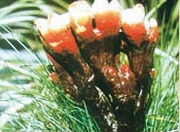 The pileipellis (hymeniderm) is a typical sporiferous-layer type, hazel (pale brown) in color; the composite hyphae are clavate, with tips either enlarged or nearly unenlarged, usually 5–7 μm wide and 20–25 μm long—sometimes shorter.
