Lingzhi Mushroom: Other Identified Special Species (32) Ganoderma cochlear
✵The article records another identified special species of Lingzhi mushroom—(32) Ganoderma cochlear—including its English name, Latin name, Pinyin name, properties and flavor. It provides a detailed introduction to the botanical features, growth characteristics, and ecological environment of this species; the morphological features of the fungus; its pharmacological actions, medicinal efficacy, and administration guidelines.
Other Identified Special Species of Lingzhi Mushroom (32) Ganoderma cochlear
Botanical Description:Ganoderma cochlear (Blume et Nees) Bres. is a fungus in the family Ganodermataceae (or Polyporaceae) and genus Ganoderma. It is commonly known as Ganoderma cochlear, Purple-backed Stipe Ganoderma, or Beibingzi Lingzhi. The basidiocarp (fruiting body) is annual or perennial, stipitate, suberose to lignified. The pileus (cap) is orbicular or nearly circular, 6–9 × 8–10 cm, ~1.5 cm thick; the surface is atropurpureus (purplish-black) to black, with a lacquer-like luster, often exhibiting radial wrinkles and inconspicuous concentric ridges; the margin is blunt or truncate; the context is dark coffee-colored (dark brown), up to 1 cm thick; the tubes are 3–5 mm long and similar in color to the context; the pore surface is nearly white or yellowish; pores are round or orbicular, with thick tube walls, 4–5 per mm. The stipes are dorsiferous (tergiferous); some are short and stout (4–5 cm long, 1–2 cm in diameter), while others reach up to 20 cm in length; the central portion is flattened, up to 4.5 cm wide; stipes share the same color as the pileus, are glossy, and typically swell at the substrate junction to form an enlarged base.
The hymenium is an irregular sporiferous layer, hazel (pale brown) to brown; the generative hyphae are clavate, with the enlarged apical portion 4.5–7.0 μm wide and 20–30 μm long.
The mycelial system is trimitic: generative hyphae are hyaline, leptodermous (thin-walled), 3–5 μm in diameter; skeletal hyphae are hazel (pale brown) to brown, pachydermous (thick-walled) to farctate, with dendritic branching or acicular morphology; the skeletal portion measures 3–5 μm in dry diameter; flagelliform, pigmented binding hyphae arise from the tips of branches; binding hyphae are colorless, pachydermous (thick-walled), 1–2 μm in diameter.
The basidiospores are ovoid or broadly ellipsoid, sometimes with a slightly truncate apex; they are double-walled—the outer wall is colorless, transparent, and smooth; the inner wall is hazel (pale brown) to brown and ornamented with spinules or occasionally smooth; dimensions: 10.5–12 × 6.5–7.5 μm.
Ecological Environment:Ganoderma cochlear (Blume et Nees) Bres. grows in mountainous forests. This species is distributed in China and Java. Globally, it is native to China and Java.
References:
1. Introduction of Ling Zhi: Ganoderma lucidum, Fairy Grass.
2. Lingzhi Mushroom: Other Identified Special Species — Ganoderma cochlear.

 ✵The article records another identified special species of Lingzhi mushroom—(32) Ganoderma cochlear—including its English name, Latin name, Pinyin name, properties and flavor. It provides a detailed introduction to the botanical features, growth characteristics, and ecological environment of this species; the morphological features of the fungus; its pharmacological actions, medicinal efficacy, and administration guidelines.
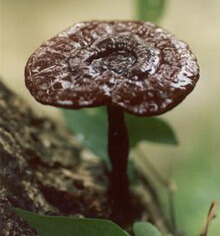 Botanical Description: Ganoderma cochlear (Blume et Nees) Bres. is a fungus in the family Ganodermataceae (or Polyporaceae) and genus Ganoderma. It is commonly known as Ganoderma cochlear, Purple-backed Stipe Ganoderma, or Beibingzi Lingzhi. The basidiocarp (fruiting body) is annual or perennial, stipitate, suberose to lignified. The pileus (cap) is orbicular or nearly circular, 6–9 × 8–10 cm, ~1.5 cm thick; the surface is atropurpureus (purplish-black) to black, with a lacquer-like luster, often exhibiting radial wrinkles and inconspicuous concentric ridges; the margin is blunt or truncate; the context is dark coffee-colored (dark brown), up to 1 cm thick; the tubes are 3–5 mm long and similar in color to the context; the pore surface is nearly white or yellowish; pores are round or orbicular, with thick tube walls, 4–5 per mm. The stipes are dorsiferous (tergiferous); some are short and stout (4–5 cm long, 1–2 cm in diameter), while others reach up to 20 cm in length; the central portion is flattened, up to 4.5 cm wide; stipes share the same color as the pileus, are glossy, and typically swell at the substrate junction to form an enlarged base.
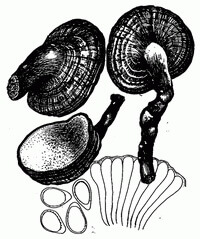 The hymenium is an irregular sporiferous layer, hazel (pale brown) to brown; the generative hyphae are clavate, with the enlarged apical portion 4.5–7.0 μm wide and 20–30 μm long.
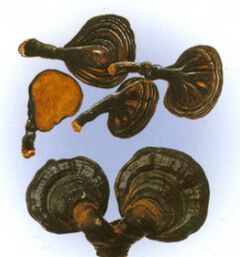 The basidiospores are ovoid or broadly ellipsoid, sometimes with a slightly truncate apex; they are double-walled—the outer wall is colorless, transparent, and smooth; the inner wall is hazel (pale brown) to brown and ornamented with spinules or occasionally smooth; dimensions: 10.5–12 × 6.5–7.5 μm.
