Lingzhi mushroom: Other Identified Common Species: (9) Ganoderma boninense.
✵The article records other identified common species of the Lingzhi mushroom—(9) Ganoderma boninense—including its English name, Latin name, Pinyin name, properties and flavor, and provides a detailed introduction to the botanical features, growth characteristics, and ecological environment of these species; their morphological features; pharmacological actions; medicinal efficacy; and administration guidelines.
Other Identified Common Species of the Lingzhi Mushroom: (9) Ganoderma boninense.
Botanical Description:Ganoderma boninense Pat. is a fungus in the family Ganodermataceae (or Polyporaceae) and genus Ganoderma. It is commonly known as Long-Narrow-Spore Ganoderma or Xiao Chang Bao Lingzhi. The fruiting body (basidiocarp) is annual, sessile or stout, and corky to woody. The pileus (cap) is nearly circular, measuring 9.5 × 9 cm, with a thickness of approximately 1.2 cm. Its surface is dark purple, bearing fine, dense, and distinct concentric rings and radial wrinkles, and exhibits a lacquer-like luster; the margin is obtuse. The upper layer of the context is brown; the portion adjacent to the tubes is bistre (dark brown), about 0.3 cm thick. The tubes are brown and 0.8 cm long; the pore surface is brown; the pores are nearly circular; and the tube walls are thick, with approximately 5 pores per mm. The stipe (if present) is dorsiferous, 0.8 cm long and about 3 cm in diameter.
The hymenial structure is of the irregular sporiferous layer type, ranging from hazel (pale brown) to brown. The composite hyphae are clavate, with enlarged, lobed, or fusiform (spindle-shaped) tips, typically 3–6.7 μm wide and 25–30 μm long.
The mycelial system is trimitic: generative hyphae are hyaline and thin-walled, 3–4 μm in diameter; skeletal hyphae are nearly colorless to hazel (pale brown), pachypleurous (thick-walled) to farctate, with dendritic (arboriform) or acicular branching; they measure 3–4.5 (–5) μm in diameter. Colorless, flagelliform, binding hyphae—pachypleurous and 1–2 μm in diameter—are formed at the tips of branches.
The basidiospores are narrowly ovate or slightly truncate at the apex, double-walled; the outer wall is colorless, transparent, and smooth; the inner wall bears inconspicuous spines and is fawn-colored (flavotestaceous), measuring 9.2–12 × 5.7–7.9 μm.
Ecological Environment:Ganoderma boninense Pat. grows in mountainous forests. This species is primarily distributed in China and is also found in Central America.
References:
1. Introduction of Ling Zhi: Ganoderma lucidum, Fairy Grass.
2. Lingzhi Mushroom: Other Identified Common Species—Ganoderma boninense.

 ✵The article records other identified common species of the Lingzhi mushroom—(9) Ganoderma boninense—including its English name, Latin name, Pinyin name, properties and flavor, and provides a detailed introduction to the botanical features, growth characteristics, and ecological environment of these species; their morphological features; pharmacological actions; medicinal efficacy; and administration guidelines.
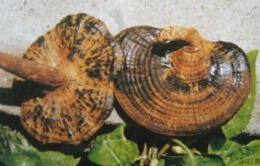 Botanical Description: Ganoderma boninense Pat. is a fungus in the family Ganodermataceae (or Polyporaceae) and genus Ganoderma. It is commonly known as Long-Narrow-Spore Ganoderma or Xiao Chang Bao Lingzhi. The fruiting body (basidiocarp) is annual, sessile or stout, and corky to woody. The pileus (cap) is nearly circular, measuring 9.5 × 9 cm, with a thickness of approximately 1.2 cm. Its surface is dark purple, bearing fine, dense, and distinct concentric rings and radial wrinkles, and exhibits a lacquer-like luster; the margin is obtuse. The upper layer of the context is brown; the portion adjacent to the tubes is bistre (dark brown), about 0.3 cm thick. The tubes are brown and 0.8 cm long; the pore surface is brown; the pores are nearly circular; and the tube walls are thick, with approximately 5 pores per mm. The stipe (if present) is dorsiferous, 0.8 cm long and about 3 cm in diameter.
