Lingzhi Mushroom: Other Identified Common Species: (19) Ganoderma gibbosum.
✵The article records other identified common species of the Lingzhi mushroom—(19) Ganoderma gibbosum—including its English name, Latin name, Pinyin name, properties and flavor, as well as a detailed introduction to the botanical features, growth characteristics, ecological environment, morphological traits, pharmacological actions, medicinal efficacy, and administration guidelines.
Other Identified Common Species of Lingzhi Mushroom: (19) Ganoderma gibbosum.
Botanical Description:Ganoderma gibbosum (Nees) Pat. is a fungus in the family Ganodermataceae (or Polyporaceae) and genus Ganoderma. It is commonly known as Petiolate Ganoderma, Stipitate Ganoderma or Yǒubǐnglíngzhī.
The basidiocarp (fruiting body) is stipitate, suberose or lignified. The pileus (cap) is semicircular or nearly fan-shaped, measuring 4–10 × 5–9 cm, with a thickness of up to 2 cm. The upper surface is rusty brown, dirty yellowish-brown, or khaki, bearing dense concentric ridges. The cuticle is thin—sometimes friable to finger pressure, occasionally cracked—and lacks luster. The margin is blunt or obtuse and intact. The context is dark brown or dark tan (dark chocolate brown), 0.5–1 cm thick; the tubes are dark brown, 0.5–1 cm long; the pore surface is dirty white to brown; the pores are circular, 4–5 per mm. The stipe is short and stout, lateral, 4–8 cm long and 1–3 cm thick, with a widened base and the same color as the pileus.
The cuticular structure comprises hyaline, leptodermous (thin-walled) generative hyphae and pachydermous (thick-walled), brown skeletal hyphae, densely interwoven—difficult to separate. With age, the hyphae turn hazel (pale brown); they are branched, with some apices enlarged into subspherical shapes, 4.5–6 μm in diameter; the skeletal hyphae are also branched, 4–7.5 μm in diameter; the overall height of the cuticular layer is 80–100 μm. This resembles an interlaced cuticular type; unlike that of Ganoderma applanatum, it lacks a surface layer of hyaline mycelial mat.
The mycelial system is a three-element type: generative hyphae are transparent or slightly fawn-colored (flavotestaceous), leptodermous (thin-walled), 2–4 μm in diameter; skeletal hyphae are pale russet (pale reddish-brown), pachypleurous (thick-walled) to farctate, arborizing (dendritic branching) or acicular (acerose), with a skeletal part 2–3 μm in dry diameter; flagelliform, colorless binding hyphae are formed at the tips of branches; binding hyphae are colorless to slightly pale brown, pachypleurous (thick-walled), branched, 1–2 μm in diameter.
The basidiospores are oval (egg-shaped), sometimes with a truncate apex, double-walled, the outer wall is colorless and transparent and smooth, the inner wall is hazel (pale brown) and ornamented with spinules, 6.9–8.7 × 5.0–5.2 μm.
Ecological Environment:Ganoderma gibbosum (Nees) Pat. grows in mountains and forests. This species is mainly distributed in China and also occurs in Brazil.
References:
1. Introduction of Ling Zhi: Ganoderma lucidum, Fairy Grass.
2. Lingzhi Mushroom: Other Identified Common Species — Ganoderma gibbosum.

 ✵The article records other identified common species of the Lingzhi mushroom—(19) Ganoderma gibbosum—including its English name, Latin name, Pinyin name, properties and flavor, as well as a detailed introduction to the botanical features, growth characteristics, ecological environment, morphological traits, pharmacological actions, medicinal efficacy, and administration guidelines.
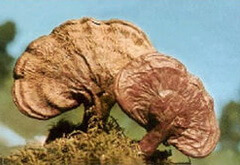 Botanical Description: Ganoderma gibbosum (Nees) Pat. is a fungus in the family Ganodermataceae (or Polyporaceae) and genus Ganoderma. It is commonly known as Petiolate Ganoderma, Stipitate Ganoderma or Yǒubǐnglíngzhī.
