Lingzhi mushroom: Other Identified Common Species: (10) Ganoderma calidophilum.
✵The article records other identified common species of the Lingzhi mushroom—(10) Ganoderma calidophilum—including its English name, Latin name, pinyin name, properties and flavor, and provides a detailed introduction to the botanical features, growth characteristics, and ecological environment of these species; their morphological features; pharmacological actions; medicinal efficacy; and administration guidelines.
Other Identified Common Species of Lingzhi mushroom:(10) Ganoderma calidophilum.
Botanical Description:Ganoderma calidophilum J. D. Zhao is a fungus in the family Ganodermataceae (or Polyporaceae) and genus Ganoderma. It is commonly known as Hot-Prefer Ganoderma or Xi Re Lingzhi. The basidiocarp (fruiting body) is annual, petiolate, and suberose. The pileus (cap) is orbicular, semicircular, or nearly fan-shaped—sometimes irregular—measuring 2–2.7 × 2.4–4.5 cm, with a thickness of 0.5–1.5 cm. Its surface is russet (reddish-brown) or puce (purple-brown), occasionally blackish-brown, exhibiting a lacquer-like luster, concentric ring grooves and patterns, and vertical wrinkles; the margin is blunt or truncate. The context is divided into two layers: the upper layer is wood-colored to hazel (pale brown); the portion adjacent to the tubes is brown to dark brown, 0.1–0.3 cm thick. The tubes are 0.3–0.5 cm long and brown; the pore surface is white or nearly white; the pores are circular, 4–6 per mm. The stipe (if present) is dorsiferous, 5–12 (–24) cm long and 0.4–0.7 (–0.9) cm thick. It is typically puce (purple-brown) or atropurpureus (purple-black), glossy, variably thickened, and often curved.
The hymenial structure is of the irregular sporiferous layer type, ranging from hazel (pale brown) to brown. The tips of the composite hyphae are enlarged, measuring 5–7.5 μm in width and 20–30 μm in length.
The mycelial system is trimitic: generative hyphae are hyaline and thin-walled, 3–4.5 μm in diameter; skeletal hyphae are hazel (pale brown), pachypleurous (thick-walled) to farctate, with dendritic branching, 3–4.5 μm in dry diameter; occasionally, one end connects to a thin-walled generative hypha, and flagelliform, colorless, binding hyphae—pachypleurous and 1.5–2 μm in diameter—are formed at branch tips; some branches may differentiate into thin-walled generative hyphae.
The basidiospores are oval (egg-shaped), with numerous umbilicate protuberances at the apex; a few are slightly truncate. They are double-walled: the outer wall is colorless, transparent, and smooth; the inner wall is hazel (pale brown), lacking spines or bearing only inconspicuous spines, measuring 8.7–11.6 × 5.8–7.8 μm (original records cited 10–12 or 13 × 6.2–8.7 μm).
Ecological Environment:Ganoderma calidophilum J. D. Zhao grows in forested and mountainous areas. This species is primarily distributed in China.
References:
1. Introduction of Ling Zhi: Ganoderma lucidum, Fairy Grass.
2. Lingzhi mushroom: Other Identified Common Species: (10) Ganoderma calidophilum.

 ✵The article records other identified common species of the Lingzhi mushroom—(10) Ganoderma calidophilum—including its English name, Latin name, pinyin name, properties and flavor, and provides a detailed introduction to the botanical features, growth characteristics, and ecological environment of these species; their morphological features; pharmacological actions; medicinal efficacy; and administration guidelines.
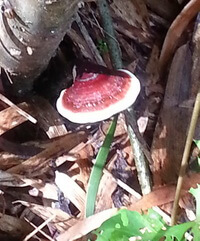 Botanical Description: Ganoderma calidophilum J. D. Zhao is a fungus in the family Ganodermataceae (or Polyporaceae) and genus Ganoderma. It is commonly known as Hot-Prefer Ganoderma or Xi Re Lingzhi. The basidiocarp (fruiting body) is annual, petiolate, and suberose. The pileus (cap) is orbicular, semicircular, or nearly fan-shaped—sometimes irregular—measuring 2–2.7 × 2.4–4.5 cm, with a thickness of 0.5–1.5 cm. Its surface is russet (reddish-brown) or puce (purple-brown), occasionally blackish-brown, exhibiting a lacquer-like luster, concentric ring grooves and patterns, and vertical wrinkles; the margin is blunt or truncate. The context is divided into two layers: the upper layer is wood-colored to hazel (pale brown); the portion adjacent to the tubes is brown to dark brown, 0.1–0.3 cm thick. The tubes are 0.3–0.5 cm long and brown; the pore surface is white or nearly white; the pores are circular, 4–6 per mm. The stipe (if present) is dorsiferous, 5–12 (–24) cm long and 0.4–0.7 (–0.9) cm thick. It is typically puce (purple-brown) or atropurpureus (purple-black), glossy, variably thickened, and often curved.
