Lingzhi mushroom: Other Identified Common Species: (17) Ganoderma duropora.
✵The article records other identified common species of the Lingzhi mushroom—(17) Ganoderma duropora—including its English name, Latin name, Pinyin name, properties and flavor, as well as a detailed introduction to the botanical features, growth characteristics, and ecological environment of these species; the morphological features of the fungi; their pharmacological actions, medicinal efficacy, and administration guidelines.
Other Identified Common Species of Lingzhi Mushroom: (17) Ganoderma duropora.
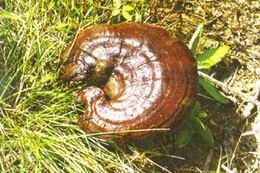
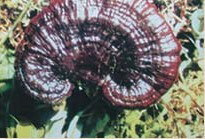
Botanical Description:Ganoderma duropora Lloyd is a fungus in the family Ganodermataceae (or Polyporaceae) and genus Ganoderma. It is commonly known as Hard-hole Ganoderma or Ying Kong Lingzhi. The basidiocarp (fruiting body) is annual, stipitate, suberose or lignous. The pileus (cap) is nearly circular, with a centrally depressed, often concave and funnel-shaped surface, measuring 6–15 × 8–16 cm. The surface is atropurpureus (purplish-black) to black, exhibiting a strong lacquer-like luster, with conspicuous or inconspicuous concentric ridges or wrinkles; the margin is slightly thin or sharp, slightly involute (rolled inward), and sinuate. The context is bistre (seal brown), 0.8–1.5 cm thick; the tubes are dark brown, 0.3–0.6 cm long; the pore surface is hazel (pale brown) to brown or dark brown; and the pores are circular, 5–6 per mm. The stipe is central, 10–20 cm long and 1.2–1.8 cm in diameter, subcylindrical (nearly cylindrical), the same color as the pileus, with a strong lacquer-like luster, sometimes irregular in diameter or torose (bead-like).
The hymenial structure is a typical sporiferous layer type; the pale brown, composite hyphae are clavate, with enlarged or slightly truncate apices, usually 5–7 μm wide and 17.5–25 μm long.
The mycelial system is trimitic: generative hyphae are hyaline, leptodermous (thin-walled), 2.5–4 μm in diameter; skeletal hyphae are pale brown to brown, pachydermous (thick-walled) to farctate, with dendritic branching; the skeletal portion measures 4–5 μm in dry diameter; flagelliform, colorless binding hyphae arise at branch tips; binding hyphae are pachydermous (thick-walled), branched, and 1.0–2.0 μm in diameter.
The basidiospores are oval or broadly oval, with umbilicate protuberances at the apex, double-walled: the outer wall is colorless and transparent and smooth; the inner wall is pale brown and ornamented with spinules; dimensions are 9–11.5 × 6–7.5 μm.
Ecological Environment:Ganoderma duropora Lloyd grows in mountainous forests and is mainly distributed in China.
References:
1. Introduction of Ling Zhi: Ganoderma lucidum, Fairy Grass.
2. Lingzhi Mushroom: Other Identified Common Species: Ganoderma duropora.

 ✵The article records other identified common species of the Lingzhi mushroom—(17) Ganoderma duropora—including its English name, Latin name, Pinyin name, properties and flavor, as well as a detailed introduction to the botanical features, growth characteristics, and ecological environment of these species; the morphological features of the fungi; their pharmacological actions, medicinal efficacy, and administration guidelines.
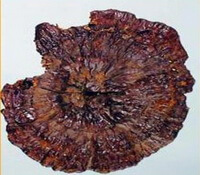 Botanical Description: Ganoderma duropora Lloyd is a fungus in the family Ganodermataceae (or Polyporaceae) and genus Ganoderma. It is commonly known as Hard-hole Ganoderma or Ying Kong Lingzhi. The basidiocarp (fruiting body) is annual, stipitate, suberose or lignous. The pileus (cap) is nearly circular, with a centrally depressed, often concave and funnel-shaped surface, measuring 6–15 × 8–16 cm. The surface is atropurpureus (purplish-black) to black, exhibiting a strong lacquer-like luster, with conspicuous or inconspicuous concentric ridges or wrinkles; the margin is slightly thin or sharp, slightly involute (rolled inward), and sinuate. The context is bistre (seal brown), 0.8–1.5 cm thick; the tubes are dark brown, 0.3–0.6 cm long; the pore surface is hazel (pale brown) to brown or dark brown; and the pores are circular, 5–6 per mm. The stipe is central, 10–20 cm long and 1.2–1.8 cm in diameter, subcylindrical (nearly cylindrical), the same color as the pileus, with a strong lacquer-like luster, sometimes irregular in diameter or torose (bead-like).
 The hymenial structure is a typical sporiferous layer type; the pale brown, composite hyphae are clavate, with enlarged or slightly truncate apices, usually 5–7 μm wide and 17.5–25 μm long.
 The basidiospores are oval or broadly oval, with umbilicate protuberances at the apex, double-walled: the outer wall is colorless and transparent and smooth; the inner wall is pale brown and ornamented with spinules; dimensions are 9–11.5 × 6–7.5 μm.
