Lingzhi Mushroom: Other Identified Common Species: (16) Ganoderma tropicum
✵The article records other identified common species of the Lingzhi mushroom—(16) Ganoderma tropicum—including its English name, Latin name, Pinyin name, properties and flavor, and provides a detailed introduction to the botanical features, growth characteristics, and ecological environment of these species; the morphological features of the fungi; their pharmacological actions, medicinal efficacy, and administration guidelines.
Other Identified Common Species of Lingzhi Mushroom: (16) Ganoderma tropicum
Pinyin Name: Rèdài Língzhī
English Name: Tropical Ganoderma
Latin Name:Ganoderma tropicum Property and Flavor: Neutral; slightly bitter
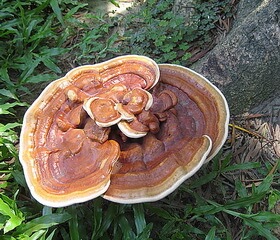
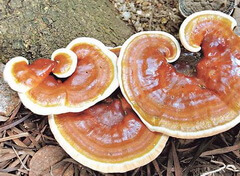
Botanical Description:Ganoderma tropicum (Jungh.) Bres. is a fungus in the family Ganodermataceae (or Polyporaceae) and genus Ganoderma. It is commonly known as Tropical Ganoderma or Rèdài Língzhī. The basidiocarp (fruiting body) is annual, sessile, and suberose to lignified. The pileus (cap) is semicircular, nearly fan-shaped, reniform, or nearly funnelform—sometimes irregular in shape—or small pilei may form at the margin of larger pilei. Dimensions: 2.5–8.5 × 4.5–15 cm; thickness: 0.5–2 cm. The surface is maroon (brownish-red), puce (purple-brown), or prunus (violet-red), with a faint lacquer-like luster; the outer margin often gradually lightens to yellowish-white or fawn (flavotestaceous). The margin is thin. The context is uniformly brown, 0.5–1.9 cm thick, and lacks a black chitinous layer (cuticle). The tubes are 0.1–0.2 cm long and brown. The pore surface is dirty white or hazel (pale brown), sometimes slightly brownish. The pores are irregularly shaped, 4–5 per mm.
The hymenium is a sporiferous layer type, pale brown to brown; the composite hyphae are clavate, with apical enlargements typically 4–6 μm wide and 20–25 μm long. The tips of some hyphae are coated with a gelatinous substance.
The mycelial system is trimitic: generative hyphae are transparent, leptodermous (thin-walled), and 3–5 μm in diameter; skeletal hyphae are pale brown, pachypleurous (thick-walled) to farctate, with dendritic branching (arborizations); the skeletal portion is 4–6 μm in diameter; flagelliform, colorless binding hyphae arise at the tips of branches; occasionally, pachypleurous skeletal hyphae connect at one end to leptodermous generative hyphae and at the other end to colorless binding hyphae; binding hyphae are colorless, pachypleurous (thick-walled), and 1.0–2.5 μm in diameter.
The basidiospores are ovoid (egg-shaped), nearly elliptic, or slightly truncate at the apex; they are double-walled—the outer wall colorless, transparent, and smooth; the inner wall pale brown, bearing spinules, and sometimes containing a single large oil droplet; dimensions: 8.4–11.4 × 5.2–6.9 (–7.2) μm.
Ecological Environment:Ganoderma tropicum (Jungh.) Bres. grows on stumps and dead roots of Acacia species, including Acacia confusa. This species is mainly distributed in China.
Growth Characteristics:Ganoderma tropicum grows on stumps or dead roots of the Lebbeck tree (Albizia lebbeck) and Acacia rachii.
Characteristics of the Herb: The pileus is reniform or semicircular, 10–20 cm in diameter, and approximately 3 mm thick. The surface is reddish-brown or purplish-red, with a lacquer-like luster, concentric rings or wrinkles; the margin is obtuse, undulate, or shallowly valvular-dehiscent. The pore surface is white or pale brown; the pores are oblong or polygonal, 4–5 per mm. The stipe (if present) is mostly lateral, 5–10 cm long and up to 4 cm in diameter, russet (reddish-brown), and suberose. The herb has a faint odor and a mild, slightly bitter taste.
Medicinal Efficacy: Tonic (nourishing), adaptogenic (roborant), and antineoplastic. Indicated for coronary heart disease and neoplastic conditions.
Administration of Ganoderma tropicum (Rèdài Língzhī):
Reference:
Administration Guide of Ganoderma tropicum (Rèdài Língzhī)
TCM Books:
Internally:water decoction, 3–9 grams; or as finely powdered herb, taken with water, wine, or other suitable vehicles.
References:
1. Introduction of Ling Zhi: Ganoderma lucidum, Fairy Grass.
2. Lingzhi mushroom:Other Identified Common Species:Ganoderma tropicum.

 ✵The article records other identified common species of the Lingzhi mushroom—(16) Ganoderma tropicum—including its English name, Latin name, Pinyin name, properties and flavor, and provides a detailed introduction to the botanical features, growth characteristics, and ecological environment of these species; the morphological features of the fungi; their pharmacological actions, medicinal efficacy, and administration guidelines.
 Pinyin Name: Rèdài Língzhī
 Ecological Environment: Ganoderma tropicum (Jungh.) Bres. grows on stumps and dead roots of Acacia species, including Acacia confusa. This species is mainly distributed in China.
