Lingzhi Mushroom: Other Identified Common Species — (20) Ganoderma lobatum.
✵The article records other identified common species of Lingzhi mushroom, namely (20) Ganoderma lobatum, including its English name, Latin name, Pinyin name, properties and flavor, and provides a detailed introduction to the botanical features, growth characteristics, ecological environment, morphological features, pharmacological actions, medicinal efficacy, and administration guidelines of these species.
Other Identified Common Species of Lingzhi Mushroom — (20) Ganoderma lobatum.
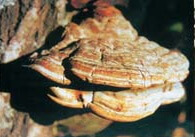
Botanical Description:Ganoderma lobatum (Schw.) Atk. is a fungus in the family Ganodermataceae (or Polyporaceae) and genus Ganoderma. It is commonly known as Layered Ganoderma or Cengdie Lingzhi. The basidiocarp (fruiting body) is annual to perennial, sessile, suberose or lignose. The pileus (cap) is slightly rounded to nearly flat, 14–17 × 9–13.5 cm; the pileolus (small cap) measures 4 × 3.5 cm and is 0.5–2.5 cm thick. The upper surface is gray to pale brown, sometimes rusty brown, with concentric ring bands but lacking a lacquer-like luster; the margin is blunt and entire. The context is brown to chestnut brown, up to 1 cm thick, and bears a black chitinous layer (shell layer). The tubes are monolayered (single-layered), 1–2 cm long, and dark brown to chestnut brown. The pore surface is primrose yellow (pale yellow), slightly brownish, or dirty white to dirty gray; the pores are slightly rounded, 4–5 per mm. The cutis (skin shell) is hard, resembling an interwoven shell, composed of transparent, leptodermous (thin-walled) generative hyphae and pachypleurous (thick-walled), brown skeletal hyphae; the hyphae are intricately intertwined and difficult to separate. The tips of the former hyphae are sharp and slender or blunt, 6–7.5 μm in diameter; the latter hyphae are branched, 5–7 μm in diameter. Generative hyphae on the surface of the cutis form a mycelial mat intermixed with skeletal hyphae; the total thickness is 60–80 μm.
The mycelial system is a three-element type: generative hyphae are transparent, leptodermous (thin-walled), branched, 4–5.5 μm in diameter; skeletal hyphae are brown to pale brown, pachypleurous (thick-walled) to farctate, arborizing (dendritic branching) or acicular (acerose), with a skeletal part 3–5 μm in dry diameter; flagelliform binding hyphae are formed at the tips of branches; binding hyphae are fawn-colored (flavotestaceous), pachypleurous (thick-walled), often branched, 1–2 μm in diameter.
The basidiospores are broadly elliptical to oval (egg-shaped), sometimes with a truncate apex, double-walled, the outer wall is colorless and transparent and smooth, the inner wall is hazel (pale brown) and ornamented with spinules, 7.0–10.0 × 4.5–6.8 μm.
Ecological Environment:Ganoderma lobatum (Schw.) Atk. grows in mountains and forests. This species is distributed in China and is mainly found in the USA (United States of America).
References:
1. Introduction of Ling Zhi: Ganoderma lucidum, Fairy Grass.
2. Lingzhi Mushroom: Other Identified Common Species — Ganoderma lobatum.

 ✵The article records other identified common species of Lingzhi mushroom, namely (20) Ganoderma lobatum, including its English name, Latin name, Pinyin name, properties and flavor, and provides a detailed introduction to the botanical features, growth characteristics, ecological environment, morphological features, pharmacological actions, medicinal efficacy, and administration guidelines of these species.
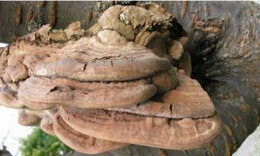 Botanical Description: Ganoderma lobatum (Schw.) Atk. is a fungus in the family Ganodermataceae (or Polyporaceae) and genus Ganoderma. It is commonly known as Layered Ganoderma or Cengdie Lingzhi. The basidiocarp (fruiting body) is annual to perennial, sessile, suberose or lignose. The pileus (cap) is slightly rounded to nearly flat, 14–17 × 9–13.5 cm; the pileolus (small cap) measures 4 × 3.5 cm and is 0.5–2.5 cm thick. The upper surface is gray to pale brown, sometimes rusty brown, with concentric ring bands but lacking a lacquer-like luster; the margin is blunt and entire. The context is brown to chestnut brown, up to 1 cm thick, and bears a black chitinous layer (shell layer). The tubes are monolayered (single-layered), 1–2 cm long, and dark brown to chestnut brown. The pore surface is primrose yellow (pale yellow), slightly brownish, or dirty white to dirty gray; the pores are slightly rounded, 4–5 per mm. The cutis (skin shell) is hard, resembling an interwoven shell, composed of transparent, leptodermous (thin-walled) generative hyphae and pachypleurous (thick-walled), brown skeletal hyphae; the hyphae are intricately intertwined and difficult to separate. The tips of the former hyphae are sharp and slender or blunt, 6–7.5 μm in diameter; the latter hyphae are branched, 5–7 μm in diameter. Generative hyphae on the surface of the cutis form a mycelial mat intermixed with skeletal hyphae; the total thickness is 60–80 μm.
 The basidiospores are broadly elliptical to oval (egg-shaped), sometimes with a truncate apex, double-walled, the outer wall is colorless and transparent and smooth, the inner wall is hazel (pale brown) and ornamented with spinules, 7.0–10.0 × 4.5–6.8 μm.
