Lingzhi Mushroom: Other Identified Common Species: (14) Ganoderma ahmadii
✵The article records other identified common species of the Lingzhi mushroom—(14) Ganoderma ahmadii—including its English name, Latin name, Pinyin name, properties and flavor, and provides a detailed introduction to the botanical features, growth characteristics, and ecological environment of these species; the morphological features of the fungi; their pharmacological actions, medicinal efficacy, and administration guidelines.
Other Identified Common Species of Lingzhi mushroom:(14) Ganoderma ahmadii.
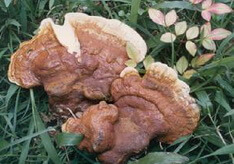
Botanical Description:Ganoderma ahmadii Steyaert is a fungus in the family Ganodermataceae (or Polyporaceae) and genus Ganoderma. It is commonly known as Quasi-tropical Ganoderma or Nire Dai Lingzhi. The basidiocarp (fruiting body) is annual, petiolate, and suberose or lignified. The pileus (cap) is orbicular or nearly fan-shaped, measuring 4.6–8 × 4–6.5 cm, with a thickness of 3–7 mm. Its color ranges from fusco-testaceous (dark reddish-brown) to puce (purple-brown) or dirty purple-brown; the center is slightly concave or nearly funnelform (funnel-shaped); the surface is rugulose, dull or weakly lustrous. The margin is entire, whitish to fawn (flavotestaceous), 3–5 mm wide, intact, and the undersurface is sterile. The context is uniformly pale brown or dark brown, 2–3 mm thick. The tubes are very short—no more than 1 mm long; the pore surface is whitish or dirty white; the pores are slightly rounded, 5–6 per mm.
The stipe (stalk) arises near the center or is lateral, subcylindrical (nearly cylindrical) or slightly rounded, 4–10.5 cm long and 1–1.5 cm in diameter, solitary or fused at the base, with a strong lacquer-like luster.
The hymenium (sporiferous layer) is irregular in structure, hazel (pale brown) to brown; the composite hyphae are clavate and irregularly arranged; the enlarged apical portion is typically 5–7 μm wide and 25–30 μm long.
The mycelial system is trimitic: generative hyphae are colorless and transparent, thin-walled, 2.5–6 μm in diameter; skeletal hyphae are slightly brownish to hazel (pale brown), pachypleurous (thick-walled) to farctate, with dendritic branching; skeletal hyphae are 3–5 μm in dry diameter; flagelliform, colorless binding hyphae arise at the tips of branches; binding hyphae are colorless, pachypleurous (thick-walled), and 1–2 μm in diameter.
The basidiospores are elliptic, broadly elliptic, or ovoid (egg-shaped), double-walled; the outer wall is colorless and transparent and smooth; the inner wall is pale brown and bears spinules; dimensions: 7.5–10 × 5–6.3 μm.
Ecological Environment:Ganoderma ahmadii Steyaert grows on subterranean rotten wood in broad-leaved forests. This species is mainly distributed in China and also occurs in South Asia.
References:
1. Introduction of Ling Zhi: Ganoderma lucidum, Fairy Grass.
2. Lingzhi mushroom:Other Identified Common Species:Ganoderma ahmadii.

 ✵The article records other identified common species of the Lingzhi mushroom—(14) Ganoderma ahmadii—including its English name, Latin name, Pinyin name, properties and flavor, and provides a detailed introduction to the botanical features, growth characteristics, and ecological environment of these species; the morphological features of the fungi; their pharmacological actions, medicinal efficacy, and administration guidelines.
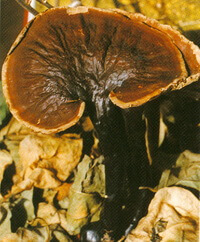 Botanical Description: Ganoderma ahmadii Steyaert is a fungus in the family Ganodermataceae (or Polyporaceae) and genus Ganoderma. It is commonly known as Quasi-tropical Ganoderma or Nire Dai Lingzhi. The basidiocarp (fruiting body) is annual, petiolate, and suberose or lignified. The pileus (cap) is orbicular or nearly fan-shaped, measuring 4.6–8 × 4–6.5 cm, with a thickness of 3–7 mm. Its color ranges from fusco-testaceous (dark reddish-brown) to puce (purple-brown) or dirty purple-brown; the center is slightly concave or nearly funnelform (funnel-shaped); the surface is rugulose, dull or weakly lustrous. The margin is entire, whitish to fawn (flavotestaceous), 3–5 mm wide, intact, and the undersurface is sterile. The context is uniformly pale brown or dark brown, 2–3 mm thick. The tubes are very short—no more than 1 mm long; the pore surface is whitish or dirty white; the pores are slightly rounded, 5–6 per mm.
 The basidiospores are elliptic, broadly elliptic, or ovoid (egg-shaped), double-walled; the outer wall is colorless and transparent and smooth; the inner wall is pale brown and bears spinules; dimensions: 7.5–10 × 5–6.3 μm.
