Lingzhi mushroom: Other Identified Common Species: (12) Ganoderma resinaceum.
✵The article records other identified common species of the Lingzhi mushroom—(12) Ganoderma resinaceum—including its English name, Latin name, pinyin name, properties and flavor, and provides a detailed introduction to the botanical features, growth characteristics, and ecological environment of these species; their morphological features; pharmacological actions; medicinal efficacy; and administration guidelines.
Other Identified Common Species of the Lingzhi Mushroom: (12) Ganoderma resinaceum.
Botanical Description:Ganoderma resinaceum Boud. is a fungus in the family Ganodermataceae (or Polyporaceae) and genus Ganoderma. It is commonly known as Stalkless Ganoderma, Sessile Ganoderma, or Wu Bing Lingzhi. The basidiocarp (fruiting body) is annual, sessile, and suberose or lignified. The pileus (cap) is semicircular or nearly fan-shaped and imbricate. The smallest pileus measures 9 × 10 cm; the largest reaches up to 26 × 35 cm, with a thickness at the base of up to 9 cm. The surface is russet (reddish-brown) to blackish-brown; occasionally, it exhibits an annulus of alternating olive-brown (earthy brown) and khaki bands, and displays a lacquer-like luster with a deep base color; the margin is thin and pale.
The upper layer of the context is light wood-colored; the portion adjacent to the tubes is brown to cinnamomeous (tawny), 0.5–0.8 cm thick, and annulate (bearing concentric ring zones). The tubes are 0.5–0.8 cm long and hazel (pale brown) to brown; the pore surface is hazel to brown; the pores are circular, 4–5 per mm, with thickened walls. The fruiting body is sessile or bears a short, stout stipe (~4.5 cm long and ~6 cm thick), glossy and blackish-brown.
The hymenial structure is of the sporiferous layer type, ranging from hazel (pale brown) to brown. The composite hyphae are clavate, with the enlarged apical portion typically 6–7.5 μm wide and 20–25 μm long.
The mycelial system is trimitic: generative hyphae are hyaline and leptodermous (thin-walled), 3–4.5 μm in diameter; skeletal hyphae are hazel to brown, pachypleurous (thick-walled) to farctate, with dendritic or acicular branching, 3–5 μm in dry diameter; flagelliform, colorless, binding hyphae—pachypleurous and 1–2 μm in diameter—are formed at branch tips.
The basidiospores are oval (egg-shaped) or elliptic, mostly truncate at the apex, double-walled: the outer wall is colorless, transparent, and smooth; the inner wall bears spinules, is hazel (pale brown), and occasionally contains oil droplets, measuring 7.3–11.8 × 5–8 μm.
Ecological Environment:Ganoderma resinaceum Boud. grows in mountainous and forested areas, in wild habitats, and on decaying hardwood logs and stumps. This species is primarily distributed in China and is also widely reported from Argentina, Cuba, Denmark, France, Germany, Honduras, Jamaica, Poland, the United States, the United Kingdom, Uruguay, Venezuela, and elsewhere.
Pharmacognosy and Traditional Uses: This species is sweet or tasteless, slightly bitter, neutral in nature, and non-toxic. Its principal actions include tonifying the lungs and kidneys, harmonizing the stomach and strengthening the spleen, calming the mind and enhancing mental resolve, reinforcing the zheng-qi (antipathogenic qi) and consolidating the yuan-qi (primordial qi), boosting immune function, inhibiting tumor growth, alleviating gastrointestinal, hepatic, renal, and chronic bronchial disorders, nourishing essence, reducing inflammation, exerting sedative and antibacterial effects, promoting detoxification and diuresis, and purifying the blood. It serves as a natural immunomodulator with a long history of use in traditional medicine.
References:
1. Introduction of Ling Zhi: Ganoderma lucidum, Fairy Grass.
2. Lingzhi mushroom:Other Identified Common Species:Ganoderma resinaceum.

 ✵The article records other identified common species of the Lingzhi mushroom—(12) Ganoderma resinaceum—including its English name, Latin name, pinyin name, properties and flavor, and provides a detailed introduction to the botanical features, growth characteristics, and ecological environment of these species; their morphological features; pharmacological actions; medicinal efficacy; and administration guidelines.
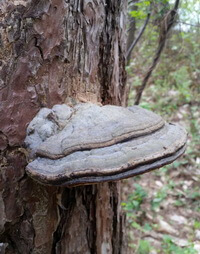 Botanical Description: Ganoderma resinaceum Boud. is a fungus in the family Ganodermataceae (or Polyporaceae) and genus Ganoderma. It is commonly known as Stalkless Ganoderma, Sessile Ganoderma, or Wu Bing Lingzhi. The basidiocarp (fruiting body) is annual, sessile, and suberose or lignified. The pileus (cap) is semicircular or nearly fan-shaped and imbricate. The smallest pileus measures 9 × 10 cm; the largest reaches up to 26 × 35 cm, with a thickness at the base of up to 9 cm. The surface is russet (reddish-brown) to blackish-brown; occasionally, it exhibits an annulus of alternating olive-brown (earthy brown) and khaki bands, and displays a lacquer-like luster with a deep base color; the margin is thin and pale.
