Lingzhi mushroom: Other Cultivated Species — (3) Ganoderma tsugae
✵The article documents other cultivated species of Lingzhi mushroom, including (3) Ganoderma tsugae, along with their English names, Latin names, Pinyin names, properties and flavors. It also provides a detailed introduction to the botanical features, growth characteristics, and ecological environments of these cultivated fungal species; their morphological characteristics; pharmacological actions; medicinal efficacies; and administration guidelines.
Approximately 250 species belong to the genus Ganoderma worldwide. In China, about 98–100 Ganoderma species have been documented within the family Ganodermataceae. They are distributed across southern to northern regions of the country.
Botanical description:Ganoderma tsugae Murr. is a fungus of the family Ganodermataceae (or Polyporaceae) and genus Ganoderma. It is commonly known as Hemlock Reishi, Mù Língzhī, Sōng Zhī, Sōng Shān Língzhī, or Pine Reishi (Sōng Zhī meaning “Pine Lingzhi Mushroom”).
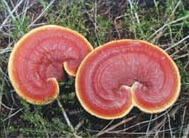
The fruiting body (basidiocarp) is annual and petiolate. When fresh, it is soft and suberose; upon drying, it becomes firm and corky, with a marked reduction in weight. The pileus (cap) is reniform, semicircular, or nearly fan-shaped, 3–25 cm in diameter and 0.8–3 cm thick (up to 4 cm). The surface is russet (reddish-brown) or stained russet, with a lacquer-like luster; annular zones are absent or inconspicuous. The context is white or pale whitish; the region adjacent to the hymenophore is often hazel (pale brown). The tubes are 0.5–1.5 cm long, fawn (flavotestaceous) or darker; the pore surface is whitish initially, gradually darkening to match the tube color. Pores are slightly rounded, 4–5 per mm. The stipe is typically thick and short—usually 4–5 cm long and 2–3 cm in diameter—with an atropurpureus (purple-black) surface and strong luster.
The hymenium exhibits a sporiferous-layer structure. Generative hyphae are colorless, transparent, leptodermous (thin-walled), and 3–5 μm in diameter. Skeletal hyphae are hazel (pale brown), pachydermous (thick-walled) to farctate, with dendritic branching; the skeletal portion measures 4–7 μm in dry diameter. Flagelliform, colorless binding hyphae arise at branch tips; binding hyphae are pachydermous and ramified, 1.5–2 μm in diameter.
Basidiospores are elliptic, occasionally truncate at the apex; they are double-walled—the outer wall is colorless, transparent, and smooth; the inner wall is hazel (pale brown) and echinulate (bearing spinules)—measuring 7.5–11 × 6–7 μm.
Ecological Environment:Ganoderma tsugae Murr. grows primarily at elevations of 700–1,400 m above sea level in mixed forests of red pine and broad-leaved trees, as well as in coniferous mixed forests containing fir, larch, red pine, and spruce—especially on cut stumps, decaying wood, and larch stumps. It is an extremely rare and valuable medicinal fungus, predominantly distributed in cold-temperate regions of China.
Characteristics of the Herb: The fruiting body is medium to large and corky. The pileus diameter ranges from 6.5–21 cm; shape is semicircular, flattened, or reniform. The surface is red, dark red, or brown-red, with a bright, lacquer-like cuticle lacking distinct concentric rings—or with only faint ones. With age, it develops no prominent bands but irregular wrinkles; margins are ribbed and blunt. The context is woody in color and 0.5–1.5 cm thick. The pore surface (hymenophore) appears dirty white initially, gradually turning tawny (cinnamomeous) or light brown; pores number 4–5 per mm. The stipe is 3–6 cm long and 3–4 cm in diameter—short, thick, same-colored as the pileus, glossy, pleurogenous or oblique. Basidiospores are echinulate, brown, sometimes truncate at one end; the exospore is colorless, transparent, and ovoid.
This species exhibits immunomodulatory, antitumor, hepatoprotective, cardiovascular-protective, neurosoothing, digestive-regulatory, lung-moistening, antiasthmatic, anti-aging, and cosmeceutical effects.
Modern studies indicate that Ganoderma tsugae (Pine Reishi) is nutritionally rich, containing essential amino acids, nucleosides, trace elements, vitamins, bioactive polysaccharides, triterpenoids, alkaloids, and dietary fiber beneficial for health maintenance. It demonstrates therapeutic potential in hepatitis, arthritis, diabetes, hypertension, hyperlipidemia, and neurasthenia—and shows significant efficacy against the three leading causes of human mortality: coronary heart disease, cancer, and stroke.
The polysaccharides consist primarily of monosaccharide polymers—including bioactive β-D-glucans—with physiological activities such as antitumor, immunoenhancing, antiviral, free-radical-scavenging, anti-aging, antithrombotic, and anticoagulant effects.
The triterpenoids are another class of bioactive constituents isolated from Ganoderma. Experiments have confirmed that Ganoderma triterpenoids rapidly enhance immune function—evidenced by promoting lymphocyte proliferation, increasing the phagocytic activity of macrophages, natural killer (NK) cells, and T lymphocytes, and directly or indirectly inducing tumor cell death. Triterpenoids also exhibit hepatoprotective, antioxidant, antibacterial, anti-inflammatory, anti-HIV, and anti-herpes virus activities; inhibit hepatic tumor cell growth; and constitute a principal active component underlying its detoxification effects.
Alkaloids improve coronary blood flow, reduce myocardial oxygen consumption, enhance myocardial tolerance to hypoxia, and lower serum cholesterol levels—demonstrating significant therapeutic potential in coronary heart disease, hypertension, hyperlipidemia, hepatitis, and muscular weakness.
Nucleosides are indispensable building blocks of DNA and RNA, playing essential roles in genetic inheritance and cellular information transfer. Adenosine, uridine, adenine, uracil, and other bioactive nucleosides constitute the primary molecular basis for Ganoderma’s antimutagenic activity.
Amino acids are the fundamental units of proteins and vital nutritional components for organisms. Essential amino acids—those not synthesized endogenously and thus requiring dietary intake—are abundantly present in Ganoderma tsugae (Pine Reishi) fruiting bodies, which contain 18 amino acids, including all nine human essentials. Notably, methionine content in G. tsugae is significantly higher than in most edible fungi, where methionine levels are typically low.
Studies show that the G. tsugae fruiting body contains trace elements including Mn, Cr, Cu, Fe, Ca, Mg, Zn, Se, and Ge. Selenium, germanium, zinc, iron, calcium, and magnesium occur at comparatively high concentrations. Boron has also been reported, confirming G. tsugae as a rich natural reservoir of trace elements. These elements act synergistically with other bioactive compounds: organic germanium exhibits antitumor properties, and its synergy with G. tsugae polysaccharides markedly potentiates their antitumor efficacy.
G. tsugae is also rich in vitamins—including vitamin C and vitamin E—and contains high levels of carotenoids, conferring potent antioxidant and anti-aging activities.
References:
1. Introduction of Ling Zhi: Ganoderma lucidum, Fairy Grass.
2. Lingzhi mushroom: Other Cultivated Species — Ganoderma tsugae.

 ✵The article documents other cultivated species of Lingzhi mushroom, including (3) Ganoderma tsugae, along with their English names, Latin names, Pinyin names, properties and flavors. It also provides a detailed introduction to the botanical features, growth characteristics, and ecological environments of these cultivated fungal species; their morphological characteristics; pharmacological actions; medicinal efficacies; and administration guidelines.
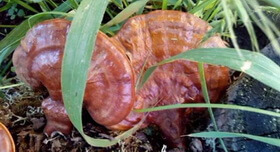 Botanical description: Ganoderma tsugae Murr. is a fungus of the family Ganodermataceae (or Polyporaceae) and genus Ganoderma. It is commonly known as Hemlock Reishi, Mù Língzhī, Sōng Zhī, Sōng Shān Língzhī, or Pine Reishi (Sōng Zhī meaning “Pine Lingzhi Mushroom”).
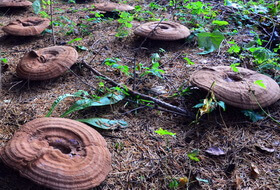 Ecological Environment: Ganoderma tsugae Murr. grows primarily at elevations of 700–1,400 m above sea level in mixed forests of red pine and broad-leaved trees, as well as in coniferous mixed forests containing fir, larch, red pine, and spruce—especially on cut stumps, decaying wood, and larch stumps. It is an extremely rare and valuable medicinal fungus, predominantly distributed in cold-temperate regions of China.
 The polysaccharides consist primarily of monosaccharide polymers—including bioactive β-D-glucans—with physiological activities such as antitumor, immunoenhancing, antiviral, free-radical-scavenging, anti-aging, antithrombotic, and anticoagulant effects.
