Lingzhi mushroom: Other Cultivated Species (7) Ganoderma atrum
✵The article documents additional cultivated Lingzhi mushroom species, specifically (7) Ganoderma atrum J. D. Zhao. It also covers two related species historically associated with the name “Black Lingzhi”: ① Amauroderma ruda (Berk.) Pat. and ② Amauroderma rogosum (Blume et Nees) Bres. For each, it provides the English name, Latin name, Pinyin name, properties and flavor, and a detailed introduction to botanical features, growth characteristics, ecological environment, macroscopic and microscopic morphology, pharmacological actions, medicinal efficacy, and administration guidelines.
Lingzhi mushroom: Other Cultivated Species:(7) Ganoderma atrum.
Approximately 250 species belong to the genus Ganoderma worldwide. In China, about 98–100 Ganoderma species have been documented within the family Ganodermataceae. They are distributed across southern to northern regions of the country.
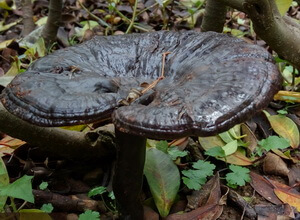
Pinyin Name: Hēi Zhī or Hēi Líng Zhī
English Name: Black Ganoderma
Latin Name:Ganoderma atrum Properties and Flavor: Neutral; taste mild or bland
Botanical Description:Ganoderma atrum J. D. Zhao is a fungus in the family Ganodermataceae (formerly Polyporaceae), genus Ganoderma. It is commonly known as Black Ganoderma or Hēi Líng Zhī (“Black Lingzhi”). Traditional herbal classics refer to the fruiting bodies of two distinct species under this designation: ① Amauroderma ruda (Berk.) Pat., also known as Zhōu Gài Wū Zhī, and ② Amauroderma rogosum (Blume et Nees) Bres., also known as Wū Zhī (“Wū” meaning black). These two species are described below.
①.Amauroderma ruda (Berk.) Pat.: Also known as Zhōu Gài Wū Zhī. The basidiocarp (fruiting body) is annual and petiolate. The pileus (cap) is rounded to orbicular (subrotund), sometimes irregularly shaped, 3–13 cm wide. The pileus surface has an inconspicuous cuticle, color ranging from hazel (pale brown) to dark brown (blackish-brown) or black; it is tomentulose (finely pubescent), with radial wrinkles. The margin is even or undulate. The pore surface is white when fresh but turns reddish or prunus (violet-red) upon injury, then blackens. Pores are angular (corniform), 4–6 per mm. The tubes are single-layered, short, and dark. The stipe is mesic, slanting laterally to nearly pleurogenous, often tortuous (contorted), taupe (grayish-brown) to pullous (nearly black), measuring (3.5–8) cm × (0.5–1) cm. The context is yellowish-white, turning reddish-violet upon injury and subsequently blackening.
The mycelial system is trimitic: generative hyphae are hyaline and possess clamp connections.
Spores are broadly ellipsoid to subspherical, bilayered; the outer wall is smooth and colorless; the inner wall is slightly rough or verruculose, hazel (pale brown), measuring (8–10) × (6–7) μm.
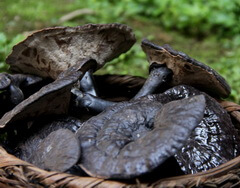
②.Amauroderma rogosum (Blume et Nees) Bres.:Also known as Polyporus rugosus Blume et Nees or Wū Zhī. The pileus is reniform, occasionally rounded, with lateral stipes; texture is hard and suberose, oblate, tomentulose (finely pubescent) or smooth, color ranging from dark greenish-brown or maroon (dark grayish-brown) to dark gray or grayish-black; surface bears concentric annuli and inconspicuous radial wrinkles; width is 2–15 cm, thickness is 5–10 mm. The margin is sharp or truncate, undulate. The context is pale-colored, 1.5–6 mm thick. Tube length is 2–6 mm, darker than the context; pore surface is nearly white, turning sanguine upon injury; pores are circular (rounded), averaging 6 per mm. The stipe is cylindrical, often curved, same color as the pileus, tomentulose or smooth, 5–40 cm long and 2–14 mm in diameter; rhizoids (pseudorhizae) present—sometimes bifurcated. Spores are torulose (subspherical), pale yellow, measuring (8.5–11) × (8–9) μm.
Ecological Environment:Ganoderma atrum J. D. Zhao grows in forests and mountainous regions. It is primarily distributed in China. Pharmacologically, it enhances immunity, inhibits tumor growth, supports hepatic detoxification, improves cardiovascular function, and exhibits anti-aging effects.
Growth Characteristics: ① Amauroderma ruda (Berk.) Pat. grows on the ground or on buried wood in forest habitats. ② Amauroderma rogosum (Blume et Nees) Bres. grows on soil, attached to decaying wood.
Characteristics of The Herb: ① Amauroderma ruda (Berk.) Pat. (Zhōu Gài Wū Zhī): The pileus is reniform or quasi-circular, 3–10 cm in diameter and 5–7 mm thick. Surface color is taupe (grayish-brown) or brown, tomentulose, with deep radial wrinkles and faint concentric rings. Margin is sharp, undulate, and often valvular-dehiscent. Pore surface is white, black, or dark brown. In longitudinal section, a single layer of tubes is visible. The stipe is laterally inclined, cylindrical, curved, 4–12 cm long and 3–10 mm in diameter; rhizoids (pseudorhizae) arise at the base; stipe color matches the pileus and is tomentulose. Texture is suberose. Odor is mild; taste is bland.
② Amauroderma rogosum (Blume et Nees) Bres.: Also known as Wū Zhī. The pileus (cap) measures 2–15 cm in diameter and 5–10 mm in thickness. The surface is bluish-brown, maroon (dark grayish-brown), or grayish-black; it is tomentulose or smooth, with concentric annuli and inconspicuous radial wrinkles. The pore surface is dark brown. The stipe is smooth and bears rhizoids (pseudorhizae). Texture is hard and suberose. Odor is mild; taste is bland.
Medicinal Efficacy: Tonifies the kidney, promotes diuresis, and resolves Qi stagnation or food retention. It is indicated for acute nephritis, chronic nephritis, and dyspepsia (indigestion).
Administration of Black Ganoderma (Hēi Líng Zhī):
Reference:
Administration Guide for Black Ganoderma (Hēi Líng Zhī
TCM Books:
Internally: water decoction, 10–15 grams.
References:
1. Introduction of Ling Zhi: Ganoderma lucidum, Fairy Grass.
2.Lingzhi mushroom: Other Cultivated Species (7) Ganoderma atrum.

 ✵The article documents additional cultivated Lingzhi mushroom species, specifically (7) Ganoderma atrum J. D. Zhao. It also covers two related species historically associated with the name “Black Lingzhi”: ① Amauroderma ruda (Berk.) Pat. and ② Amauroderma rogosum (Blume et Nees) Bres. For each, it provides the English name, Latin name, Pinyin name, properties and flavor, and a detailed introduction to botanical features, growth characteristics, ecological environment, macroscopic and microscopic morphology, pharmacological actions, medicinal efficacy, and administration guidelines.
 Pinyin Name: Hēi Zhī or Hēi Líng Zhī
 Ecological Environment: Ganoderma atrum J. D. Zhao grows in forests and mountainous regions. It is primarily distributed in China. Pharmacologically, it enhances immunity, inhibits tumor growth, supports hepatic detoxification, improves cardiovascular function, and exhibits anti-aging effects.
