Lingzhi mushroom: Other Cultivated Species — (4) Ganoderma hainanense
✵The article documents other cultivated species of Lingzhi mushroom, including (4) Ganoderma hainanense, along with their English names, Latin names, Pinyin names, properties and flavors. It also provides a detailed introduction to the botanical features, growth characteristics, and ecological environments of these cultivated fungal species; their morphological characteristics; pharmacological actions; medicinal efficacies; and administration guidelines.
Approximately 250 species belong to the genus Ganoderma worldwide. In China, about 98–100 Ganoderma species have been documented within the family Ganodermataceae. They are distributed across southern to northern regions of the country.
Botanical description:Ganoderma hainanense Zhao, Xu et Zhang is a fungus in the family Ganodermataceae (formerly placed in Polyporaceae) and genus Ganoderma. It is commonly known as Hainan Ganoderma or Hainan Lingzhi. The fruiting body (basidiocarp) is annual or perennial, stipitate, and suberose. The pileus (cap) is semicircular, orbicular, or subreniform; flat or nearly horseshoe-shaped; measuring 1.5–5.5 × 1.5–4.5 cm, with a thickness of 1–2.2 cm. Its surface is reddish-brown to dark brown or purple to purplish-brown, with a lacquer-like luster, conspicuous concentric ring grooves, and inconspicuous radial wrinkles. The margin is blunt or truncate and intact. Context stratification is indistinct: the upper layer is woody-colored, brown, or light brown; the portion near the tubes is brown; thickness is 0.1–0.2 cm. The tubes are 0.3–2 cm long, with indistinct stratification and brown coloration. The tube pores are effuse, light brown to brown, circular or rounded, 4–6 per mm. The stipe is dorsifixed or dorso-lateral, cylindrical, variably thickened—sometimes beaded—with a length of 4–15 cm and thickness of 0.3–1 cm; it is the same color as the pileus or darker.
The hymenium is a sporiferous layer type, hazel (pale brown) to brown in color. The generative hyphae are clavate; the apically enlarged portion measures 4.5–7 μm in width and 20–30 μm in length; occasionally, these hyphae are shorter.
The hyphal system is trimitic: generative hyphae are hyaline, thin-walled, and septate, 3–4.5 μm in diameter; skeletal hyphae are hazel (pale brown), thick-walled (pachydermous), dendritically branched, with a dry diameter of 2.5–4.5 μm; flagelliform, colorless binding hyphae arise at the tips of branches; binding hyphae are colorless, thick-walled, and ramified, 1.5–2 μm in diameter.
The basidiospores are ellipsoid or slightly truncate at the apex, double-walled: the outer wall is colorless, transparent, and smooth; the inner wall is hazel (pale brown) to brown, with conspicuous echinulations (spines); dimensions: 8.7–11 × 5.2–6.9 μm.
Ecological Environment:Ganoderma hainanense Zhao, Xu et Zhang grows on the bases of larch trunks.
References:
1. Introduction of Ling Zhi: Ganoderma lucidum, Fairy Grass.
2. Lingzhi mushroom: Other Cultivated Species — (4) Ganoderma hainanense

 ✵The article documents other cultivated species of Lingzhi mushroom, including (4) Ganoderma hainanense, along with their English names, Latin names, Pinyin names, properties and flavors. It also provides a detailed introduction to the botanical features, growth characteristics, and ecological environments of these cultivated fungal species; their morphological characteristics; pharmacological actions; medicinal efficacies; and administration guidelines.
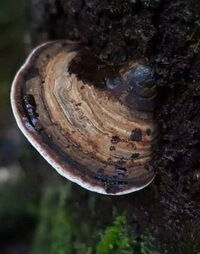 Botanical description: Ganoderma hainanense Zhao, Xu et Zhang is a fungus in the family Ganodermataceae (formerly placed in Polyporaceae) and genus Ganoderma. It is commonly known as Hainan Ganoderma or Hainan Lingzhi. The fruiting body (basidiocarp) is annual or perennial, stipitate, and suberose. The pileus (cap) is semicircular, orbicular, or subreniform; flat or nearly horseshoe-shaped; measuring 1.5–5.5 × 1.5–4.5 cm, with a thickness of 1–2.2 cm. Its surface is reddish-brown to dark brown or purple to purplish-brown, with a lacquer-like luster, conspicuous concentric ring grooves, and inconspicuous radial wrinkles. The margin is blunt or truncate and intact. Context stratification is indistinct: the upper layer is woody-colored, brown, or light brown; the portion near the tubes is brown; thickness is 0.1–0.2 cm. The tubes are 0.3–2 cm long, with indistinct stratification and brown coloration. The tube pores are effuse, light brown to brown, circular or rounded, 4–6 per mm. The stipe is dorsifixed or dorso-lateral, cylindrical, variably thickened—sometimes beaded—with a length of 4–15 cm and thickness of 0.3–1 cm; it is the same color as the pileus or darker.
