Lingzhi Mushroom: Other Cultivated Species (8) Ganoderma shandongense
✵The article documents another cultivated Lingzhi mushroom species: (8) Ganoderma shandongense J. D. Zhao et L. W. Hsu. It provides its English name, Latin name, Pinyin name, properties and flavor, and a detailed introduction to its botanical features, growth characteristics, ecological environment, macroscopic and microscopic morphology, pharmacological actions, medicinal efficacy, and administration guidelines.
Lingzhi Mushroom: Other Cultivated Species (8) Ganoderma shandongense
Approximately 250 species belong to the genus Ganoderma worldwide. In China, about 98–100 Ganoderma species have been documented within the family Ganodermataceae. They are distributed across southern to northern regions of the country.
Botanical Description:Ganoderma shandongense J. D. Zhao et L. W. Hsu is a fungus in the family Ganodermataceae (formerly Polyporaceae), genus Ganoderma. It is commonly known as Shāndōng Ganoderma (“Mountain East Ganoderma”). The basidiocarp (fruiting body) is annual or perennial, petiolate, and suberose or ligneous. The pileus is horseshoe-shaped (U-shaped), with numerous concentric annular zones. The upper surface is pale reddish-brown or fawn (flavotestaceous), exhibiting a lacquer-like luster; dimensions are approximately 2.5 × 1.8 cm, with a thickness of ~2.5 cm. The margin is entire and slightly involute (rolled inward). The context is pale white (whitish). Tubes are hazel (pale brown), ~3 cm long; the pore surface is whitish or slightly pale yellowish-white; pores are orbicular and entire, 4–5 per mm, slightly decurrent. The stipe is pale reddish-brown, dorsiferous, slightly curved, 0.7–1 cm in diameter and up to 10 cm long; part of it is flattened, same in color as the pileus, and sometimes exhibits a strong lacquer-like luster.
The hymenium is an irregular sporiferous layer, nearly colorless to hazel (pale brown). Generative hyphae are clavate, with apically enlarged or irregularly swollen tips—sometimes shallowly lobed—typically 4.5–7.5 μm wide and 20–25 μm long (length uneven).
The mycelial system is trimitic: generative hyphae are hyaline, leptodermous (thin-walled), 3.5–5 μm in diameter; skeletal hyphae are hazel (pale brown) to slightly brownish, pachydermous (thick-walled) to farctate, with arboriform (dendritic) branching; the skeletal portion measures 3.5–4 μm in dry diameter; flagelliform, colorless binding hyphae arise at branch tips; binding hyphae are colorless, pachydermous (thick-walled), with nearly orthogonal branching, 1.5–2 μm in diameter.
Basidiospores are elongate-ovoid, sometimes slightly truncate at the apex, hazel (pale brown) to brown, bilayered; the outer wall is colorless, transparent, and smooth; the inner wall is pigmented and bears distinct spinules; dimensions: 12–13.5(–15) × 6.5–9 μm.
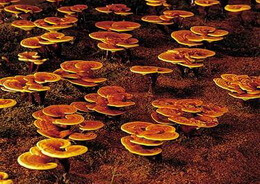
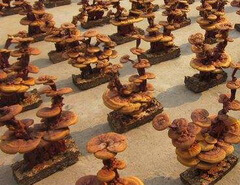
Ecological Environment:Ganoderma shandongense J. D. Zhao et L. W. Hsu grows in forests and mountainous regions. It is primarily distributed in China. Pharmacologically, it enhances immunity and calms the mind. It is also used in ornamental potted landscapes.
References:
1. Introduction of Ling Zhi: Ganoderma lucidum, Fairy Grass.
2. Lingzhi Mushroom: Other Cultivated Species (8) Ganoderma shandongense

 ✵The article documents another cultivated Lingzhi mushroom species: (8) Ganoderma shandongense J. D. Zhao et L. W. Hsu. It provides its English name, Latin name, Pinyin name, properties and flavor, and a detailed introduction to its botanical features, growth characteristics, ecological environment, macroscopic and microscopic morphology, pharmacological actions, medicinal efficacy, and administration guidelines.
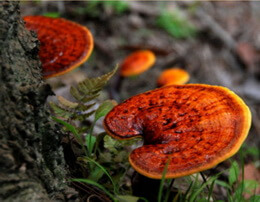 Botanical Description: Ganoderma shandongense J. D. Zhao et L. W. Hsu is a fungus in the family Ganodermataceae (formerly Polyporaceae), genus Ganoderma. It is commonly known as Shāndōng Ganoderma (“Mountain East Ganoderma”). The basidiocarp (fruiting body) is annual or perennial, petiolate, and suberose or ligneous. The pileus is horseshoe-shaped (U-shaped), with numerous concentric annular zones. The upper surface is pale reddish-brown or fawn (flavotestaceous), exhibiting a lacquer-like luster; dimensions are approximately 2.5 × 1.8 cm, with a thickness of ~2.5 cm. The margin is entire and slightly involute (rolled inward). The context is pale white (whitish). Tubes are hazel (pale brown), ~3 cm long; the pore surface is whitish or slightly pale yellowish-white; pores are orbicular and entire, 4–5 per mm, slightly decurrent. The stipe is pale reddish-brown, dorsiferous, slightly curved, 0.7–1 cm in diameter and up to 10 cm long; part of it is flattened, same in color as the pileus, and sometimes exhibits a strong lacquer-like luster.
 The hymenium is an irregular sporiferous layer, nearly colorless to hazel (pale brown). Generative hyphae are clavate, with apically enlarged or irregularly swollen tips—sometimes shallowly lobed—typically 4.5–7.5 μm wide and 20–25 μm long (length uneven).
 Basidiospores are elongate-ovoid, sometimes slightly truncate at the apex, hazel (pale brown) to brown, bilayered; the outer wall is colorless, transparent, and smooth; the inner wall is pigmented and bears distinct spinules; dimensions: 12–13.5(–15) × 6.5–9 μm.
