Lingzhi Mushroom: Other Cultivated Species — (6) Ganoderma tenue
✵The article documents other cultivated species of Lingzhi mushroom, including (6) Ganoderma tenue, along with their English names, Latin names, Pinyin names, properties and flavors. It also provides a detailed introduction to the botanical features, growth characteristics, and ecological environments of these cultivated fungal species; their morphological characteristics; pharmacological actions; medicinal efficacies; and administration guidelines.
Lingzhi Mushroom: Other Cultivated Species — (6) Ganoderma tenue
Approximately 250 species belong to the genus Ganoderma worldwide. In China, about 98–100 Ganoderma species have been documented within the family Ganodermataceae. They are distributed across southern to northern regions of the country.
Pinyin Name: Mìwén Báozhī
English Name: Dense-Thin Ganoderma
Latin Name: Ganoderma tenue
Property and Flavor: Warm in nature; slightly bitter in taste.
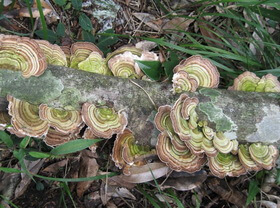
Botanical Description:Ganoderma tenue is a fungus in the family Ganodermataceae (formerly placed in Polyporaceae) and genus Ganoderma. It is commonly known as Dense Thin Ganoderma or Mi Wen Bo Zhi. The basidiocarp (fruiting body) is annual, petiolate or sessile, and suberose. The pileus (cap) is semicircular or nearly fan-shaped; bases are often confluent, measuring 5.5–7.5 × 3.5–6 cm, with a diameter of 3.5–7.5 cm and thickness of 2–4 mm. The surface is puce (purplish-brown) to nearly dark brown (blackish-brown); the region near the margin is lighter in color—russet (reddish-brown)—and exhibits a lacquer-like luster and distinctive concentric markings, which are denser near the margin. Vertical wrinkles at the base are conspicuous. The margin is thin and sharp, mostly involute (rolled inward), and sometimes undulate (wavy). The context is whitish (pale white) to wood-colored, 1–2 mm thick, and contains numerous globose or subspherical gasterospores, 10–14 μm in diameter, with a coarse, rough surface and color ranging from hazel (pale brown) to brown. The tubes are 1–1.5 mm long and hazel (pale brown); the pore surface is dirty white to pale yellow; pores are round or suborbicular, 5–6 per mm. The stipe (prostheca) is cylindrical, of variable diameter or slightly flattened, sometimes torose (bead-like), pleurogenous or dorsiferous; the portion attached to the pileus is protuberant (raised), same in color as the pileus or darker, and likewise exhibits lacquer luster.
The hymenium is a sporiferous layer type, slightly brownish; the generative hyphae are clavate, with apically enlarged portions 4.5–9 μm wide and 20–25 μm long.
The mycelial system is trimitic: generative hyphae are hyaline, leptodermous (thin-walled), 3–5 μm in diameter; skeletal hyphae are hazel (pale brown), pachydermous (thick-walled) to farctate, with dendritic branching; the skeletal portion measures 4–6 μm in dry diameter; flagelliform, colorless binding hyphae arise at the tips of branches; binding hyphae are colorless, pachydermous (thick-walled), 1.5–2 μm in diameter.
Basidiospores are ellipsoid (ovoid), sometimes truncate at the apex, bilayered; the outer wall is colorless and transparent, smooth; the inner wall is hazel (pale brown) to brown, lacking spinules or bearing inconspicuous spinules, measuring 9–11 × 6–7.3 μm. Gasterospores are subspherical (torulose), hazel (pale brown), with a rough surface bearing irregular markings; numerous, measuring 12–13.5 × 10.5–12 μm.
Ecological Environment:Ganoderma tenue grows on stumps or is cultivated on woody substrates. This species is primarily distributed in China.
Characteristics of the Herb: The pileus (cap) is semicircular, 5.5–7.5 cm in maximum diameter, 3.5–6 cm in minimum diameter, and 2–4 mm thick. The surface is puce (purplish-brown) or light dark brown; the margin is slightly russet (reddish-brown). It exhibits a lacquer luster and conspicuous concentric lines, denser near the margin. The margin is thin, undulate, and involute. The pore surface is dirty white or pale yellow; pores are circular (rounded), 5–6 per mm. In vertical section, tubes are visible and approximately 1.5 mm long, hazel (pale brown). The stipe is cylindrical, variably thickened, often torose (torulose or bead-like), same in color as the pileus, and lustrous. Texture is suberose or ligneous. Odor is mild; taste is bland.
Medicinal Efficacy: Calms the mind and soothes the nerves (relieves mental and physical restlessness), detoxifies, and protects the liver. This species functions to tranquilize the nervous system and support hepatic detoxification. It is indicated for neurasthenia (neurosis, asthenia), palpitations, insomnia (agrypnia, sleeplessness), acute hepatitis, and chronic hepatitis.
Administration of Ganoderma tenue (Mìwén Báozhī):
Reference:
Administration Guide for Ganoderma tenue (Mìwén Báozhī)
TCM Books:
Internally:water decoction, 3–9 grams; or as powdered herb, mixed with water or wine and taken orally.
References:
1. Introduction of Ling Zhi: Ganoderma lucidum, Fairy Grass.
2. Lingzhi Mushroom: Other Cultivated Species — (6) Ganoderma tenue

 ✵The article documents other cultivated species of Lingzhi mushroom, including (6) Ganoderma tenue, along with their English names, Latin names, Pinyin names, properties and flavors. It also provides a detailed introduction to the botanical features, growth characteristics, and ecological environments of these cultivated fungal species; their morphological characteristics; pharmacological actions; medicinal efficacies; and administration guidelines.
 Pinyin Name: Mìwén Báozhī
