Introduction of Ling Zhi: Ganoderma lucidum, Fairy Grass
✵The article records the herb Lucid Ganoderma—its English name, Latin name, Pinyin name, properties and flavor, and the botanical sources defined in herbal classics: two fungal species, (1) Ganoderma lucidum (Leyss. ex Fr.) Karst. and (2) Ganoderma sinense Zhao, Xu et Zhang; and another commonly used fungal species, (3) Ganoderma tsugae Murr. It provides a detailed introduction to the botanical features, growth characteristics, and ecological environments of these three fungal species; the macroscopic and microscopic features of the herb Lucid Ganoderma; its pharmacological actions, medicinal efficacy, and administration guidelines.
Ganoderma lucidum (Lucid Ganoderma)
Pinyin Name: Línɡ Zhī
English Name: Lucid Ganoderma or Fairy Grass
Latin Name:Ganoderma lucidum Properties and Flavor: Neutral in nature; mild or tasteless, or slightly warm and sweet
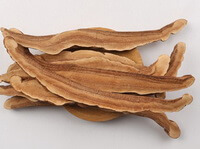
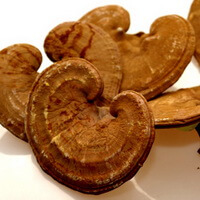
Brief Introduction: The herb Ganoderma lucidum is the dried fruiting body of the fungus Ganoderma lucidum (Leyss. ex Fr.) Karst. It is used (1) as a tranquilizer to treat dizziness and insomnia, and (2) as a tonic to treat weakness or debility. It is commonly known as Ganoderma lucidum, Lucid Ganoderma, Reishi, Fairy Grass, or Línɡ Zhī.
Botanical source: The Lingzhi (or Reishi) mushroom refers today to a species complex encompassing several fungal species primarily within the genus Ganoderma—and occasionally other genera. The most commonly venerated species in China, where it has been used as a medicinal mushroom in Traditional Chinese Medicine for over 2,000 years, is Ganoderma lucidum. This makes it one of the oldest documented medicinal mushrooms. In contemporary Chinese practice, fungi classified under the Lingzhi category belong to four genera: (1) Ganoderma Karst., (2) Amauroderma, (3) Haddowia, and (4) Humphreya.
The medicinal values of Ganoderma fungi are recorded in classical herbal texts. Among the Ganoderma genus, three species are officially recognized in authoritative herbal classics for therapeutic use: (1) Ganoderma lucidum, also known as Línɡ Zhī or Chì Zhī (“Red Lingzhi”); (2) Ganoderma sinense, also known as Zǐ Zhī (“Purple Lingzhi”); and (3) Ganoderma tsugae, also known as Sōng Zhī (“Pine Lingzhi”).
Herbal classics define the herb Ganoderma lucidum (Lingzhi) as the sporocarp (fruiting body) of fungal species belonging to the family Ganodermataceae (or Polyporaceae), specifically: (1) Ganoderma lucidum (Leyss. ex Fr.) Karst., and (2) Ganoderma sinense Zhao, Xu et Zhang.. These belong to the genus Ganoderma Karst., family Polyporaceae, order Polyporales. The third commonly used species, (3) Ganoderma tsugae, are introduced:
(1) Ganoderma lucidum (Leyss. ex Fr.) Karst.
Pinyin Name: Chì Zhī or Chì Línɡ Zhī
English Name: Red Ganoderma
Latin Name:Ganoderma lucidum Properties and Flavor: Neutral in nature; bitter in taste
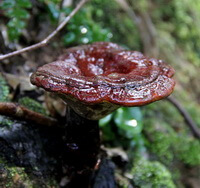
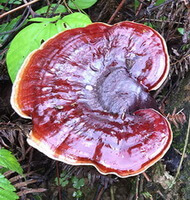
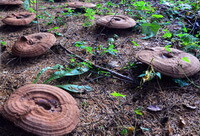
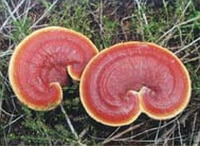
Botanical Description:Ganoderma lucidum (Leyss. ex Fr.) Karst. is a fungus in the family Ganodermataceae (or Polyporaceae) and genus Ganoderma. It is commonly known as Ganoderma lucidum, Red Ganoderma, or Chì Zhī (“Red Lingzhi Mushroom”). The basidiocarp (fruiting body) is annual, stipitate, and suberose. The pileus (cap) is semicircular or reniform, 10–20 cm in diameter; the context (flesh) of the pileus is 1.5–2 cm thick. The pileus surface is brownish-yellow or russet (reddish-brown); the margin gradually becomes pale yellow, bearing concentric ring patterns and slight wrinkles or smooth texture, with a lacquer-like gloss; the margin is slightly blunt. The context is creamy white, and the portion adjacent to the tubes is hazel (pale brown). The tubes are up to 1 cm long, with 4–5 pores per 1 mm. The pore openings are orbicular (subrotund), white when young, later becoming pale yellow or brown. The stipe (prostheca) is cylindrical, laterally attached (pleurogenous) or obliquely lateral, occasionally central (mesocentric); 10–19 cm long and 1.5–4 cm in diameter; its color resembles that of the pileus.
The hyphae of the cuticle are rod-shaped, with swollen apices. The hyphal system is trimitic: generative hyphae are hyaline and thin-walled; skeletal hyphae are tawny (yellowish-brown), thick-walled, and nearly farctate; binding hyphae are hyaline, thick-walled, curved, and highly branched.
The basidiospores are ellipsoid (egg-shaped), with truncate apices, double-walled; the outer wall is hyaline, the inner wall is hazel (pale brown), ornamented with minute spinules; dimensions: (9–11) μm × (6–7) μm. The basidiocarp (fruiting body) matures in autumn, or in winter in southern and southwestern China.
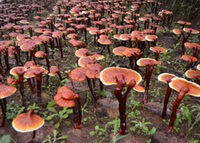
Ecological Environment:Ganoderma lucidum (Leyss. ex Fr.) Karst. grows on sun-exposed rhizospheres or dead stumps of trees in the Fagaceae family and the Pinus genus (Pinaceae family). This species is widely distributed across China.
Growth Characteristics:Ganoderma lucidum (Leyss. ex Fr.) Karst. is a saprophytic fungus; however, it can also parasitize living trees, rendering it a facultative parasite. Ganoderma lucidum is an aerobic organism; fruiting body (carpophore) development requires ample oxygen and diffused (scattered) sunlight.
Ganoderma lucidum is a macrofungus—a higher fungus within the fungal kingdom—and belongs to the polypore group. Its pileus is umbelliform (umbellate), semicircular, reniform, or suborbicular (subrotund), 10–18 cm wide and 1–2 cm thick. The outer cuticle is hard, dull yellowish-brown to dull reddish-brown, lustrous, marked with annular ridges and radial wrinkles; the margin is thin and truncate (as if squared off), often slightly involute. The hymenophore (underside of pileus) consists of numerous tubules (not gills), white to light brown in youth, aging to pale brown. The stipe is lateral; 7–15 cm long and 1–3.5 cm in diameter; dull reddish-brown to dull purplish-brown, lustrous. Spores within the tubes are dull yellowish-brown. The mushroom is slightly fragrant and has a bitter, astringent taste.
Lingzhi is a hard, polyporous, and mildly bitter mushroom. Polypores are conspicuous fungi that typically grow laterally from logs or tree trunks. The actual fungal organism—the mycelium—is a network of filamentous (threadlike) hyphae originating from spores. This mycelial network spreads throughout the nutrient substrate—such as decaying wood or soil—absorbing and accumulating nutrients as it grows. Mycelia inhabit soil, fallen logs, and other organic debris. As long as nutrients remain available, the mycelium is perennial and may persist for many years. At least once annually, fruiting bodies emerge from the mycelial network. As the reproductive structure of the fungus, mushrooms produce and disperse spores.
Unlike green plants—which synthesize many nutrients via photosynthesis—mushrooms obtain nutrients primarily from dead organic matter or soil. Mushrooms and their mycelium serve as nature’s original recyclers. Without them, Earth’s surface would accumulate vast quantities of undecomposed, decaying organic material.
Mushrooms emerge from the mycelium when sufficient nutrients have accumulated and environmental conditions are favorable. At maturity, mushrooms release spores, which are dispersed by wind; upon landing in a suitable habitat, the life cycle begins anew.
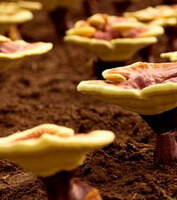
Polypores—commonly known as bracket or shelf fungi—are conspicuous macrofungi that typically grow laterally from logs or tree trunks. On a walk through the forest, one commonly observes numerous such bracket fungi.
What remains invisible to the naked eye, however, is the true fungal organism: the mycelium. Just as an apple is the fruit of an apple tree, a mushroom is the reproductive fruiting body of a mycelial network. The mycelium is a network of filamentous (threadlike) hyphae originating from spores. It spreads throughout the nutrient substrate, absorbing and accumulating nutrients as it grows. As long as environmental conditions remain favorable, the mycelium continues to grow and propagate until available nutrients are exhausted.
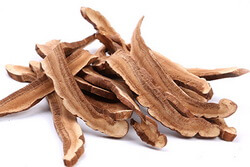
Characteristics of the Herb: The fruiting body (carpophore) is umbelliform (umbellate); the pileus (cap) is firm and hard, suberose, semicircular or reniform, 12–20 cm wide and approximately 2 cm thick. The cuticle is hard and rigid: yellow when young, gradually turning reddish-brown, with a lacquer-like gloss, marked by concentric ridges and radial wrinkles; the margin is thin and truncate—often slightly involute (rolled inward). The context (flesh) is nearly white to hazel (pale brown). The hymenophore (undersurface of the pileus) is white to light brown and composed of numerous fine tubular pores; these tubes contain basidia and basidiospores. The stipe (prostheca) is laterally attached (pleurogenous), 19 cm long and approximately 4 cm in diameter; its surface is russet (reddish-brown) to purplish-brown (puce), with a lacquer-like luster. The herb has a faint odor and a mild, slightly bitter taste.
(2) Ganoderma sinense Zhao, Xu et Zhang.
Pinyin Name: Zǐ Zhī or Zǐ Líng Zhī.
English Name: Purple Ganoderma.
Latin Name:Ganoderma sinense Zhao, Xu et Zhang. Property and Flavor: Neutral or warm in nature; sweet in taste.
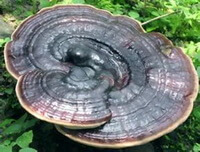
Botanical Description:Ganoderma sinense Zhao, Xu et Zhang is a fungus of the family Ganodermataceae (or Polyporaceae) and genus Ganoderma. It is commonly known as Ganoderma sinense, Purple Ganoderma, Purple Lingzhi Mushroom, or Zǐ Zhī (meaning “Purple Lingzhi Mushroom”). It differs from Ganoderma lucidum in several features: the pileus (cap) is predominantly atropurpureus (purple-black) to nearly brown-black; the context is well-proportioned brown, bistre (seal brown) to chestnut brown; the spore tip is umbilical and protuberant, with conspicuous protuberant spinules on the inner wall; spores are larger, measuring (9.5–13.8) μm × (6.9–8.5) μm.
The pileus (cap) is suberose, mostly semicircular to reniform; a few are orbicular (subrotund). Large specimens reach up to 20 cm in length and width; typical specimens measure approximately 4.7 × 4 cm; smaller ones measure about 2 × 1.4 cm. The surface is black, with a laccate luster, annular concentric ridges, and radial ridge patterns. The context is rusty brown. The tube orifices are round, 5 per mm, and the same color as the context. The stipe is pleurogenous, growing up to 15 cm long and about 2 cm in diameter; it is black and glossy. Spores are broadly ovoid, 10–12.5 × 7–8.5 μm, with a conspicuously verruculose inner wall.
Ecological Environment:Ganoderma sinense Zhao, Xu et Zhang grows on stumps of broad-leaved trees or on stumps of coniferous trees in the family Pinaceae (genus Pinus), causing white rot of wood. It is a species endemic to China and is mainly distributed in high-temperature, high-rainfall regions.
Characteristics of the Herb: The fruiting body (basidiocarp) of Ganoderma sinense Zhao, Xu et Zhang resembles that of Ganoderma lucidum. Key distinguishing features include: the pileus (cap) and stipe surfaces are atropurpureus (purple-black) or brown-black; the context and hymenophore (tube layer) beneath the pileus are rusty brown.
Pharmacological Actions: (1) Sedative and analgesic effects in mice; (2) enhanced cold tolerance and hypoxia tolerance in mice; (3) improved survival rate in animals during the terminal stage of radiation sickness; (4) reduced heart rate, etc.
Medicinal Efficacy: Tonifies Qi and calms the Shen (spirit); invigorates Qi and blood; strengthens the Spleen and Stomach; alleviates cough and asthma. Indicated for restlessness, insomnia, palpitations, fatigue, dizziness, consumptive disorders (e.g., tuberculosis), coronary heart disease, dyspepsia, anorexia, lung-deficiency cough and dyspnea, chronic cough and asthma, pneumosilicosis (silicosis), and tumors.
Administration of Ganoderma sinense (Zǐ Zhī):
Reference:
Administration Guide for Ganoderma sinense (Zǐ Zhī)
TCM Books:
(1) Internally: 6–12 grams; (2) Internally: finely powdered herb, 0.5–1 qián (≈1.5–3 gramns); or prepared as a wine infusion; (3) Internally:water decoction, 10–15 grams; powdered herb, 2–6 grams; or wine infusion.
Contraindications, Precautions, and Adverse Reactions: Ganoderma sinense is preferably combined with flaxseed (Linum usitatissimum) and Cinnamomum loureiroi Nees. It should not be combined with Dichroa febrifuga root (Antifebrile Dichroa Root), azurite, or Artemisia scoparia (Capillary Wormwood Herb).
(3) Ganoderma tsugae Murr.
Pinyin Name: Sōng Zhī or Sōng Shān Líng Zhī.
English Name: Woody Ganoderma (Hemlock Reishi) or Pine Reishi (Pine Tree Lingzhi Mushroom).
Latin Name:Ganoderma tsugae Murr. Property and Flavor: Neutral in nature; bitter in taste.
Botanical Description:Ganoderma tsugae Murr. is a fungus of the family Ganodermataceae (or Polyporaceae) and genus Ganoderma. It is commonly known as Hemlock Reishi, Mù Língzhī, Sōng Zhī, Sōng Shān Língzhī, or Pine Reishi (Sōng Zhī meaning “Pine Lingzhi Mushroom”).
The fruiting body (basidiocarp) is annual and petiolate. When fresh, it is soft and suberose; upon drying, it becomes firm and corky, with a marked reduction in weight. The pileus (cap) is reniform, semicircular, or nearly fan-shaped, 3–25 cm in diameter and 0.8–3 cm thick (up to 4 cm). The surface is russet (reddish-brown) or stained russet, with a lacquer-like luster; annular zones are absent or inconspicuous. The context is white or pale whitish; the region adjacent to the hymenophore is often hazel (pale brown). The tubes are 0.5–1.5 cm long, fawn (flavotestaceous) or darker; the pore surface is whitish initially, gradually darkening to match the tube color. Pores are slightly rounded, 4–5 per mm. The stipe is typically thick and short—usually 4–5 cm long and 2–3 cm in diameter—with an atropurpureus (purple-black) surface and strong luster.
The hymenium exhibits a sporiferous-layer structure. Generative hyphae are colorless, transparent, leptodermous (thin-walled), and 3–5 μm in diameter. Skeletal hyphae are hazel (pale brown), pachydermous (thick-walled) to farctate, with dendritic branching; the skeletal portion measures 4–7 μm in dry diameter. Flagelliform, colorless binding hyphae arise at branch tips; binding hyphae are pachydermous and ramified, 1.5–2 μm in diameter.
Basidiospores are elliptic, occasionally truncate at the apex; they are double-walled—the outer wall is colorless, transparent, and smooth; the inner wall is hazel (pale brown) and echinulate (bearing spinules)—measuring 7.5–11 × 6–7 μm.
Ecological Environment:Ganoderma tsugae Murr. grows primarily at elevations of 700–1,400 m above sea level in mixed forests of red pine and broad-leaved trees, as well as in coniferous mixed forests containing fir, larch, red pine, and spruce—especially on cut stumps, decaying wood, and larch stumps. It is an extremely rare and valuable medicinal fungus, predominantly distributed in cold-temperate regions of China.
Characteristics of the Herb: The fruiting body is medium to large and corky. The pileus diameter ranges from 6.5–21 cm; shape is semicircular, flattened, or reniform. The surface is red, dark red, or brown-red, with a bright, lacquer-like cuticle lacking distinct concentric rings—or with only faint ones. With age, it develops no prominent bands but irregular wrinkles; margins are ribbed and blunt. The context is woody in color and 0.5–1.5 cm thick. The pore surface (hymenophore) appears dirty white initially, gradually turning tawny (cinnamomeous) or light brown; pores number 4–5 per mm. The stipe is 3–6 cm long and 3–4 cm in diameter—short, thick, same-colored as the pileus, glossy, pleurogenous or oblique. Basidiospores are echinulate, brown, sometimes truncate at one end; the exospore is colorless, transparent, and ovoid.
This species exhibits immunomodulatory, antitumor, hepatoprotective, cardiovascular-protective, neurosoothing, digestive-regulatory, lung-moistening, antiasthmatic, anti-aging, and cosmeceutical effects.
Modern studies indicate that Ganoderma tsugae (Pine Reishi) is nutritionally rich, containing essential amino acids, nucleosides, trace elements, vitamins, bioactive polysaccharides, triterpenoids, alkaloids, and dietary fiber beneficial for health maintenance. It demonstrates therapeutic potential in hepatitis, arthritis, diabetes, hypertension, hyperlipidemia, and neurasthenia—and shows significant efficacy against the three leading causes of human mortality: coronary heart disease, cancer, and stroke.
The polysaccharides consist primarily of monosaccharide polymers—including bioactive β-D-glucans—with physiological activities such as antitumor, immunoenhancing, antiviral, free-radical-scavenging, anti-aging, antithrombotic, and anticoagulant effects.
The triterpenoids are another class of bioactive constituents isolated from Ganoderma. Experiments have confirmed that Ganoderma triterpenoids rapidly enhance immune function—evidenced by promoting lymphocyte proliferation, increasing the phagocytic activity of macrophages, natural killer (NK) cells, and T lymphocytes, and directly or indirectly inducing tumor cell death. Triterpenoids also exhibit hepatoprotective, antioxidant, antibacterial, anti-inflammatory, anti-HIV, and anti-herpes virus activities; inhibit hepatic tumor cell growth; and constitute a principal active component underlying its detoxification effects.
Alkaloids improve coronary blood flow, reduce myocardial oxygen consumption, enhance myocardial tolerance to hypoxia, and lower serum cholesterol levels—demonstrating significant therapeutic potential in coronary heart disease, hypertension, hyperlipidemia, hepatitis, and muscular weakness.
Nucleosides are indispensable building blocks of DNA and RNA, playing essential roles in genetic inheritance and cellular information transfer. Adenosine, uridine, adenine, uracil, and other bioactive nucleosides constitute the primary molecular basis for Ganoderma’s antimutagenic activity.
Amino acids are the fundamental units of proteins and vital nutritional components for organisms. Essential amino acids—those not synthesized endogenously and thus requiring dietary intake—are abundantly present in Ganoderma tsugae (Pine Reishi) fruiting bodies, which contain 18 amino acids, including all nine human essentials. Notably, methionine content in G. tsugae is significantly higher than in most edible fungi, where methionine levels are typically low.
Studies show that the G. tsugae fruiting body contains trace elements including Mn, Cr, Cu, Fe, Ca, Mg, Zn, Se, and Ge. Selenium, germanium, zinc, iron, calcium, and magnesium occur at comparatively high concentrations. Boron has also been reported, confirming G. tsugae as a rich natural reservoir of trace elements. These elements act synergistically with other bioactive compounds: organic germanium exhibits antitumor properties, and its synergy with G. tsugae polysaccharides markedly potentiates their antitumor efficacy.
G. tsugae is also rich in vitamins—including vitamin C and vitamin E—and contains high levels of carotenoids, conferring potent antioxidant and anti-aging activities.
Other Species of Lingzhi mushroom.
Approximately 250 species belong to the genus Ganoderma worldwide. In China, about 98–100 Ganoderma species have been documented within the family Ganodermataceae. They are distributed across southern to northern regions of the country.
Other Cultivated Species of Lingzhi Mushroom: In addition to the two species officially recognized in classical Chinese herbal works—(1) Ganoderma lucidum (Leyss. ex Fr.) Karst. and (2) Ganoderma sinense Zhao, Xu et Zhang—several other Ganoderma species are now cultivated in China, including: (3) Ganoderma tsugae, (4) Ganoderma hainanense, (5) Ganoderma multiplicatum, (6) Ganoderma tenue, (7) Ganoderma atrum, and (8) Ganoderma shandongense. These cultivated species are detailed in: Lingzhi mushroom:Other Cultivated Species. more
Other Identified Wild Species of Lingzhi Mushroom: Beyond the pharmacopoeial species—(1) Ganoderma lucidum (Leyss. ex Fr.) Karst. and (2) Ganoderma sinense Zhao, Xu et Zhang—and the cultivated species listed above, numerous wild Ganoderma species are documented for potential medicinal use. Commonly identified examples include: (9) Ganoderma boninense, (10) Ganoderma calidophilum, (11) Ganoderma mongolicum, (12) Ganoderma resinaceum, (13) Ganoderma valesiacum, (14) Ganoderma ahmadii, (15) Ganoderma capense, (16) Ganoderma tropicum, (17) Ganoderma duropora, (18) Ganoderma applanatum, (19) Ganoderma gibbosum, and (20) Ganoderma lobatum. These wild species are described in: “Lingzhi Mushroom: Other Identified Wild Species.” more
Other Identified Special Species of Lingzhi Mushroom: Except for the species defined in classical herbal works, cultivated Ganoderma species, and other identified wild Lingzhi mushroom species commonly used in practice, there remain additional identified special (wild) species that are not commonly utilized. These special wild species are listed below:(21) Ganoderma curtisii, (22) Ganoderma daiqingshanense, (23) Ganoderma flexipes, (24) Ganoderma kunmingense, (25) Ganoderma ramosissimum, (26) Ganoderma rotundatum, (27) Ganoderma sichuanense, (28) Ganoderma submucronatum, (29) Ganoderma theaecolum, (30) Ganoderma amboinense, (31) Ganoderma austrofujianense, (32) Ganoderma cochlear, (33) Ganoderma crebrostriatum, (34) Ganoderma dahlii, (35) Ganoderma fornicatum, (36) Ganoderma fulvellum, (37) Ganoderma guinanense, (38) Ganoderma luteomarginatum, (39) Ganoderma magniporum, (40) Ganoderma mastoporum, (41) Ganoderma mediosinense, (42) Ganoderma mirivelutinum, (43) Ganoderma ochrolaccatum, (44) Ganoderma parviungulatum, (45) Ganoderma simaoense, (46) Ganoderma tibeticum, (47) Ganoderma chenghaiense, (48) Ganoderma tsunodae, (49) Ganoderma formosanum, (50) Ganoderma multiplex, (51) Ganoderma australe, (52) Ganoderma sanmingense, (53) Ganoderma annulatum, (54) Ganoderma bawanglingense, (55) Ganoderma brownii, (56) Ganoderma aensitonatum, (57) Ganoderma diaoluoshanense,
(58) Ganoderma limushanense, (59) Ganoderma meijiangense, (60) Ganoderma philippii, (61) Ganoderma shangsiense, (62) Ganoderma triangulatum, (63) Ganoderma nugatum, (64) Ganoderma koningsbergii. These special wild species are introduced in: “Lingzhi Mushroom: Other Identified Special Species.” more
References:
1. Introduction of Ling Zhi: Ganoderma lucidum, Fairy Grass.
2. Lingzhi Mushroom: Other Cultivated Species.
3. Lingzhi Mushroom: Other Identified Common Species.
4. Lingzhi Mushroom: Other Identified Special Species.

 ✵The article records the herb Lucid Ganoderma—its English name, Latin name, Pinyin name, properties and flavor, and the botanical sources defined in herbal classics: two fungal species, (1) Ganoderma lucidum (Leyss. ex Fr.) Karst. and (2) Ganoderma sinense Zhao, Xu et Zhang; and another commonly used fungal species, (3) Ganoderma tsugae Murr. It provides a detailed introduction to the botanical features, growth characteristics, and ecological environments of these three fungal species; the macroscopic and microscopic features of the herb Lucid Ganoderma; its pharmacological actions, medicinal efficacy, and administration guidelines.
 Pinyin Name: Línɡ Zhī
 Botanical source: The Lingzhi (or Reishi) mushroom refers today to a species complex encompassing several fungal species primarily within the genus Ganoderma—and occasionally other genera. The most commonly venerated species in China, where it has been used as a medicinal mushroom in Traditional Chinese Medicine for over 2,000 years, is Ganoderma lucidum. This makes it one of the oldest documented medicinal mushrooms. In contemporary Chinese practice, fungi classified under the Lingzhi category belong to four genera: (1) Ganoderma Karst., (2) Amauroderma, (3) Haddowia, and (4) Humphreya.
 The medicinal values of Ganoderma fungi are recorded in classical herbal texts. Among the Ganoderma genus, three species are officially recognized in authoritative herbal classics for therapeutic use: (1) Ganoderma lucidum, also known as Línɡ Zhī or Chì Zhī (“Red Lingzhi”); (2) Ganoderma sinense, also known as Zǐ Zhī (“Purple Lingzhi”); and (3) Ganoderma tsugae, also known as Sōng Zhī (“Pine Lingzhi”).
 Pinyin Name: Chì Zhī or Chì Línɡ Zhī
 Ecological Environment: Ganoderma lucidum (Leyss. ex Fr.) Karst. grows on sun-exposed rhizospheres or dead stumps of trees in the Fagaceae family and the Pinus genus (Pinaceae family). This species is widely distributed across China.
 Lingzhi is a hard, polyporous, and mildly bitter mushroom. Polypores are conspicuous fungi that typically grow laterally from logs or tree trunks. The actual fungal organism—the mycelium—is a network of filamentous (threadlike) hyphae originating from spores. This mycelial network spreads throughout the nutrient substrate—such as decaying wood or soil—absorbing and accumulating nutrients as it grows. Mycelia inhabit soil, fallen logs, and other organic debris. As long as nutrients remain available, the mycelium is perennial and may persist for many years. At least once annually, fruiting bodies emerge from the mycelial network. As the reproductive structure of the fungus, mushrooms produce and disperse spores.
 Polypores—commonly known as bracket or shelf fungi—are conspicuous macrofungi that typically grow laterally from logs or tree trunks. On a walk through the forest, one commonly observes numerous such bracket fungi.
 Characteristics of the Herb: The fruiting body (carpophore) is umbelliform (umbellate); the pileus (cap) is firm and hard, suberose, semicircular or reniform, 12–20 cm wide and approximately 2 cm thick. The cuticle is hard and rigid: yellow when young, gradually turning reddish-brown, with a lacquer-like gloss, marked by concentric ridges and radial wrinkles; the margin is thin and truncate—often slightly involute (rolled inward). The context (flesh) is nearly white to hazel (pale brown). The hymenophore (undersurface of the pileus) is white to light brown and composed of numerous fine tubular pores; these tubes contain basidia and basidiospores. The stipe (prostheca) is laterally attached (pleurogenous), 19 cm long and approximately 4 cm in diameter; its surface is russet (reddish-brown) to purplish-brown (puce), with a lacquer-like luster. The herb has a faint odor and a mild, slightly bitter taste.
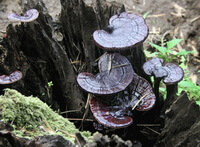 Pinyin Name: Zǐ Zhī or Zǐ Líng Zhī.
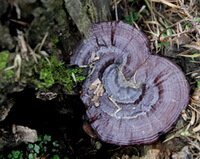 Ecological Environment: Ganoderma sinense Zhao, Xu et Zhang grows on stumps of broad-leaved trees or on stumps of coniferous trees in the family Pinaceae (genus Pinus), causing white rot of wood. It is a species endemic to China and is mainly distributed in high-temperature, high-rainfall regions.
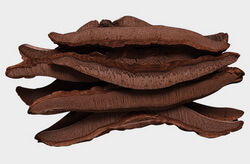 Characteristics of the Herb: The fruiting body (basidiocarp) of Ganoderma sinense Zhao, Xu et Zhang resembles that of Ganoderma lucidum. Key distinguishing features include: the pileus (cap) and stipe surfaces are atropurpureus (purple-black) or brown-black; the context and hymenophore (tube layer) beneath the pileus are rusty brown.
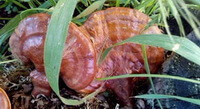 Pinyin Name: Sōng Zhī or Sōng Shān Líng Zhī.
 This species exhibits immunomodulatory, antitumor, hepatoprotective, cardiovascular-protective, neurosoothing, digestive-regulatory, lung-moistening, antiasthmatic, anti-aging, and cosmeceutical effects.
 Amino acids are the fundamental units of proteins and vital nutritional components for organisms. Essential amino acids—those not synthesized endogenously and thus requiring dietary intake—are abundantly present in Ganoderma tsugae (Pine Reishi) fruiting bodies, which contain 18 amino acids, including all nine human essentials. Notably, methionine content in G. tsugae is significantly higher than in most edible fungi, where methionine levels are typically low.
 Other Cultivated Species of Lingzhi Mushroom: In addition to the two species officially recognized in classical Chinese herbal works—(1) Ganoderma lucidum (Leyss. ex Fr.) Karst. and (2) Ganoderma sinense Zhao, Xu et Zhang—several other Ganoderma species are now cultivated in China, including: (3) Ganoderma tsugae, (4) Ganoderma hainanense, (5) Ganoderma multiplicatum, (6) Ganoderma tenue, (7) Ganoderma atrum, and (8) Ganoderma shandongense. These cultivated species are detailed in: Lingzhi mushroom:Other Cultivated Species. more

