Introduction of Bitter Melon: Fruit of Momordica charantia
✵This article documents the herb Bitter Melon, including its English name, Latin name, Pinyin name, common names and synonyms, property and flavor, botanical source—namely the fruit of (1) Momordica charantia L.—and provides a detailed introduction to the botanical features, growth characteristics, and ecological environment of this species, as well as the characteristics of the herb, its pharmacological actions, medicinal efficacy, and administration guidelines.
Bitter Melon (fruit of Momordica charantia)
English Name: Bitter Melon
Latin Name: Momordica charantia
Pinyin Name: Kǔ Guā
Common Names: bitter melon, bitter gourd, bitter apple, wild cucumber, bitter cucumber, balsam apple, balsam pear, margose, la-kwa, leprosy gourd, karela
Synoms: ampalaya, pomme de merveille, pomo balsamo, balsamini longa, muop dang, tsuru reishi, bittergourd, balsamina, balsamapfel, mara, sopropo, arsorossie, ku gua foo, pare, peria, karela, balsam pear
Property and Flavor: Cold in nature; bitter in taste
Brief Introduction: Bitter melon is a green, cucumber-shaped fruit covered with wart-like tubercles. It resembles an unattractive, light-green cucumber. The fruit should be firm, similar to a cucumber, and has an intensely bitter taste. Although the seeds, leaves, and vines of Momordica charantia have all been used traditionally, the fruit is the safest and most commonly employed part for medicinal purposes.
Botanical Source: Common herbal classics define the herb Bitter Melon as the fruit of (1) Momordica charantia L., a species of the genus Momordica in the family Cucurbitaceae (the gourd or squash family). The fruit is the medicinally used part. This widely used species is described below:
(1) Momordica charantia L.
Botanical Description:Momordica charantia is an annual, climbing herb with numerous branches and villous, unbranched tendrils. Leaves are large, reniform to nearly circular, 5–12 cm in both length and width, usually 5- to 7-lobed with ovate lobes, a cordate or truncate base, undulate-serrate margins, and surfaces that are nearly glabrous or sparsely pilose; petioles are 3–6 cm long. Flowers are monoecious. Male flowers are solitary and pedicellate, pedicels 5–15 cm long, with bracts at the middle or base; bracts are reniform-cordate, 5–15 mm wide, and entire. The calyx is campanulate and 5-lobed; lobes are ovate-lanceolate, mucronate at the apex, and 4–6 mm long. The corolla is yellow and 5-lobed; lobes are obovate to oval, 1.5–2 cm long, with obtuse or slightly concave apices. There are three stamens, adnate to the throat of the calyx tube. Female flowers are solitary and pedicellate, pedicels are 5–10 cm long, with bracts at the base. The ovary is fusiform, covered with spinose tubercles, with a beaked apex, a slender style, three stigmas, and numerous ovules. The fruit is ellipsoid, ovoid, or narrowly fusiform, 8–30 cm long, densely covered with dull, rounded, and irregular tubercles; it turns orange at maturity and dehisces apically into three valves. Seeds are ovoid and flattened, 10–15 mm long, with angular teeth at both ends and irregular striations on both faces, enclosed in a bright red, succulent aril. Flowering occurs from June to July; fruiting from September to October.
Bitter gourd fruit is a pepo (a type of berry characteristic of Cucurbitaceae), bearing numerous irregular, wart-like tubercles. Fruit shape varies: fusiform, short clavate, or oblong-clavate. Immature fruits are green, greenish-white, or white; mature fruits turn yellow. Ripe fruits dehisce readily at the apex, exposing scarlet pulp that envelops the seeds. The fruit is edible when harvested immature and cooked; it has a characteristically intense bitterness.
Bitter melon seeds are large, flattened, tortoiseshell-patterned, and yellow, with a thick, hard seed coat bearing prominent surface reticulations. Each fruit contains 20–30 seeds; 1,000 seeds weigh 150–180 g. Sowing rate is approximately 200–300 g per acre.
Ecological Environment:Momordica charantia—also known as bitter melon or bitter gourd—is a tropical, tender perennial vine native to Asia and widely naturalized in tropical regions of the Caribbean and South America. It is cultivated both as a food crop and for medicinal use. Leaves and fruits have traditionally been used to prepare teas, fermented beverages (e.g., herbal beers), and soup seasonings.
Growth Characteristics:Momordica charantia thrives in warm climates. It is heat-tolerant but sensitive to low temperatures and waterlogging; it is not drought-resistant. Cultivation is best undertaken on well-drained, deep, fertile soils in low-lying areas.
Bitter gourd roots are well-developed and highly branched, primarily concentrated in the 30–50 cm plow layer. Root mass distribution spans over 130 cm in width and extends deeper than 30 cm. Roots prefer consistently moist (but not saturated) conditions and are highly susceptible to waterlogging.
Characteristics of the Herb: Dried balsam pear (bitter gourd) slices are oval or oblong, 2–8 mm thick, 3–15 cm long, and 0.4–2 cm wide. They are shriveled, curved, and have a light grayish-brown, rough epidermis marked by longitudinal wrinkles or nodular protrusions. Occasionally, seed cavities or residual seeds are visible in the central cavity. The herb is brittle and fractures easily. Odor is faint; taste is distinctly bitter. Higher-grade herb material exhibits greenish margins, white parenchyma, thin uniform slices, and minimal seed content.
Medicinal Efficacy: In folk medicine, bitter melon has been used for viral infections (e.g., colds and influenza), hypercholesterolemia, psoriasis, and certain tumor-related conditions. According to Traditional Chinese Medicine (TCM) texts, bitter melon clears summer-heat and excess fire, improves visual acuity, and detoxifies. It is indicated for summer-heat syndrome with polydipsia, consumptive thirst (xiao ke), painful red eyes, dysentery, carbuncles, ulcers, and swellings due to toxic accumulation.
Administration of Bitter Melon (fruit of Momordica charantia):
Reference:
Administration Guide for Bitter Melon (fruit of Momordica charantia)
Herbal classic books and TCM works:
In TCM, the recommended internal dosage is 6–15 g of dried fruit or 30–60 g of fresh fruit, decocted in water. Alternatively, the fruit may be calcined (with property preserved) and ground into a fine powder. Externally, an appropriate amount of fresh fruit may be mashed and applied as a poultice, or its expressed juice may be topically smeared. In Europe, standardized preparations include fruit juice or concentrate, capsules or tablets containing concentrated fruit and seed extracts, and powdered whole herb or vine extracts in capsules and tinctures. A typical daily dose is 1 g of standardized extract.
Contraindications, Precautions, and Adverse Reactions: In general, bitter melon is considered safe when used appropriately. Studies indicate relatively low oral toxicity for all plant parts of Momordica charantia. However, fruit and leaf extracts are not considered safe during pregnancy due to potential uterotonic and abortifacient effects. Bitter melon should not be used concurrently with anti-diabetic agents and cholesterol-lowering medicine.
References:
1.Introduction of Bitter Melon: Fruit of Momordica charantia

 ✵This article documents the herb Bitter Melon, including its English name, Latin name, Pinyin name, common names and synonyms, property and flavor, botanical source—namely the fruit of (1) Momordica charantia L.—and provides a detailed introduction to the botanical features, growth characteristics, and ecological environment of this species, as well as the characteristics of the herb, its pharmacological actions, medicinal efficacy, and administration guidelines.
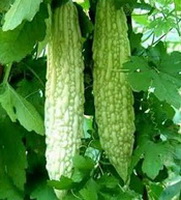 English Name: Bitter Melon
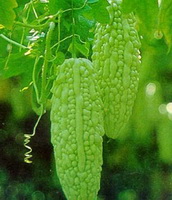 Botanical Description: Momordica charantia is an annual, climbing herb with numerous branches and villous, unbranched tendrils. Leaves are large, reniform to nearly circular, 5–12 cm in both length and width, usually 5- to 7-lobed with ovate lobes, a cordate or truncate base, undulate-serrate margins, and surfaces that are nearly glabrous or sparsely pilose; petioles are 3–6 cm long. Flowers are monoecious. Male flowers are solitary and pedicellate, pedicels 5–15 cm long, with bracts at the middle or base; bracts are reniform-cordate, 5–15 mm wide, and entire. The calyx is campanulate and 5-lobed; lobes are ovate-lanceolate, mucronate at the apex, and 4–6 mm long. The corolla is yellow and 5-lobed; lobes are obovate to oval, 1.5–2 cm long, with obtuse or slightly concave apices. There are three stamens, adnate to the throat of the calyx tube. Female flowers are solitary and pedicellate, pedicels are 5–10 cm long, with bracts at the base. The ovary is fusiform, covered with spinose tubercles, with a beaked apex, a slender style, three stigmas, and numerous ovules. The fruit is ellipsoid, ovoid, or narrowly fusiform, 8–30 cm long, densely covered with dull, rounded, and irregular tubercles; it turns orange at maturity and dehisces apically into three valves. Seeds are ovoid and flattened, 10–15 mm long, with angular teeth at both ends and irregular striations on both faces, enclosed in a bright red, succulent aril. Flowering occurs from June to July; fruiting from September to October.
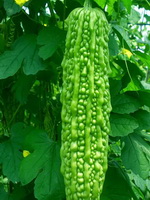 Ecological Environment: Momordica charantia—also known as bitter melon or bitter gourd—is a tropical, tender perennial vine native to Asia and widely naturalized in tropical regions of the Caribbean and South America. It is cultivated both as a food crop and for medicinal use. Leaves and fruits have traditionally been used to prepare teas, fermented beverages (e.g., herbal beers), and soup seasonings.
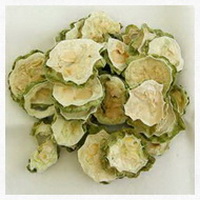 Characteristics of the Herb: Dried balsam pear (bitter gourd) slices are oval or oblong, 2–8 mm thick, 3–15 cm long, and 0.4–2 cm wide. They are shriveled, curved, and have a light grayish-brown, rough epidermis marked by longitudinal wrinkles or nodular protrusions. Occasionally, seed cavities or residual seeds are visible in the central cavity. The herb is brittle and fractures easily. Odor is faint; taste is distinctly bitter. Higher-grade herb material exhibits greenish margins, white parenchyma, thin uniform slices, and minimal seed content.
