✵The article documents the herb Bilberry, including its English name, Latin name, Pinyin name, common names, properties and flavors, and its botanical sources—two plant species: (1) Vaccinium myrtillus L. and (2) Vaccinium hirtum Thunb. It provides a detailed introduction to the botanical features, growth characteristics, and ecological environments of these two species; the morphological and medicinal features of the herb Bilberry; its pharmacological actions, medicinal efficacy, and administration guidelines.
Bilberry (Vaccinium myrtillus)
English Name: Bilberry
Latin Name:Vaccinium myrtillus L. Pinyin Name: Yuè Jú, Zǐ Guǒ Yuè Jú, Hóng Guǒ Yuè Jú.
Common Names: Bog bilberry, dwarf bilberry, European blueberry, huckleberry, whortleberry, trackleberry, dyeberry, bleaberry, black whortles, Burren myrtle
Property and Flavor: The leaf is warm in nature and bitter in taste; the berry is neutral in nature and sour-sweet in taste.
Brief Introduction: Bilberry is a thickly branched, deciduous shrub belonging to the same plant family as cranberry and American blueberry. Its juicy, black, coarsely wrinkled berries contain purple flesh and multiple brownish-red seeds. It is a flowering perennial found in woods and forest meadows across northeastern Asia, Europe, and parts of North America. Both the dried berries and the oval leaves are used medicinally.
Bilberry (scientific name: Vaccinium myrtillus) is known as bilberry, bleaberry, wineberry, or whortleberry in the UK, and as huckleberry in the USA (United States of America). It has been used as a food plant since ancient times. In early 16th-century Europe, it was employed as a medicinal plant; its leaves have traditionally been used for astringent, anti-inflammatory, antibacterial, and antidiabetic effects, and have been incorporated into various herbal mixtures for diabetes management.
Botanical Source: Common herbal classics define Bilberry as the dried fruit (berry) of (1) Vaccinium myrtillus L. and (2) Vaccinium hirtum Thunb.—two species of the genus Vaccinium in the Ericaceae family (Ericaceae Juss.). The fresh fruit, dried fruit, and oval leaves are used medicinally. These two commonly used species are described below:
(1) Vaccinium myrtillus L.
Botanical Description:Vaccinium myrtillus L. is a deciduous shrub, short in stature (15–30 cm, occasionally up to 60 cm tall), with creeping rhizomes. Stems are upright and highly branched; young branches are green, glabrous, and sharply angled. Leaves are scattered along the branches; they are chartaceous (papery), egg-shaped or oval, 1–2.8 cm long and 0.6–1.3 cm wide; the apex is acute or obtuse; the base is broadly cuneate to obtuse; the margin is finely serrulate; both surfaces are glabrous; the midrib, lateral veins, and reticulate veins are slender—flat on the adaxial surface and slightly raised on the abaxial surface; petioles are extremely short (~1 mm). One to two flowers arise from the axils of current-year branches, drooping; pedicels are 2.5–3.5 mm long, emerging between two scaly bracts and glabrous; bracteoles are absent; the calyx tube is glabrous, nearly undivided at the mouth, with an undulating or nearly entire margin and glabrous surface; the corolla is pale green with a reddish halo, globose, 4–6 mm long and 4–5-lobed, with reflexed lobes; there are 8–10 stamens; filaments are extremely short and glabrous, gradually widening toward the base, bearing a pair of spur-like appendages on the back of each anther cell. The berry is spherical, 6–10 mm in diameter, blue-black when ripe, and covered with a whitish, waxy bloom. Flowering occurs in June; fruiting in September.
Ecological Environment: This species grows in China—in larch-spruce forests at altitudes of 2,200–2,500 meters—often forming patches. It is also distributed widely across most of Europe and northern Asia, from the Altai Mountains to Kamchatka via Lake Baikal. The fruit is sweet and sour.
Growth Characteristics: The plant thrives at altitudes of 2,200–2,500 meters above sea level, in larch-spruce or pine-mixed raw coniferous forests, preferring moist, acidic soils, and commonly grows in patches.
(2) Vaccinium hirtum Thunb.
Botanical Description:Vaccinium hirtum Thunb. is a deciduous shrub; stems are many-branched; young branches are pale yellow, grooved, and sparsely white pubescent, whereas older branches are glabrous. Leaves are scattered along the branches; they are chartaceous (papery), egg-shaped or oval, 3–6.5 cm long and 1.3–3 cm wide; the apex is acute or acuminate; the base is cuneate to broadly cuneate or slightly obtuse; both surfaces bear sparse white pubescence when young; the midrib and lateral veins are slender—slightly visible on the adaxial surface and slightly raised on the abaxial surface; petioles are 1–2 mm long and sparsely pilose. Flowers are not documented in available botanical records. One to three berries develop in the axils of the uppermost leaves of last year’s branches. The fruit stalks (carpopodia) are 6–8 mm long, glabrous, and articulately joined to the fruit. The fruit is red, oblong, 5-ribbed, and glabrous when ripe. The calyx is persistent, with five teeth that are triangular or semicircular, 2–3 mm long; the base is commissural, and the calyx teeth are glabrous. Fruit ripens in September.
Ecological Environment: Vaccinium hirtum Thunb. is distributed in China, growing on mountain summits and upper slopes. It is also found in other northeastern regions of Asia, and North America.
Differences from Blueberry: Bilberry is often confused with blueberry; although both belong to the genus Vaccinium and family Ericaceae, they are distinct species with notable differences in morphology, fruit structure, and ecology.
Bilberry fruit is smaller than blueberry fruit, but its flavor is more intense. The color of bilberry fruit is deeper—typically dark purple to blackish-purple—whereas blueberry fruit is usually light to deep blue. Bilberry pulp is greenish, while European blueberry pulp is reddish or purplish. Consumption of bilberry fruit readily stains fingers and lips; consequently, some European dentists have used its pigmented juice to demonstrate to children how proper toothbrushing prevents staining—since unbrushed areas retain the pigment.
Blueberry fruit grows in clusters, whereas bilberry fruit typically occurs singly or in pairs (opposite). Bilberry fruit is softer and juicier than blueberry fruit, making it less suitable for transport; hence, fresh bilberry fruit commands a higher market price. Frozen bilberries retain quality and are available year-round.
Characteristics of the Herb: The leaves and fruits of bilberry are harvested from the wild between July and August and dried in the shade.
Pharmacological Actions: (1) Anthocyanins may help maintain the structural integrity and stability of capillary collagen; (2) promote vasodilation and vascular elasticity; (3) enhance oxygen and blood delivery to the retina; (4) exert antioxidant effects; (5) exhibit potential anticancer activity.
Medicinal Efficacy: Traditionally, Europeans used bilberry tea to treat simple diarrhea. A decoction of dried berries has been employed for gingivitis, sore throat, and other inflammatory conditions of the mouth and pharynx, as well as urinary tract infections. Following World War II, pilots reportedly consumed bilberry to support night vision and visual acuity during nocturnal missions; subsequently, it was applied to other ophthalmic conditions—including cataracts and glaucoma. Today, herbalists recommend bilberry for diabetes, peptic ulcers, dysmenorrhea, and vascular disorders such as varicose veins. Folk uses also include prevention and management of diabetes; gastrointestinal, renal, and urinary tract complaints; arthritis, gout, and dermatitis (internally); and topical applications for oral mucositis, conjunctivitis, burns, and inflammatory skin conditions. It is officially approved (e.g., by the German Commission E) for acute diarrhea and inflammation of the mouth and pharynx.
In Traditional Chinese Medicine (TCM) works, bilberry leaf is recorded to function in detoxification and promoting diuresis to resolve dampness; it is indicated for stranguria and gout. Bilberry fruit is recorded to arrest diarrhea and is indicated for diarrhea, dysentery, and enteritis.
Administration of Bilberry (Vaccinium myrtillus):
Reference:
Administration Guide for Bilberry (Vaccinium myrtillus)
Herbal classic books and TCM works:
In North America, recommended dosages include chewing 1–2 teaspoonfuls of dried bilberries with fluid, or taking two 500 mg capsules twice daily. In Europe, the recommended internal dose of dried fruit is 20–60 grams per day; a 10% infusion (for external use) is prepared by macerating 5–10 grams of crushed herb in cold water, bringing to a gentle simmer for 10 minutes, then straining. A 10% decoction is used externally. Commercially available standardized tablets or capsules (containing 36% anthocyanosides) are typically dosed at 60–160 mg three times daily. No established safe or effective dosage exists for bilberry leaf. In TCM practice, bilberry leaf is administered internally as a water decoction at 3–9 grams per day; bilberry fruit is similarly decocted at 3–9 grams per day.
Contraindications, Precautions, and Adverse Reactions: Bilberry is generally safe when used in typically recommended amounts. However, toxic reactions—including weight loss, anemia, and other systemic complications—have been observed with prolonged use or high doses of the leaves in animal studies; some fatalities have also occurred. Bilberry should be avoided during pregnancy and lactation.

 ✵The article documents the herb Bilberry, including its English name, Latin name, Pinyin name, common names, properties and flavors, and its botanical sources—two plant species: (1) Vaccinium myrtillus L. and (2) Vaccinium hirtum Thunb. It provides a detailed introduction to the botanical features, growth characteristics, and ecological environments of these two species; the morphological and medicinal features of the herb Bilberry; its pharmacological actions, medicinal efficacy, and administration guidelines.
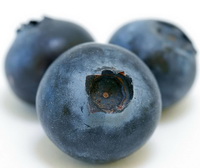 English Name: Bilberry
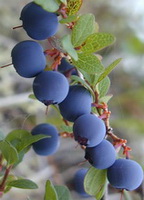 Botanical Description: Vaccinium myrtillus L. is a deciduous shrub, short in stature (15–30 cm, occasionally up to 60 cm tall), with creeping rhizomes. Stems are upright and highly branched; young branches are green, glabrous, and sharply angled. Leaves are scattered along the branches; they are chartaceous (papery), egg-shaped or oval, 1–2.8 cm long and 0.6–1.3 cm wide; the apex is acute or obtuse; the base is broadly cuneate to obtuse; the margin is finely serrulate; both surfaces are glabrous; the midrib, lateral veins, and reticulate veins are slender—flat on the adaxial surface and slightly raised on the abaxial surface; petioles are extremely short (~1 mm). One to two flowers arise from the axils of current-year branches, drooping; pedicels are 2.5–3.5 mm long, emerging between two scaly bracts and glabrous; bracteoles are absent; the calyx tube is glabrous, nearly undivided at the mouth, with an undulating or nearly entire margin and glabrous surface; the corolla is pale green with a reddish halo, globose, 4–6 mm long and 4–5-lobed, with reflexed lobes; there are 8–10 stamens; filaments are extremely short and glabrous, gradually widening toward the base, bearing a pair of spur-like appendages on the back of each anther cell. The berry is spherical, 6–10 mm in diameter, blue-black when ripe, and covered with a whitish, waxy bloom. Flowering occurs in June; fruiting in September.
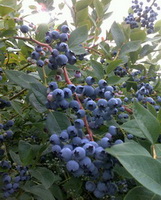 Ecological Environment: This species grows in China—in larch-spruce forests at altitudes of 2,200–2,500 meters—often forming patches. It is also distributed widely across most of Europe and northern Asia, from the Altai Mountains to Kamchatka via Lake Baikal. The fruit is sweet and sour.
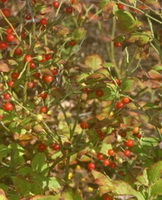 Botanical Description: Vaccinium hirtum Thunb. is a deciduous shrub; stems are many-branched; young branches are pale yellow, grooved, and sparsely white pubescent, whereas older branches are glabrous. Leaves are scattered along the branches; they are chartaceous (papery), egg-shaped or oval, 3–6.5 cm long and 1.3–3 cm wide; the apex is acute or acuminate; the base is cuneate to broadly cuneate or slightly obtuse; both surfaces bear sparse white pubescence when young; the midrib and lateral veins are slender—slightly visible on the adaxial surface and slightly raised on the abaxial surface; petioles are 1–2 mm long and sparsely pilose. Flowers are not documented in available botanical records. One to three berries develop in the axils of the uppermost leaves of last year’s branches. The fruit stalks (carpopodia) are 6–8 mm long, glabrous, and articulately joined to the fruit. The fruit is red, oblong, 5-ribbed, and glabrous when ripe. The calyx is persistent, with five teeth that are triangular or semicircular, 2–3 mm long; the base is commissural, and the calyx teeth are glabrous. Fruit ripens in September.
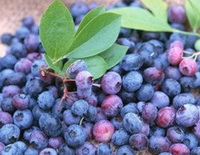 Characteristics of the Herb: The leaves and fruits of bilberry are harvested from the wild between July and August and dried in the shade.
