✵This article documents the herb Bayberry, including its English name, Latin name, Pinyin name, common names, property and flavor, botanical sources—two plant species: (1) Myrica cerifera L. and (2) Myrica pensylvanica L.—and provides a detailed description of the botanical features, growth characteristics, and ecological environments of these species, as well as the herb’s characteristics, pharmacological actions, medicinal efficacy, and administration guidelines.
Bayberry (Southern Bayberry)
English Name: Bayberry.
Latin Name:Myrica cerifera L. and Myrica pensylvanica L. Pinyin Name: Là Yáng Méi, Bīnxīfǎníyà Yáng Méi
Common Names: Candleberry, southern bayberry, southern wax myrtle, tallow shrub, waxberry, wax myrtle
Property and Flavor: The fruit is astringent and bitter; the leaves possess an aromatic odor
Property and Flavor: The fruit tastes astringent and bitter, the leaves have an aromatic odor.
Brief Introduction: Bayberry is utilized in horticulture, candle making, and traditional medicine. Myrica cerifera is a deciduous shrub or small tree that can reach up to 9 meters in height. It is harvested from the wild for local use as food, medicine, and raw material.
Botanical Source: Traditional herbal classics define Bayberry as the fruits (berries) of (1) Myrica cerifera L. or (2) Myrica pensylvanica L. These species belong to the genus Morella (formerly classified under Myrica), family Myricaceae (wax myrtle family). In North America, the dried root bark is used medicinally. In Europe, both the dried root bark and the wax extracted from the berries are employed therapeutically. The two principal species are described below:
(1) Myrica cerifera L.
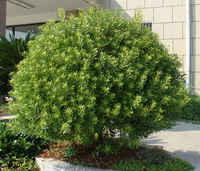
Botanical Description:Myrica cerifera is an evergreen small tree or large shrub that grows up to 6–7.5 meters tall, or even up to 10 meters, but is usually much shorter. The light olive-green leaves are alternate and have a toothed margin; they emit a spicy, aromatic odor when crushed, and both surfaces bear yellow resin dots. The bark is thin, smooth, and grayish brown—nearly white—with a white, peeling outer layer covering a reddish-brown inner layer. In spring, small, unisexual, slender, cylindrical flowers mature. The plant produces bluish-white drupes that mature in clusters on short stalks and persist through winter. Some individuals are dioecious, while others are monoecious, meaning that only female plants bear fruit in dioecious populations.
The flowers are unisexual and lack a calyx or corolla; they are small and yellowish, grow in scaly catkins. The small, round, grayish-white berries occur in clusters, contain numerous black seeds, and are coated with a usable greenish-white wax, which helps maintain seed viability for 2–3 years.
Ecological Environment:Myrica cerifera is native to North America. This shrub is highly adaptable and grows naturally in wetlands, along flowing water bodies, dunes, fields, hillsides, pine barrens, thickets on sandy soils near swamps and marshes, and in both coniferous and mixed-deciduous forests. It also occurs on dry, arid hillsides, where it may be only a few centimeters tall. Its range extends from Central America to Delaware and Maryland in the United States; it is successfully cultivated as far north as southern Connecticut and Long Island on the U.S. East Coast—i.e., southeastern North America. It also occurs in Bermuda and the Caribbean and is possibly naturalized in southern England.
Growth Characteristics:Myrica cerifera thrives under almost any condition. It makes an excellent xeriscaping shrub, requiring minimal maintenance. The plant prefers moist, lime-free, loamy or peaty soil and grows well in open, well-drained sites in full sun or light shade. According to one report, it thrives in ordinary garden soil; another indicates a preference for acidic soil.
Myrica cerifera exhibits tolerance to light, salt, and alkali, as well as to waterlogging and high humidity, making it suitable for coastal areas and marshes. It is a key species in wave-breaking forests. With high salt tolerance, it can be planted on beaches where soil salinity remains below 0.6% and is widely recommended for beaches with salinity below 0.4%.
Characteristics of the Herb: The fruit of Myrica cerifera is also known as southern bayberry. It serves as a food source for many bird species. Wax myrtle is harvested in autumn, thoroughly dried, powdered, and stored in airtight containers in dark, cool places.
The fruit is about 3 mm in diameter and contains a large seed; edible flesh is minimal. Leaves and berries are used as food flavorings—serving as an aromatic, attractive, and agreeable substitute for bay leaves in soups, stews, and other dishes. Dried leaves are brewed into a robust tea.
Bayberry bark refers to the bark harvested from the trunk and branches of Myrica cerifera.
(2) Myrica pensylvanica L.
Botanical Description:Myrica pensylvanica is a broadleaf, deciduous to semi-evergreen shrub that grows up to 1.5–3.7 meters tall, with multiple upright stems, a rounded habit, and a tendency to sucker and form colonies. Leaves are simple and alternate, obovate to oblong, 4–10 cm long and 3–4 cm wide, entire or shallowly toothed toward the apex, glossy dark green and pubescent above, and aromatic when crushed. Flowers are monoecious or dioecious, inconspicuous, and grow in yellowish-green catkins—male and female flowers occurring on the same or separate plants. Fruit is grayish white and coated with a waxy bloom, conspicuous from fall through spring.
Ecological Environment:Myrica pensylvanica is native to the eastern part of the North American continent and has become naturalized in the New Forest of Britain. It grows in dry or wet, nutrient-poor soils near the coast—including coastal dunes, pine barrens, pine-oak forests, old fields, bogs, and along stream margins, pond edges, and swamps—from sea level to elevations of approximately 300 meters.
Growth Characteristics:Myrica pensylvanica prefers moist soil and grows well in open, well-drained sites in full sun or light shade. It thrives in ordinary garden soil and favors lime-free, loamy or peaty soil.
Characteristics of the Herb: The fruit of Myrica pensylvanica is also known as northern bayberry or candleberry. It is about 4 mm in diameter and contains a single large seed; edible flesh is minimal. Leaves and fruit are used as food flavorings—particularly in soups—and serve as a delicate bay leaf substitute, imparting a subtle aroma and mild flavor. It is harvested from the wild for local use as food, medicine, and a source of raw materials.
Pharmacological Actions: (1) Astringent; (2) mineralocorticoid activity; (3) stimulation of bile flow; (4) spermicidal and antimicrobial (against certain bacteria and Paramecium spp.) activity; etc.
Medicinal Efficacy: Wax myrtle is a popular herbal remedy in North America, where it is used to improve circulation, promote diaphoresis, and help control bacterial infections. Bayberry was traditionally employed to treat diarrhea, ulcers, hemorrhoids, and sore throats. Historically, it was used internally as a stimulant, tonic, antipyretic, astringent (for diarrhea and infectious diarrhea), analgesic for headache, expectorant to relieve congestion during colds and influenza, vaginal douche for excessive vaginal discharge, topical poultice for recalcitrant ulcers, hemorrhoids, and varicose veins, gargle for sore throats, and mouthwash for sensitive gums. Large doses were formerly used to induce vomiting in cases of poisoning. The root bark was used in the nineteenth century to treat colds and fever. The waxy fruit—commonly called wax berries—has been used to make scented candles; hence, the plant is also known as candleberry.
In Europe, southern bayberry is recommended in folk medicine for coughs and colds when taken internally, and externally for skin disorders and ulcers.
Administration of Bayberry (southern bayberry):
Reference:
Administration Guide for Bayberry (southern bayberry)
Herbal classic works:
North American herbalists advised that “bayberry should not be used medicinally.” In Europe, southern bayberry is recommended as a liquid extract (1:1) for internal use or in powdered form—450 mg per dose—as capsules or liquid extract.
Contraindications, Precautions, and Adverse Reactions: North American herbalists caution against medicinal use of bayberry, primarily due to the high tannin and phenolic content in its bark, which has been associated with increased cancer risk in animal studies. In large doses, the herb may cause gastric irritation, nausea, and vomiting. It is contraindicated during pregnancy. In Europe, southern bayberry is documented as having no known health hazards or side effects when used at the recommended therapeutic dosages; however, higher doses are reported to induce vomiting and have been used historically as an emetic.

 ✵This article documents the herb Bayberry, including its English name, Latin name, Pinyin name, common names, property and flavor, botanical sources—two plant species: (1) Myrica cerifera L. and (2) Myrica pensylvanica L.—and provides a detailed description of the botanical features, growth characteristics, and ecological environments of these species, as well as the herb’s characteristics, pharmacological actions, medicinal efficacy, and administration guidelines.
 English Name: Bayberry.
