✵This article documents the herb Bay—including its English name, Latin name, Pinyin name, property and flavor, botanical sources (two plant species), and detailed descriptions of (1) Laurus nobilis L., covering its botanical features, growth characteristics, ecological environment, macroscopic and microscopic herb characteristics, main pharmacological actions, medicinal efficacy, and administration guidelines.
Bay (Sweet Bay)
English Name: Bay or Sweet Bay
Latin Name:Laurus nobilis L. Pinyin Name: Yuè Guì, Tián Yuè Guì
Common Names: Bay, Grecian laurel, green bay, black bay, cherry laurel, laurel, Mediterranean bay, true bay, true laurel, Daphne (historical misnomer), noble laurel, Roman laurel, sweet bay.
Property and Flavor: Bay leaves are warm in nature and pungent in taste.
Brief Introduction:Laurus nobilis is a small, aromatic, evergreen flowering tree, widely cultivated but notoriously difficult to grow under non-native conditions. The dried, coriaceous, dark green leaves and shiny black berries are used medicinally. An essential oil is obtained from the leaves and branches via steam distillation.
Botanical Source: Traditional herbal classics define Bay as the dried, coriaceous, dark green leaves and shiny black berries of Laurus nobilis L.—a species of the genus Laurus in the family Lauraceae (Juss., 1789). In North America, only the leaves and berries are used medicinally; in Europe, the leaves, fruits, and essential oil are all employed. The following description pertains to this primary medicinal species.
(1) Laurus nobilis L.
Botanical Description:Laurus nobilis is a small evergreen tree or shrub that grows up to 12 meters tall, with dark brown bark. Branchlets are cylindrical, bearing longitudinal fine stripes; young parts are slightly puberulent or nearly glabrous. Leaves are alternate, oblong or oblong-lanceolate, 5.5–12 cm long and 1.8–3.2 cm wide, with an acute or acuminate apex and a cuneate (wedge-shaped) base; the margin is finely undulate, the texture is coriaceous, the upper surface is dark green, the lower surface is slightly paler, both surfaces are glabrous, and venation is pinnate, with a convex midvein and lateral veins spreading on both sides; there are 10–12 lateral veins on each side, curving and connecting near the leaf margin. The petiole is 0.7–1 cm long, purplish-red when fresh, and slightly puberulent or nearly glabrous, with a ventral groove.
Flowers are dioecious. The inflorescences are axillary umbels, usually in 1–3 clusters or short racemes. Before flowering, they are subtended by four involucral bracts, which are opposite and spheric. The involucral bracts are suborbicular, glabrous on the outside and sericeous on the inside; the total peduncle is about 7 mm long, slightly puberulent or nearly glabrous. Male flowers: each umbel bears 5 flowers; the flowers are small and yellowish-green; the pedicel is ~2 mm long and sparsely pilose; the perianth tube is short and densely sparsely pilose externally; the perianth lobes are 4, broadly obovate or suborbicular, and appressed pilose on both surfaces; fertile stamens are usually 12, arranged in three whorls—the first whorl of filaments lacks glands, whereas the second and third whorls bear a pair of sessile reniform glands near the middle; the anthers are oval, bilocular, and introrse; the ovary is sterile. Female flowers: usually bear 4 staminodes alternating with the perianth segments; sessile glands occur at the apices of the staminodial filaments, with a lanceolate tongue-like structure extending between them; the ovary is unilocular, with a short style and a slightly enlarged, obtusely triangular stigma. The fruit is ovoid and dark purple when ripe. Flowering occurs from March to May; fruiting occurs from June to September.
Ecological Environment:Laurus nobilis is native to Mediterranean countries and has been introduced and cultivated in North America and China.
Growth Characteristics:Laurus nobilis prefers a warm, humid, and sunny climate; it is moderately shade-tolerant and slightly cold-resistant, tolerating short-term temperatures of −8 °C to −6 °C (17.6–21.2 °F). It is drought-tolerant but intolerant of waterlogging. It thrives in fertile, moist, deep, well-drained sandy loam soils. It is not salt- or alkali-tolerant, exhibits strong sprouting capacity, and responds well to pruning.
Main Values: Laurel trees are compact and aesthetically pleasing, with elegant form, delicate and glossy leaves, rich aroma, and year-round evergreen foliage; their pale yellow spring flowers are fragrant and attractive—especially striking when planted in courtyards. They are commonly used in front yards as green walls to define spaces, offering excellent screening effect. In landscape applications, they are often pruned into tufted forms, single-stemmed spheres, conical (tower) shapes, tall-stemmed spheres, or natural forms.
Characteristics of the Herb: Bay leaves are the leaves of Laurus nobilis; bay berries are the fruits of Laurus nobilis.
The leaves are oblong or lanceolate, 6–11 cm long and 1.5–4 cm wide; the apex is acute, the base is cuneate (wedge-shaped), and the margin is entire or slightly undulate and reflexed; the upper surface is gray-green, the lower surface is pale, and the lateral and reticulate veins are prominent on both surfaces and glabrous; the petiole is 5–8 mm long and glabrous; the texture is coriaceous and not easily broken; the herb has an aromatic odor and a pungent, cooling taste.
Pharmacological Actions: (1) mild hypotensive effect and bradycardic action; (2) antiviral, antibacterial, and antifungal activity.
Medicinal Efficacy: Sweet bay is traditionally used as a relaxant, appetite stimulant, diaphoretic, antipyretic, digestive aid for indigestion and colic, carminative, emmenagogue, and topical treatment for arthritic pain, sprains, bruises, insect stings, sores, other skin irritations, and scalp conditions such as dandruff. In Europe, it is traditionally employed as a skin stimulant and for rheumatic conditions. According to Traditional Chinese Medicine (TCM) works, laurel leaves are recorded to strengthen the stomach and regulate Qi flow, and are indicated for abdominal distension and pain, traumatic injury (e.g., from falls), and scabies.
Administration of Bay (Sweet Bay):
Reference:
Administration Guide for Bay (Sweet Bay)
Herbal classic books and TCM works:
The recommended dosage is an infusion prepared using 1 to 2 teaspoons of crushed leaves per cup of water, taken up to three times daily. One or two drops of the essential oil may be added to tea, brandy, or honey. The essential oil is used in ointments and soaps; formerly, both the essential oil and fatty oil were employed in the treatment of furuncles. The laurel fruit is used externally in veterinary medicine as an udder ointment. In TCM works, the herb is administered internally as a water decoction (3–6 grams) and externally in appropriate amounts—washed or applied with a decoction.
Contraindications, Precautions, and Adverse Reactions: Common preparations—including infusions—are generally considered safe; however, external formulations may occasionally cause rashes or other skin reactions in individuals with sensitive skin. The herb has a moderate sensitization potential. Ingestion of the essential oil must be avoided. Pregnant women should avoid all preparations, as the herb may stimulate uterine activity.

 ✵This article documents the herb Bay—including its English name, Latin name, Pinyin name, property and flavor, botanical sources (two plant species), and detailed descriptions of (1) Laurus nobilis L., covering its botanical features, growth characteristics, ecological environment, macroscopic and microscopic herb characteristics, main pharmacological actions, medicinal efficacy, and administration guidelines.
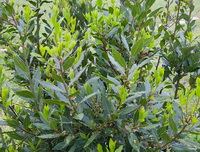 English Name: Bay or Sweet Bay
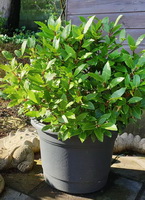 Botanical Description: Laurus nobilis is a small evergreen tree or shrub that grows up to 12 meters tall, with dark brown bark. Branchlets are cylindrical, bearing longitudinal fine stripes; young parts are slightly puberulent or nearly glabrous. Leaves are alternate, oblong or oblong-lanceolate, 5.5–12 cm long and 1.8–3.2 cm wide, with an acute or acuminate apex and a cuneate (wedge-shaped) base; the margin is finely undulate, the texture is coriaceous, the upper surface is dark green, the lower surface is slightly paler, both surfaces are glabrous, and venation is pinnate, with a convex midvein and lateral veins spreading on both sides; there are 10–12 lateral veins on each side, curving and connecting near the leaf margin. The petiole is 0.7–1 cm long, purplish-red when fresh, and slightly puberulent or nearly glabrous, with a ventral groove.
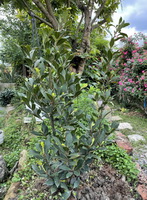 Ecological Environment: Laurus nobilis is native to Mediterranean countries and has been introduced and cultivated in North America and China.
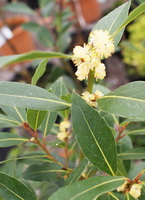 Main Values: Laurel trees are compact and aesthetically pleasing, with elegant form, delicate and glossy leaves, rich aroma, and year-round evergreen foliage; their pale yellow spring flowers are fragrant and attractive—especially striking when planted in courtyards. They are commonly used in front yards as green walls to define spaces, offering excellent screening effect. In landscape applications, they are often pruned into tufted forms, single-stemmed spheres, conical (tower) shapes, tall-stemmed spheres, or natural forms.
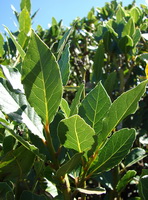 Characteristics of the Herb: Bay leaves are the leaves of Laurus nobilis; bay berries are the fruits of Laurus nobilis.
