✵This article documents the herb barberry, including its English name, Latin binomial, Pinyin name, common names, properties and flavor profile, botanical source—namely Berberis vulgaris L.—and provides a detailed description of its botanical features, growth characteristics, ecological environment, macroscopic and microscopic herb characteristics, pharmacological actions, medicinal efficacy, and administration guidelines.
Barberry (European barberry)
English Name: Barberry
Latin Name:Berberis vulgaris L.
Pinyin Name: Fú Niú Huā
Common Names: Common barberry, European barberry, berberry, pepperidge bush, pipperidge, jaundice berry, sowberry, sour-spine, mountain grape, woodsour
Properties and Flavor: The root bark is cold in nature and bitter in taste. The fruit pulp is juicy and sour.
Brief Introduction:Berberis vulgaris is native to central and southern Europe and is cultivated for its edible and medicinal fruits in many countries.
Botanical Source: Traditional herbal works define barberry as the dried stem bark and root bark of Berberis vulgaris L., a species of the genus Berberis in the family Berberidaceae (barberry family). In North America, only the dried stem and root bark are used medicinally; in Europe, both the fruit and the root bark are employed. This widely used species is described below:
(1) Berberis vulgaris L.
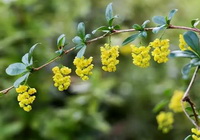
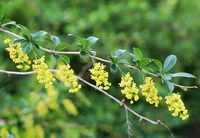
Botanical Description: Also known as European barberry, this deciduous, densely branched, thorny shrub grows up to 2 meters tall. Young branches are angular, deeply grooved, and brownish-yellow; older branches gradually turn whitish-gray. Thorns measure 1–2 cm and project horizontally. Leaves occur in fascicles (clusters), are obovate to elliptic, 2–4 cm long, narrow, dark green, reticulate-veined, and dentate along the margins. Flowers are bright yellow, 5–7 cm long, and grow in dense, pendulous racemes. Each flower has 6 yellow sepals, 6 petals with orange nectar glands at the base, and 6 stamens that dehisce laterally upon touch. The ovary is superior, with a flat stigma. The fruit is a bright scarlet, oblong-cylindrical berry, 10–12 mm long and ~6 mm in diameter. The exocarp is membranous-coriaceous and typically contains 2 seeds. Flowers emit a faintly unpleasant odor; stamens contact the carpels readily upon mechanical disturbance. The fruit pulp is juicy and distinctly sour.
Ecological Environment:Berberis vulgaris grows in light deciduous woodland, hedges, shady edges, woodland gardens with dappled shade, roadsides, and clearings. It is native to central and southern Europe, northwestern Africa, and western Asia, and is now naturalized in northern Europe—including the British Isles and Scandinavia—as well as eastern North America and rural New Zealand, where it has been widely cultivated as a hedging plant on farms.
Growth Characteristics:Berberis vulgaris prefers a sunny position and thrives in warm, moist, loamy soil; however, it is not fastidious and succeeds in thin, dry, or shallow soils, as well as heavy clay. It grows well in full sun or light shade but requires consistently moist soil when grown under tree canopies.
Berberis vulgaris is an alternate host for wheat stem rust (Puccinia graminis), a fungal pathogen that significantly reduces wheat yields. Consequently, its import and cultivation are prohibited in several countries and regions.
Characteristics of the Herb: Barberries are the ripe fruits of Berberis vulgaris. Barberry root bark (or berberis bark) refers to the dried root bark of Berberis vulgaris. Berberis aquifolium—a closely related North American species—is commonly used in commercially available Oregon grape products.
Medicinal Efficacy: Barberry root bark is a source of vitamin C, which supports immune function, enhances non-heme iron absorption, and prevents scurvy. Traditionally, it has been used for gastric upset and peptic ulcers, diarrhea, heartburn, hypertension, respiratory congestion associated with cough, oral ulcers, sore throat, fever, infections, and abnormal uterine bleeding. In Europe, it was historically employed to alleviate symptoms of liver disease. In North America, it appeared in early 20th-century alternative cancer protocols—though these lacked scientific validation. In homeopathy, highly diluted preparations are indicated for arthritis, intestinal disorders, sciatica, and herpes simplex. The vitamin C–rich berries are used in jams and jellies; historically, the roots were also valued as a source of yellow dye.
The antimicrobial activity of barberry root bark is primarily attributed to its isoquinoline alkaloids—especially berberine—which exhibit activity against bacteria, fungi, and protozoa responsible for wound infections, urinary tract infections, vaginal candidiasis, cholera, and infectious diarrhea. Berbamine—a related alkaloid—has been shown to stimulate white blood cell and macrophage activity, thereby enhancing innate immune defense. Additional documented pharmacological properties include sedative, anticonvulsant, antiarrhythmic, uterotonic, hypotensive, antispasmodic, and antiamebic effects.
In Europe, decoctions of barberry fruit have traditionally been recommended for pulmonary, splenic, and hepatic disorders. Fresh berry jam or wine is used to relieve constipation and stimulate appetite; alcoholic extracts of the berries were historically employed for heartburn and gastric cramps, as well as for infections, febrile colds, and urinary tract disorders. The root is used in folk medicine for hepatic dysfunction, cholecystitis, jaundice, splenomegaly, indigestion, diarrhea, tuberculosis, hemorrhoids, renal disease, urinary tract disorders, gout, rheumatism, arthritis, lumbago, malaria, and leishmaniasis. In homeopathic practice, it is indicated for kidney stones, gout, rheumatism, hepatic and biliary disorders, and xerosis (dry skin).
In North America, berberine salts were formerly used in ophthalmic solutions to soothe inflamed eyelids and manage allergic conjunctivitis (“pink eye”) and other ocular irritations—including soreness, photosensitivity, and conjunctival injection—but such use is now extremely rare in the United States.
Administration of Barberry (Berberis vulgaris, European barberry):
Reference:
Administration Guide for Barberry
Herbal classic works:
— Internally, barberry is used as infusions, decoctions, or standardized extracts.
— A tea infusion is prepared by pouring 150 mL of freshly boiled water over 1–2 tsp (2–4 grams) of dried, whole or crushed barberries; steep for 10–15 minutes, then strain. Typical dosage: 2–3 cups daily. The dosage of the infusion is 2 grams in 250 ml water, to be sipped, the tincture dosage is 20 to 40 drops daily.
— A decoction of root bark is prepared by simmering a half teaspoon (0.5–1 grams) of powdered root bark in 250 mL water for 10–15 minutes; strain and drink once daily.
— The tincture is dosed at 1 and a half to 3 teaspoons, up to three times daily. The dropperful may be a more appropriate dosage if the alcohol content is high.
— Homeopathic preparations recommended as 5 drops, 1 tablet, or 10 globules every 30 to 60 minutes for an acute condition, or 1 to 3 times daily for a chronic condition, or parenterally 1 to mL 3 times daily, or suppositories 2 to 3 times daily, or ointment 1 to 2 times daily.
Contraindications, Precautions, and Adverse Reactions: There are no known health hazards or side effects associated with the proper administration of designated therapeutic dosages. Berberine and berberine-containing plants are generally considered nontoxic at commonly reported doses; however, berberine doses greater than 0.5 grams have been associated with skin and eye irritation, nosebleeds, shortness of breath, lethargy, nausea, vomiting, and diarrhea. Cases of kidney irritation and inflammation, as well as fatal poisonings, have been reported. High doses may alter the normal metabolism of vitamin B. Pregnant women should avoid this herb, as it may stimulate uterine muscles.

 ✵This article documents the herb barberry, including its English name, Latin binomial, Pinyin name, common names, properties and flavor profile, botanical source—namely Berberis vulgaris L.—and provides a detailed description of its botanical features, growth characteristics, ecological environment, macroscopic and microscopic herb characteristics, pharmacological actions, medicinal efficacy, and administration guidelines.
 English Name: Barberry
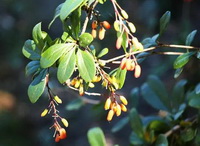 Botanical Description: Also known as European barberry, this deciduous, densely branched, thorny shrub grows up to 2 meters tall. Young branches are angular, deeply grooved, and brownish-yellow; older branches gradually turn whitish-gray. Thorns measure 1–2 cm and project horizontally. Leaves occur in fascicles (clusters), are obovate to elliptic, 2–4 cm long, narrow, dark green, reticulate-veined, and dentate along the margins. Flowers are bright yellow, 5–7 cm long, and grow in dense, pendulous racemes. Each flower has 6 yellow sepals, 6 petals with orange nectar glands at the base, and 6 stamens that dehisce laterally upon touch. The ovary is superior, with a flat stigma. The fruit is a bright scarlet, oblong-cylindrical berry, 10–12 mm long and ~6 mm in diameter. The exocarp is membranous-coriaceous and typically contains 2 seeds. Flowers emit a faintly unpleasant odor; stamens contact the carpels readily upon mechanical disturbance. The fruit pulp is juicy and distinctly sour.
 Ecological Environment: Berberis vulgaris grows in light deciduous woodland, hedges, shady edges, woodland gardens with dappled shade, roadsides, and clearings. It is native to central and southern Europe, northwestern Africa, and western Asia, and is now naturalized in northern Europe—including the British Isles and Scandinavia—as well as eastern North America and rural New Zealand, where it has been widely cultivated as a hedging plant on farms.
