✵The article records the herb Arnica, including its English name, Latin name, Pinyin name, common names, properties and flavors, and botanical sources—five plant species: (1) Arnica montana L., (2) Arnica fulgens Pursh., (3) Arnica sororia Greene, (4) Arnica latifolia Bong., and (5) Arnica cordifolia Hook. It offers a detailed introduction to the botanical features of these five species, the growth characteristics and ecological environments of the two most commonly used species, the morphological and pharmacognostic features of the herb Arnica, its pharmacological actions, medicinal efficacy, and administration guidelines.
Arnica (mountain arnica, wolfsbane)
English Name: Arnica
Latin Name:Arnica montana L. and related species
Pinyin Name: Shān Jīn Chē
Common Names: Leopard’s bane, mountain snuff, mountain tobacco, mountain arnica, wolfsbane
Properties and Flavor: The dried flower heads are aromatic; the taste is bitter and slightly irritating.
Brief Introduction: Arnica refers to the dried flower heads of Arnica montana L. or other Arnica species native to the United States of America. Species used include Arnica fulgens Pursh., Arnica sororia Greene, Arnica latifolia Bong., and Arnica cordifolia Hook. Arnica is classified as a protected species in many countries.
Botanical Source: Traditional herbal classics define Arnica as the dried flower heads of (1) Arnica montana L. and other Arnica species native to the USA: (2) Arnica fulgens Pursh., (3) Arnica sororia Greene, (4) Arnica latifolia Bong., and (5) Arnica cordifolia Hook. It belongs to the genus Arnica in the Asteraceae family (the daisy or composite family). The dried flower heads have been used medicinally for centuries; rhizomes are occasionally used as well. In Europe, the essential oil of the flowers, dried flowers, leaves collected before flowering and then dried, roots, and dried rhizomes and roots are all employed medicinally. Descriptions of these five commonly used species follow:
(1) Arnica montana L.
Botanical Description:Arnica montana L. is a perennial herb in the Asteraceae family (the daisy or composite family). It grows 15–60 cm tall and bears basal, downy leaves. Flowering occurs from May to August. Its inflorescences consist of yellow-orange ray florets surrounding yellow disk florets; the flowers are solitary and terminal on the stem. Leaves form tight rosettes at the base of the stem, and the flowers are yellow and daisy-like.
Ecological Environment:Arnica montana L., also known as wolfsbane or mountain arnica, is native to Europe. According to herbal literature, it blooms annually from May to August and grows in mountainous regions—the specific epithet “montana” meaning “of mountains.” Its native habitats include grasslands, shrublands, and alpine environments. It is also found in forests, meadows, seeps, dry pine forests, and pastures. Its distribution in Europe extends from Scandinavia to southern Europe and into Central Asia.
Growth Characteristics:Arnica montana L. tolerates most soils provided they are lime-free and well-drained, and it thrives in full sun to partial shade. It prefers slightly alkaline, moist, sandy loam. This plant is toxic and has been listed as endangered in many regions due to overharvesting for medicinal use.
(2) Arnica fulgens Pursh.
Botanical Description:Arnica fulgens Pursh., also known as hillside arnica, foothill arnica, orange arnica, or shining leopard’s bane, is a herbaceous perennial in the genus Arnica, Asteraceae family. It produces one or more unbranched stems and grows 10–75 cm tall. Flowering occurs from May to July, occasionally extending into late August.
Ecological Environment:Arnica fulgens is native to North America, primarily the USA and Canada. Its range spans central and northwestern North America—from British Columbia in the north to California and Colorado in the south. It grows wild (not cultivated) in meadows and seeps, lower montane coniferous forests, and Great Basin scrub. It prefers moist, well-drained, humus-rich, lime-free soil—a mixture of sand, loam, and peat.
The plant is typically harvested from the wild for medicinal use in North America and enjoys a reputation similar to that of Arnica montana L. in Europe. The whole plant is toxic and should be used externally only on unbroken skin.
(3) Arnica sororia Green.
Botanical Description:Arnica sororia is a dicotyledonous, rhizomatous perennial herb, also known as twin arnica. It bears one or more piliferous, glandular stems and grows up to 10–50 cm tall. Several pairs of broadly lance-shaped leaves grow along the stem; the lower leaves are petiolate and may reach up to 14 cm in length. The inflorescence consists of a single daisy-like flower head per stem (rarely more than one). The phyllaries are lined with glandular hairs. Each flower head features a central cluster of glandular yellow disc florets surrounded by a fringe of yellow ray florets. The fruit is an achene, a few millimeters long, bearing a white pappus. Flowering occurs in early summer.
Ecological Environment: The plant is native to western North America, including western USA and western Canada. It grows in grasslands, coniferous forests, sagebrush steppe, damp meadows, dry rocky soils within sagebrush communities, shrub-steppe, and east-side forests, typically at mid-elevations.
(4) Arnica latifolia Bong.
Botanical Description:Arnica latifolia Bong. is also known as broadleaf arnica. A synonym is Arnica latifolia var. angustifolia Herder. Other common names include broad-leaved arnica, mountain arnica, and daffodil leopard’s bane. It is a perennial herb in the genus Arnica, Asteraceae family. It possesses a long rhizome; its stem is piliferous and mostly glabrous, growing 10–50 cm tall. A basal rosette of leaves is present, along with a few pairs of leaves on the lower part of the stem. The leaves are lance-shaped to broadly ovate and nearly cordate, usually toothed. One or more daisy-like flower heads—each subtended by piliferous phyllaries—form a loose cluster. Each head has a central cluster of yellow disc florets and several yellow ray florets up to 3 cm long. The fruit is an achene bearing a white pappus.
Ecological Environment:Arnica latifolia typically grows in open habitats. Its leaves are usually sessile and rarely cordate. It inhabits mountain environments such as forests, meadows, and open areas, preferring sandy or loamy soils and performing poorly in heavy clay soils.
Arnica latifolia Bong. is native to North America and distributed primarily across western North America—from Alaska to New Mexico.
(5) Arnica cordifolia Hook.
Botanical Description:Arnica cordifolia Hook. is also known as heartleaf arnica. It is an upright, glandular, piliferous perennial herb growing 15–60 cm tall, usually with one to few unbranched stems. It bears 2–4 pairs of cordate leaves; the specific epithet “cordifolia” means “heart-leaved”, and although the cordate shape is often evident, leaf morphology is highly variable—upper leaves may be elongated-triangular, while lower leaves are shallowly serrated at the margins. Each flower head comprises 10–15 pointed ray florets surrounding a central disk densely covered with long, soft hairs.
Ecological Environment:Arnica cordifolia typically grows in shady woodlands, under light shade cast by trees or rocks at mid- to high elevations in mountains. Its leaves are usually petiolate. Habitats include west-side and east-side forests of North America, meadows, subalpine, and alpine zones. It is one of the most widespread and common Arnica species.
Arnica cordifolia Hook. is native to North America—from subarctic regions southward through western and west-central USA—and is distributed predominantly across western and northern North America.
Characteristics of the Herb: Flowers arise from the axils of the uppermost pair of leaves. They measure 6–8 cm in diameter and are typically egg-yolk yellow to orange-yellow, occasionally pale yellow. The rhizome may be trifurcated, bearing numerous yellow-brown secondary roots. The fruit is 5-ribbed, blackish-brown, and crowned with a bristly pappus.
Pharmacological Actions: (1) anti-inflammatory and analgesic effects; (2) mild antibacterial activity; (3) counterirritant action; (4) soothing effect on minor scrapes and muscular aches; (5) antiseptic properties.
Medicinal Efficacy:Arnica montana is a widely used medicinal plant traditionally employed to treat various inflammatory and traumatic conditions. It is extensively utilized in homeopathy for pain management and postoperative recovery. Though it has diverse applications, its most common uses include treatment of bruising, swelling, post-exertional muscle soreness, and promotion of skin clarity. In Europe, it is applied topically as a counterirritant, anti-inflammatory, and analgesic. It is also used to soothe sore throats, alleviate inflamed hemorrhoids, and incorporated into herbal preparations for psoriasis and seborrheic eczema.
Administration of Arnica:
Reference:
Administration Guide for Arnica
Herbal classic works:
Commonly recommended dosages of Arnica include: 1 tablespoon of tincture per half liter of water; an infusion prepared using 2 grams of arnica per 100 mL of water; tincture diluted 3–10 times with water for use in poultices; and ointments containing 15% arnica oil or 20–25% arnica tincture. Arnica must not be used internally or on broken skin.
Contraindications, Precautions, and Adverse Reactions: The U.S. FDA classifies arnica as an unsafe herb for internal use. Experts worldwide strongly advise against oral or systemic administration of arnica preparations, as they may irritate mucous membranes and cause gastric burning, vomiting, diarrhea, and drowsiness. Ingestion of approximately 1 oz (ounce, 30 mL) of tincture may lead to shortness of breath, elevated blood pressure, and cardiac damage; overdose can be fatal. In contrast, topical formulations are generally well tolerated by most individuals, though allergic contact dermatitis is relatively common. Individuals with known hypersensitivity to arnica or other members of the Asteraceae family (e.g., ragweed, chamomile, echinacea) should avoid its use.

 ✵The article records the herb Arnica, including its English name, Latin name, Pinyin name, common names, properties and flavors, and botanical sources—five plant species: (1) Arnica montana L., (2) Arnica fulgens Pursh., (3) Arnica sororia Greene, (4) Arnica latifolia Bong., and (5) Arnica cordifolia Hook. It offers a detailed introduction to the botanical features of these five species, the growth characteristics and ecological environments of the two most commonly used species, the morphological and pharmacognostic features of the herb Arnica, its pharmacological actions, medicinal efficacy, and administration guidelines.
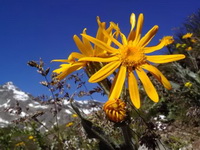 English Name: Arnica
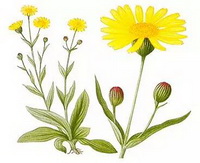 Botanical Description: Arnica montana L. is a perennial herb in the Asteraceae family (the daisy or composite family). It grows 15–60 cm tall and bears basal, downy leaves. Flowering occurs from May to August. Its inflorescences consist of yellow-orange ray florets surrounding yellow disk florets; the flowers are solitary and terminal on the stem. Leaves form tight rosettes at the base of the stem, and the flowers are yellow and daisy-like.
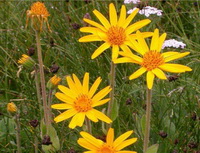 Growth Characteristics: Arnica montana L. tolerates most soils provided they are lime-free and well-drained, and it thrives in full sun to partial shade. It prefers slightly alkaline, moist, sandy loam. This plant is toxic and has been listed as endangered in many regions due to overharvesting for medicinal use.
