Introduction of Sweet Almond: Sweet Amygdalus Kernel.
✵The article documents the herb Sweet Almond, including its English name, Latin name, Pinyin name, common names, properties and flavor, botanical source—namely one plant species, Prunus amygdalus Batsch—and provides a detailed introduction to the botanical features, growth characteristics, and ecological environment of this species, as well as the characteristics of the herb Sweet Almond, its pharmacological actions, medicinal efficacy, and administration guidelines.
Sweet Almond (Sweet Amygdalus Kernel)
English Name: Almond, sweet
Latin Name:Prunus amygdalus (Mill.) D. A. Webb
Pinyin Name: Biǎn Táo Rén, Tiánwèi Biǎn Táo Rén
Common Names: Sweet Almond, Sweet Amygdalus kernel, Badan Xing Ren
Property and Flavor: Neutral in nature; tastes sweet and slightly bitter; mildly toxic.
Brief Introduction:Prunus amygdalus, a flowering deciduous tree of the Rosaceae family (rose family), is native to Western Asia and has been cultivated for thousands of years. Though commonly called “almond,” it belongs to the Amygdalus subgenus—not the true almond (Prunus dulcis, formerly Amygdalus communis), which is now widely accepted as a synonym or variant.
Botanical Source: Traditional herbal classics define Sweet Almond as the dried seed of Prunus amygdalus Batsch. It is a species within the Amygdalus subgenus of the Rosaceae family. The seed is used medicinally. This commonly employed species is described below:
(1) Prunus amygdalus Batsch.
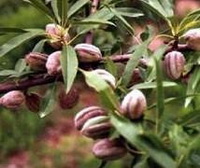
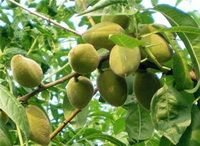
Botanical Description:Prunus amygdalus Batsch is a deciduous tree or shrub, growing 2–8 meters tall. Branches are upright or spreading, bearing numerous short branches. Annual branches are light brown; perennial branches are grayish brown to grayish black. Leaves on annual branches are alternate; those on short branches are often clustered. Petioles measure 1–2.5 cm long and typically bear 2–4 glands at the base of the leaf blade and petiole. Leaf blades are lanceolate or elliptic-lanceolate, 3–9 cm long and 1–2.5 cm wide; apex acute to shortly acuminate; base is broadly cuneate to rounded; margin is shallowly serrate. Flowers are hermaphroditic and solitary, appearing before leaf emergence. The calyx tube is cylindrical; sepals (5) are broadly oblong to broadly lanceolate, with pilose margins; petals (5) are oblong, 1.5–2 cm long, with rounded or slightly concave apices and gradually narrowed bases forming claws; color ranges from white to pink. Stamens are numerous and variable in length; the style exceeds the stamens in length; the ovary is densely villous. Fruit is obliquely ovoid or oblong, flattened, 3–4.3 cm long and 2–3 cm in diameter, externally densely pubescent; mesocarp is thin and dehiscent at maturity; seed is ovoid to broadly ovoid, asymmetric, with honeycomb-like surface pits. Flowering occurs from March to April; fruiting from July to August.
Ecological Environment:Prunus amygdalus is native to Western Asia and grows in mountainous regions at low to medium elevations, particularly on stony, arid slopes. It is now widely cultivated across both Old and New World regions—especially in warm, arid climates—such as California (USA), Italy, Spain, and East Asia.
Growth Characteristics:Prunus amygdalus prefers deep, sandy loam soils with good drainage and aeration, but it is highly adaptable: it tolerates barren land, gravelly soil, sandy soil, clay loam, calcareous (lime) soil, and even mildly saline-alkali soils. It is a sun-loving (photophilic) species.
Characteristics of the Herb: The medicinal seed is primarily derived from two variants of Amygdalus: Prunus amygdalus var. dulcis (sweet type) and Prunus amygdalus var. amara (bitter type).
Sweet Amygdalus Kernel: The dried seed of Prunus amygdalus var. dulcis, oblong-ovoid and flattened, measuring approximately 2–3 cm in length, 10–16 mm in width, and 8 mm in thickness. The seed coat is thin, reddish-brown, finely powdery, and acutely tapered at one end. The margin is rounded; the hilum is linear and located near the apex; the chalaza lies at the base. From the chalaza, numerous vascular bundles extend toward the apex, forming conspicuous dark furrows. The embryo is straight and whitish, composed of two plano-convex cotyledons, with the hypocotyl and radicle enclosed within; the latter terminates at the acute end. Odorless; taste sweet; yields a sweet, odorless emulsion when ground.
Bitter Amygdalus Kernel: The dried seed of Prunus amygdalus var. amara. Morphologically similar to the sweet type but smaller and more irregular—typically ~2 cm long, 12 mm wide, and 8 mm thick. Taste is distinctly bitter; emits a characteristic odor when crushed into an emulsion.
Pharmacological Actions: (1) Effects on the circulatory system; (2) anticoagulant and antithrombotic effects; (3) anti-inflammatory activity; (4) anti-allergic activity; (5) intestinal lubrication and laxative effect; etc.
Medicinal Efficacy: Promotes blood circulation, dispels blood stasis, and moistens the intestines to relieve constipation. It is indicated for dysmenorrhea (menstrual pain), amenorrhea due to blood stasis, postpartum abdominal pain caused by blood stasis, traumatic injury with swelling and pain due to blood stasis, chest or epigastric pain, intestinal pain, and constipation due to intestinal dryness.
Administration of Sweet Almond (Sweet Amygdalus kernel)
Reference:
Administration Guide for Sweet Almond (Sweet Amygdalus kernel)
Herbal Classics and TCM Works:
Oral administration—decoction, 6–10 grams; seeds must be crushed before use. May also be prepared as pills or powders. For frost-like powder preparation, the wrap-boiling method is required. Common dosage recommended in North America: Sweet almond oil or emulsion is used as a laxative in doses up to 30 mL. A handful of sweet almond meal is used as a facial scrub and gently rubbed onto dry skin.
Experts consider both sweet almond oil and sweet almond meal safe for topical use; neither appears to irritate nor sensitize human skin. As with any food-derived product, allergic reactions remain a potential risk.
References:
1.Introduction of Sweet Almond:Sweet Amygdalus Kernel.

 ✵The article documents the herb Sweet Almond, including its English name, Latin name, Pinyin name, common names, properties and flavor, botanical source—namely one plant species, Prunus amygdalus Batsch—and provides a detailed introduction to the botanical features, growth characteristics, and ecological environment of this species, as well as the characteristics of the herb Sweet Almond, its pharmacological actions, medicinal efficacy, and administration guidelines.
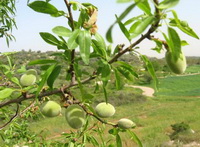 English Name: Almond, sweet
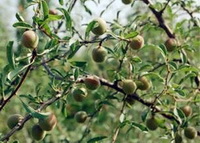 Botanical Description: Prunus amygdalus Batsch is a deciduous tree or shrub, growing 2–8 meters tall. Branches are upright or spreading, bearing numerous short branches. Annual branches are light brown; perennial branches are grayish brown to grayish black. Leaves on annual branches are alternate; those on short branches are often clustered. Petioles measure 1–2.5 cm long and typically bear 2–4 glands at the base of the leaf blade and petiole. Leaf blades are lanceolate or elliptic-lanceolate, 3–9 cm long and 1–2.5 cm wide; apex acute to shortly acuminate; base is broadly cuneate to rounded; margin is shallowly serrate. Flowers are hermaphroditic and solitary, appearing before leaf emergence. The calyx tube is cylindrical; sepals (5) are broadly oblong to broadly lanceolate, with pilose margins; petals (5) are oblong, 1.5–2 cm long, with rounded or slightly concave apices and gradually narrowed bases forming claws; color ranges from white to pink. Stamens are numerous and variable in length; the style exceeds the stamens in length; the ovary is densely villous. Fruit is obliquely ovoid or oblong, flattened, 3–4.3 cm long and 2–3 cm in diameter, externally densely pubescent; mesocarp is thin and dehiscent at maturity; seed is ovoid to broadly ovoid, asymmetric, with honeycomb-like surface pits. Flowering occurs from March to April; fruiting from July to August.
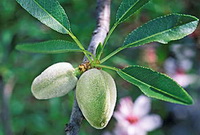 Ecological Environment: Prunus amygdalus is native to Western Asia and grows in mountainous regions at low to medium elevations, particularly on stony, arid slopes. It is now widely cultivated across both Old and New World regions—especially in warm, arid climates—such as California (USA), Italy, Spain, and East Asia.
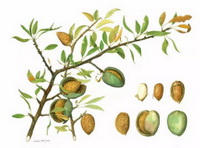 Characteristics of the Herb: The medicinal seed is primarily derived from two variants of Amygdalus: Prunus amygdalus var. dulcis (sweet type) and Prunus amygdalus var. amara (bitter type).
 Bitter Amygdalus Kernel: The dried seed of Prunus amygdalus var. amara. Morphologically similar to the sweet type but smaller and more irregular—typically ~2 cm long, 12 mm wide, and 8 mm thick. Taste is distinctly bitter; emits a characteristic odor when crushed into an emulsion.
 Pharmacological Actions: (1) Effects on the circulatory system; (2) anticoagulant and antithrombotic effects; (3) anti-inflammatory activity; (4) anti-allergic activity; (5) intestinal lubrication and laxative effect; etc.
