✵The article records the herb alfalfa, including its English name, Latin name, Pinyin name, common names, properties and flavor, and botanical sources—namely the two plant species (1) Medicago sativa L. and (2) Medicago polymorpha L.—along with a detailed introduction to the botanical features, growth characteristics, and ecological environments of these species; the morphological and quality features of the dried herb alfalfa; its pharmacological actions; medicinal efficacy; and administration guidelines.
Alfalfa (Medicago sativa)
English Name: Alfalfa.
Latin Name:Medicago sativa L.
Pinyin Name: Zǐ Mù Xu, Zǐ Huā Mù Xu
Common Names: Alfalfa, lucerne, medick, purple medick, trefoil
Properties and Flavor: Neutral; bitter and slightly astringent; non-toxic
Brief Introduction: The genus name Medicago refers to Medea, from whom this plant is thought to have originated. The specific epithet sativa means “cultivated” or “with a long history of cultivation.”
Medicago sativa is a forage legume. Its high protein content makes it suitable for livestock feed. It possesses a tetraploid genome. Medicago sativa was likely domesticated in the eastern Mediterranean region during the Bronze Age to feed horses imported from Central Asia and later spread to Europe.
Medicago sativa is widely cultivated for lucerne hay production. The greatest cost in hay production lies in stand establishment; gradual thinning and invasion by weeds and grasses can shorten pasture longevity. Herbicide combinations may be required for weed control. A genetically modified variety tolerant to glyphosate (Roundup®) has been developed and underwent field trials in preparation for a 2004–2005 release in the United States.
Botanical Source: Classical Traditional Chinese Medicine (TCM) works define alfalfa as the whole plant of (1) Medicago sativa L. or (2) Medicago polymorpha L. These are two species of the genus Medicago, family Fabaceae (legume family, formerly Leguminosae). In North America and Europe, Medicago sativa is recognized as the primary botanical source of alfalfa: in North America, the trifoliate leaf clusters and pale blue, purple, or yellow flowers are used medicinally; in Europe, the whole flowering plant or germinating seeds are employed. The two commonly used species are described below:
(1) Medicago sativa L.
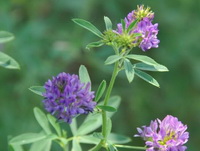
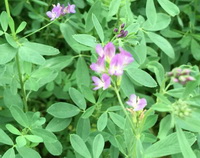
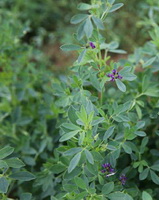
Botanical Description: A perennial herb. The main taproot extends 2–5 meters deep. Rhizomes are well developed; the root is thick and deeply penetrating, with a prominent root neck. Stems are 30–100 cm tall, erect or prostrate, smooth, and highly branched (15–25 branches). Leaves are pinnately trifoliolate; leaflets are obovate-oblong, 2–2.5 cm long, with serrations confined to the apical portion only. The leaflet apex bears a distinct midrib projection. Petioles are elongated and glabrous. Stipules are large and lanceolate. Pedicels arise from leaf axils; flowers are short-stalked and arranged in racemes of 8–25. The calyx is campanulate with five teeth; the corolla is purple. Pods are tightly coiled (spiral), sparsely pilose, dark brown, and indehiscent. Each pod contains 1–8 reniform, yellowish-brown, minute seeds. Flowering occurs from May to June; fruiting from June to August.
Ecological Environment:Medicago sativa prefers warm, semi-humid to semi-arid climates and exhibits broad environmental adaptability. In low-precipitation regions, it demonstrates drought tolerance. It possesses strong cold resistance and can survive winter temperatures as low as −30 °C. Its root system is extensive: approximately 60% of total root mass is concentrated in the 0–75 cm soil layer.
Growth Characteristics:Medicago sativa grows in fields, along roadsides, in wilderness areas, grasslands, riverbanks, and valleys. It is widely distributed and extensively cultivated as forage and pasture across Asia, Europe, and other continents worldwide.
(2) Medicago polymorpha L.
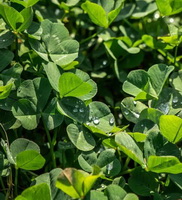
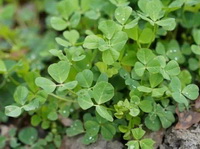
Botanical Description: It is known as burclover, Nán Mù Xu (southern alfalfa), Jīn Huā Mù Xu (golden-flower alfafa), Cǎo Mù Xu. An annual or biennial herb, 20–90 cm tall. Stems are prostrate, ascending, or erect; nearly quadrangular; branched at the base; glabrous or sparsely pilose. Leaves are pinnately trifoliolate; stipules are large, ovoid-oblong (4–7 mm long), with an acuminate apex, auriculate base, irregularly dentate or deeply lobed margins bearing filiform lobes or notches, and prominent veins. Petioles are soft, slender (1–5 cm long), and shallowly grooved adaxially. Leaflets are obovate or triangular-ovate, subequal in size (7–20 mm long × 5–15 mm wide), chartaceous, obtuse to truncate or slightly concave at the apex, apiculate, broadly cuneate at the base, and shallowly serrate on the apical one-third of the margin; upper surface is glabrous; lower surface is sparsely pilose; without glandular dots. Inflorescences are umbelliform, with 2–10 flowers; the peduncle is axillary, slender, glabrous (3–15 mm long), usually shorter than the leaves, and the inflorescence axis apex is not aristate. Pods are discoid, dark greenish-brown; each coil contains 1–2 seeds. Seeds are reniform, ~2.5 mm long × 1.25 mm wide, tan, and smooth. Flowering occurs from March to May; fruiting from May to June.
Ecological Environment:Medicago polymorpha thrives in fertile, well-drained soils—particularly dry upland sites. Optimal growth temperature ranges from 12–17 °C (53.6–62.6 °F); it grows well in subtropical regions and exhibits strong cold tolerance. Although foliage may be killed by frost at −5 °C (23 °F), regrowth occurs upon warming. It displays broad soil adaptability and grows normally across a pH range of 5.0–8.6.
Medicago polymorpha is commonly cultivated or grows semi-wild. It is native to southern Europe and southwestern Asia, and has been introduced to the Americas, Oceania, and China—where it is widely distributed and locally cultivated.
Medicinal Efficacy: In North America, alfalfa is used—consistent with traditional indications in China and Europe—as a diuretic and for managing arthritis, diabetes, asthma, digestive disturbances, weight management, peptic ulcers, hypercholesterolemia, urinary and bladder disorders, prostate conditions, allergic rhinitis (hay fever), and other ailments. Many herbalists recommend it as a vitalizing tonic. Alfalfa is a rich source of chlorophyll. In European folk medicine, it is traditionally employed for “diabetes mellitus and thyroid dysfunction.” In Traditional Chinese Medicine (TCM), alfalfa is indicated for urinary calculi (urolithiasis), vesical calculi, and stranguria; and for TCM syndromes including generalized edema (anasarca), consumptive thirst (xiao ke syndrome), and polyphagia-polyuria syndrome.
Administration of Alfalfa (Medicago sativa):
Reference:
Administration Guide for Alfalfa (Medicago sativa)
Herbal Classic and TCM Works:
In North America, the recommended dosage is an infusion prepared with 1–2 tsp (teaspoons) of dried aerial parts per cup of boiling water, taken up to three times daily. For commercial formulations, follow label instructions. In Europe, the typical dose for hyperlipoproteinemia is 40 g of heat-processed seeds, administered three times daily with meals. In TCM works, internal administration includes fresh juice (3–5 liang, ≈90–150 g) or powdered herb (2–3 qian, ≈6–9 g).
Contraindications, Precautions, and Adverse Reactions: Alfalfa is generally recognized as safe (GRAS) by the U.S. FDA. Contact dermatitis has been reported in hypersensitive individuals. Toxicity: The hemolytic activity of alfalfa root saponins is mitigated by cholesterol and β-sitosterol.

 ✵The article records the herb alfalfa, including its English name, Latin name, Pinyin name, common names, properties and flavor, and botanical sources—namely the two plant species (1) Medicago sativa L. and (2) Medicago polymorpha L.—along with a detailed introduction to the botanical features, growth characteristics, and ecological environments of these species; the morphological and quality features of the dried herb alfalfa; its pharmacological actions; medicinal efficacy; and administration guidelines.
 English Name: Alfalfa.
 Botanical Description: A perennial herb. The main taproot extends 2–5 meters deep. Rhizomes are well developed; the root is thick and deeply penetrating, with a prominent root neck. Stems are 30–100 cm tall, erect or prostrate, smooth, and highly branched (15–25 branches). Leaves are pinnately trifoliolate; leaflets are obovate-oblong, 2–2.5 cm long, with serrations confined to the apical portion only. The leaflet apex bears a distinct midrib projection. Petioles are elongated and glabrous. Stipules are large and lanceolate. Pedicels arise from leaf axils; flowers are short-stalked and arranged in racemes of 8–25. The calyx is campanulate with five teeth; the corolla is purple. Pods are tightly coiled (spiral), sparsely pilose, dark brown, and indehiscent. Each pod contains 1–8 reniform, yellowish-brown, minute seeds. Flowering occurs from May to June; fruiting from June to August.
 Ecological Environment: Medicago sativa prefers warm, semi-humid to semi-arid climates and exhibits broad environmental adaptability. In low-precipitation regions, it demonstrates drought tolerance. It possesses strong cold resistance and can survive winter temperatures as low as −30 °C. Its root system is extensive: approximately 60% of total root mass is concentrated in the 0–75 cm soil layer.
 Botanical Description: It is known as burclover, Nán Mù Xu (southern alfalfa), Jīn Huā Mù Xu (golden-flower alfafa), Cǎo Mù Xu. An annual or biennial herb, 20–90 cm tall. Stems are prostrate, ascending, or erect; nearly quadrangular; branched at the base; glabrous or sparsely pilose. Leaves are pinnately trifoliolate; stipules are large, ovoid-oblong (4–7 mm long), with an acuminate apex, auriculate base, irregularly dentate or deeply lobed margins bearing filiform lobes or notches, and prominent veins. Petioles are soft, slender (1–5 cm long), and shallowly grooved adaxially. Leaflets are obovate or triangular-ovate, subequal in size (7–20 mm long × 5–15 mm wide), chartaceous, obtuse to truncate or slightly concave at the apex, apiculate, broadly cuneate at the base, and shallowly serrate on the apical one-third of the margin; upper surface is glabrous; lower surface is sparsely pilose; without glandular dots. Inflorescences are umbelliform, with 2–10 flowers; the peduncle is axillary, slender, glabrous (3–15 mm long), usually shorter than the leaves, and the inflorescence axis apex is not aristate. Pods are discoid, dark greenish-brown; each coil contains 1–2 seeds. Seeds are reniform, ~2.5 mm long × 1.25 mm wide, tan, and smooth. Flowering occurs from March to May; fruiting from May to June.
 Ecological Environment: Medicago polymorpha thrives in fertile, well-drained soils—particularly dry upland sites. Optimal growth temperature ranges from 12–17 °C (53.6–62.6 °F); it grows well in subtropical regions and exhibits strong cold tolerance. Although foliage may be killed by frost at −5 °C (23 °F), regrowth occurs upon warming. It displays broad soil adaptability and grows normally across a pH range of 5.0–8.6.
