✵The article records the herb agrimony, including its English name, Latin name, Pinyin name, common names, properties and flavor, botanical source—namely the plant species Agrimonia eupatoria—along with a detailed introduction to the botanical features, growth characteristics, and ecological environment of this species; the morphological and quality features of the dried herb agrimony; its pharmacological actions; medicinal efficacy; and administration guidelines.
Agrimony (Church Steeples)
English Name: Agrimony
Latin Name:Agrimonia eupatoria L.
Pinyin Name: Lóng Yá Cǎo
Common Names: Church steeples, cocklebur, liverwort, stickwort
Properties and Flavor: Neutral; bitter and pungent
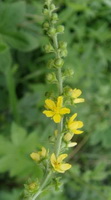
Brief Introduction:Agrimonia eupatoria is an aromatic perennial native to the Northern Hemisphere. Its yellow flowering tops are used medicinally. Star-shaped flowers bloom along an erect stem, forming tall spikes. Although less commonly used, the small hooked fruits, leaves, and roots have also been employed in traditional medicine.
Botanical Source: Classical herbal works define agrimony as the dried yellow flowering tops of Agrimonia eupatoria. It is a species of the genus Agrimonia, family Rosaceae (rose family). This widely used species is described below:
(1) Agrimonia eupatoria
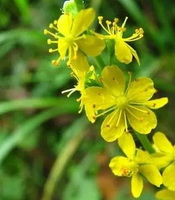
Botanical Description:Agrimonia eupatoria is a perennial, herbaceous, deciduous plant reaching up to 100 cm in height, with stout, cylindrical roots and short rhizomes. The stem, petioles, leaf axes, and inflorescence axes are villous and pubescent. It bears typical pinnate leaves with serrated margins, comprising 3–5 pairs of leaflets; the uppermost leaflets are reduced to 1–2 pairs. Leaflets are elliptic-obovate, rhombic-obovate, or oblanceolate, measuring 2.5–6 cm in length and 1–3 cm in width, with thickly serrated edges, sparse pilose hairs along the lower veins or between veins, and golden glandular dots. Upper stipules are reniform, coarsely toothed, and amplexicaul (stem-clasping); lower stipules are lanceolate and often entire. Flowering occurs from June to September, producing elongated spikes. Each flower has a single urn-shaped, curved hypanthium with several rows of soft, curved, hook-shaped bristles along the upper margin (1–4 mm long), five yellow, rounded petals, and five sepals. Five to twenty stamens and two carpels arise from the top of the hypanthium; the carpels are free, not fused, and partially sunken into the hypanthium.
Flowers are rich in pollen and attract hummingbirds and bees for pollination. Fruits bear burs that adhere to deer and grazing animals such as sheep, facilitating wide dispersal.
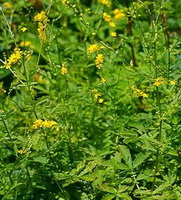
Ecological Environment:Agrimonia eupatoria is distributed across North America, Europe, and West Asia. It grows on wild hillsides, roadsides, and watersides, and is also cultivated.
Pharmacological Actions: (1) Astringent and tonic; (2) antidiarrheal; (3) mildly antiseptic; (4) inhibits certain pathogenic viruses, bacteria, and fungi—including Candida albicans, responsible for oral thrush and vaginal yeast infections; (5) antidiabetic.
Medicinal Efficacy: Agrimony is used in North America and Europe as a remedy for diarrhea and as an anti-inflammatory tonic to soothe inflamed mucous membranes associated with sore throat, gastroenteritis, and nasal congestion. It serves as a healing astringent for bleeding and inflamed hemorrhoids, sores, ulcers, blemishes, varicose veins, and rashes, and is consumed as a tonic tea. It is indicated for kidney stones and for supporting blood glucose control in West Asia and South America.
The herb contains volatile oil, flavonoids (e.g., apigenin, luteolin, quercetin, kaempferol), triterpene glycosides, phenolic acids, and 3–21% tannins.
Administration of Agrimony:
Reference:
Administration Guide for Agrimony
Herbal Classic Works:
The commonly recommended dosage is 3–6 g per day, administered as a water decoction or infusion prepared by steeping 1 teaspoon of dried herb per cup of boiling water. The decoction may be concentrated to prepare an ointment for topical application several times daily. Common internal preparations include decoctions, infusions, and tinctures; external preparations include baths, eye washes, gargles, poultices, and tinctures.
Contraindications, Precautions, and Adverse Reactions: No significant adverse effects are widely reported; however, photosensitivity reactions have been documented following ingestion. Due to its high tannin content, prolonged internal use is not advised.

 ✵The article records the herb agrimony, including its English name, Latin name, Pinyin name, common names, properties and flavor, botanical source—namely the plant species Agrimonia eupatoria—along with a detailed introduction to the botanical features, growth characteristics, and ecological environment of this species; the morphological and quality features of the dried herb agrimony; its pharmacological actions; medicinal efficacy; and administration guidelines.
 English Name: Agrimony
 Botanical Description: Agrimonia eupatoria is a perennial, herbaceous, deciduous plant reaching up to 100 cm in height, with stout, cylindrical roots and short rhizomes. The stem, petioles, leaf axes, and inflorescence axes are villous and pubescent. It bears typical pinnate leaves with serrated margins, comprising 3–5 pairs of leaflets; the uppermost leaflets are reduced to 1–2 pairs. Leaflets are elliptic-obovate, rhombic-obovate, or oblanceolate, measuring 2.5–6 cm in length and 1–3 cm in width, with thickly serrated edges, sparse pilose hairs along the lower veins or between veins, and golden glandular dots. Upper stipules are reniform, coarsely toothed, and amplexicaul (stem-clasping); lower stipules are lanceolate and often entire. Flowering occurs from June to September, producing elongated spikes. Each flower has a single urn-shaped, curved hypanthium with several rows of soft, curved, hook-shaped bristles along the upper margin (1–4 mm long), five yellow, rounded petals, and five sepals. Five to twenty stamens and two carpels arise from the top of the hypanthium; the carpels are free, not fused, and partially sunken into the hypanthium.
 Ecological Environment: Agrimonia eupatoria is distributed across North America, Europe, and West Asia. It grows on wild hillsides, roadsides, and watersides, and is also cultivated.
