✵This article documents the herb Ashwagandha, including its English name, Latin name, common names, Pinyin name, properties and flavor, botanical source—specifically the plant species Withania somnifera Dunal.—and provides a detailed description of its botanical features, growth characteristics, ecological environment, herbal characteristics, pharmacological actions, medicinal efficacy, and administration guidelines.
Ashwagandha (Winter Cherry)
English Name: Ashwagandha
Latin Name:Withania somnifera Dunal; Withania coagulans Dunal Pinyin Name: Nánfēi Zuìqié, Shuì Qié, Dōng Yīngtáo
Common Names: Ashwagandha, winter cherry, withania
Property and Flavor: Warm or slightly warm; bitter and sweet
Brief Introduction: This small evergreen undershrub grows in the Mediterranean region, West Asia, and North Africa. It bears showy greenish-yellow flowers. The dried roots, fruits (berries), and oval leaves are used medicinally.
Botanical Source: Traditional herbal classics define Ashwagandha as the fruit of Withania somnifera Dunal—a species of the genus Withania in the Solanaceae family (nightshade or potato family). The dried root, fruits (berries), and oval leaves are used medicinally. The following describes this commonly used species:
(1) Withania somnifera Dunal
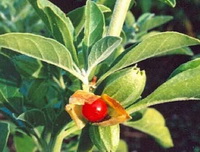
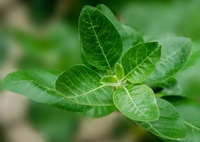
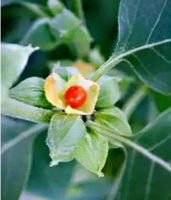
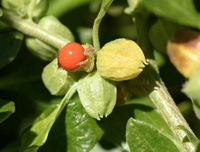
Botanical Description:Withania somnifera is a perennial plant growing up to 1.5 meters tall. Stems are mostly dichotomous and densely pilose. Leaves are broadly ovate or oval, 6–10 cm long, acute at the apex, cuneate at the base, slightly undulate along the margins, sparsely pilose on both surfaces, with dense hairs along the veins and 4–6 pairs of lateral veins. Petioles are 1–2 cm long. Flowers occur in clusters of 3–6; pedicels are 2 mm long and densely pilose. The calyx is campanulate (bell-shaped), densely pilose, 2.5–3 mm in length and diameter; calyx teeth are triangular and less than 1 mm long. The corolla is narrowly campanulate; the crown tube is sparsely hairy, while the crown margin is densely hairy, 4–4.5 mm long; lobes are ovate-triangular. Stamens are slightly exserted; corolla lobes are bent, and the connective is prominent. The persistent calyx is ovoid, membranous, 1–1.2 cm long and 9 mm in diameter, pilose, with 10 inconspicuous longitudinal ribs. The berry is globose, 8 mm in diameter; the carpopodium (fruit stalk) is ~5 mm long. Seeds are pale brown, reniform, ~2.8 mm long and ~2 mm wide, with a reticulate and concave surface. Flowering and fruiting occur in October.
Ecological Environment: The plant has a wide distribution across arid and semi-arid regions worldwide, especially in South Africa and South Asia—hence its alternative name, “South African withania.”
Growth Characteristics: The plant prefers a warm, moderately humid climate and full sun exposure (not shaded). It thrives at altitudes below 1,000 meters above sea level. Optimal cultivation sites have abundant sunshine, deep soil layers, and loose, fertile, sandy soil.
Pharmacological Actions: (1) Anti-inflammatory; (2) Antibacterial and antifungal activity; (3) Antistress; (4) Adaptogenic; (5) Hepatoprotective (liver-protective), etc.
Medicinal Efficacy: Traditionally, Ashwagandha is used as a rejuvenating tonic to enhance strength, stamina, vigor, and sexual energy. It is recommended for specific conditions including nausea, bronchitis, tuberculosis, arthritis and other inflammatory disorders, tumors, anemia, fluid retention (as a diuretic), and—externally—for skin ulcerations and swelling. It is also employed as an adaptogen, antistress agent, antioxidant, and promoter of non-sedating relaxation and mild sedation, and to support immune function.
However, firm conclusions regarding the clinical significance of its anti-inflammatory, sedative, and antistress effects in humans remain difficult to draw. To date, no well-designed human clinical trials have confirmed its adaptogenic or antistress effects, hepatoprotective activity, anti-arthritic potential, cognitive-enhancing properties, or antibacterial/antifungal efficacy.
Administration of Ashwagandha (Winter Cherry):
Reference:
Administration Guide for Ashwagandha (Winter Cherry)
Herbal classic books:
The commonly recommended daily dosage is 2–3 grams of dried winter cherry root powder, taken three times daily.
Contraindications, Precautions, and Adverse Reactions: Winter cherry is generally considered safe for short-term use at recommended doses. However, animal studies have reported marked renal lesions in test rats. If used, be mindful of its potential sedative effects and other centrally acting properties.

 ✵This article documents the herb Ashwagandha, including its English name, Latin name, common names, Pinyin name, properties and flavor, botanical source—specifically the plant species Withania somnifera Dunal.—and provides a detailed description of its botanical features, growth characteristics, ecological environment, herbal characteristics, pharmacological actions, medicinal efficacy, and administration guidelines.
 English Name: Ashwagandha
 Botanical Description: Withania somnifera is a perennial plant growing up to 1.5 meters tall. Stems are mostly dichotomous and densely pilose. Leaves are broadly ovate or oval, 6–10 cm long, acute at the apex, cuneate at the base, slightly undulate along the margins, sparsely pilose on both surfaces, with dense hairs along the veins and 4–6 pairs of lateral veins. Petioles are 1–2 cm long. Flowers occur in clusters of 3–6; pedicels are 2 mm long and densely pilose. The calyx is campanulate (bell-shaped), densely pilose, 2.5–3 mm in length and diameter; calyx teeth are triangular and less than 1 mm long. The corolla is narrowly campanulate; the crown tube is sparsely hairy, while the crown margin is densely hairy, 4–4.5 mm long; lobes are ovate-triangular. Stamens are slightly exserted; corolla lobes are bent, and the connective is prominent. The persistent calyx is ovoid, membranous, 1–1.2 cm long and 9 mm in diameter, pilose, with 10 inconspicuous longitudinal ribs. The berry is globose, 8 mm in diameter; the carpopodium (fruit stalk) is ~5 mm long. Seeds are pale brown, reniform, ~2.8 mm long and ~2 mm wide, with a reticulate and concave surface. Flowering and fruiting occur in October.
 Ecological Environment: The plant has a wide distribution across arid and semi-arid regions worldwide, especially in South Africa and South Asia—hence its alternative name, “South African withania.”
 Pharmacological Actions: (1) Anti-inflammatory; (2) Antibacterial and antifungal activity; (3) Antistress; (4) Adaptogenic; (5) Hepatoprotective (liver-protective), etc.
